




Black bears and brown bears sometimes share the same territory, and because they can react very differently when encountered, it’s a good idea to be able to quickly determine which species you’re dealing with when hunting or hiking in bear country. Black bear vs brown bear seems easy enough, though, right? One is black, and one is brown. In fact, telling the two most common bear species in North America apart can get a little complicated.
Coat color can vary in both species, depending on geographic location and individual differences, and their sizes can overlap, too, depending on the age and sex of the animal. While there are times when size or color is all you need to know, there’s also a good chance you’ll need to look closer to tell one from another. So, with that in mind, here’s a complete breakdown of black bear vs brown bear.
Black Bear vs Brown Bear: Physical Differences
In terms of fur color, black bears can range from black to brown to cinnamon to blond and—on rare occasions—even white. Brown bears often have fur that appears to be white- or sliver-tipped (grizzled), but they can also range in color from pale or reddish blond to a dark brown that looks almost black. Body size can also be misleading. In North America, brown bears include both huge coastal brown bears, which can weigh 1,600 pounds or more, and mainland grizzlies, which typically stand 5 to 8 feet tall and top out at around 800 pounds. Adult black bears stand 5 to 6 feet tall and rarely go over 600 pounds. Though brown bears are typically larger, the size difference between a mature female black bear and a juvenile grizzly can be negligible.
Black Bear vs Brown Bear: Nose-to-Tail Identification
Rather than rely on color or size to distinguish black and brown bears, look for these body features that are dead giveaways.
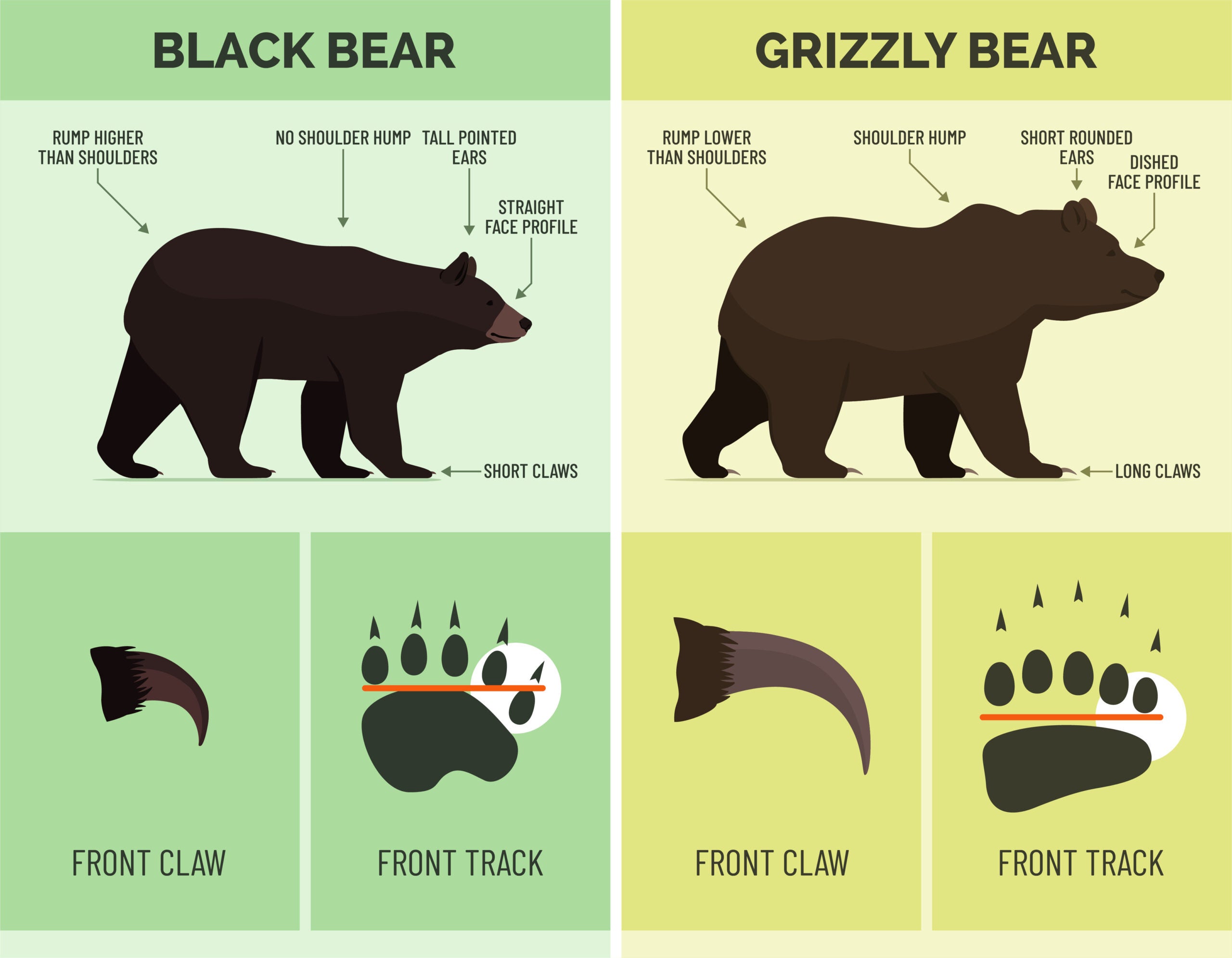
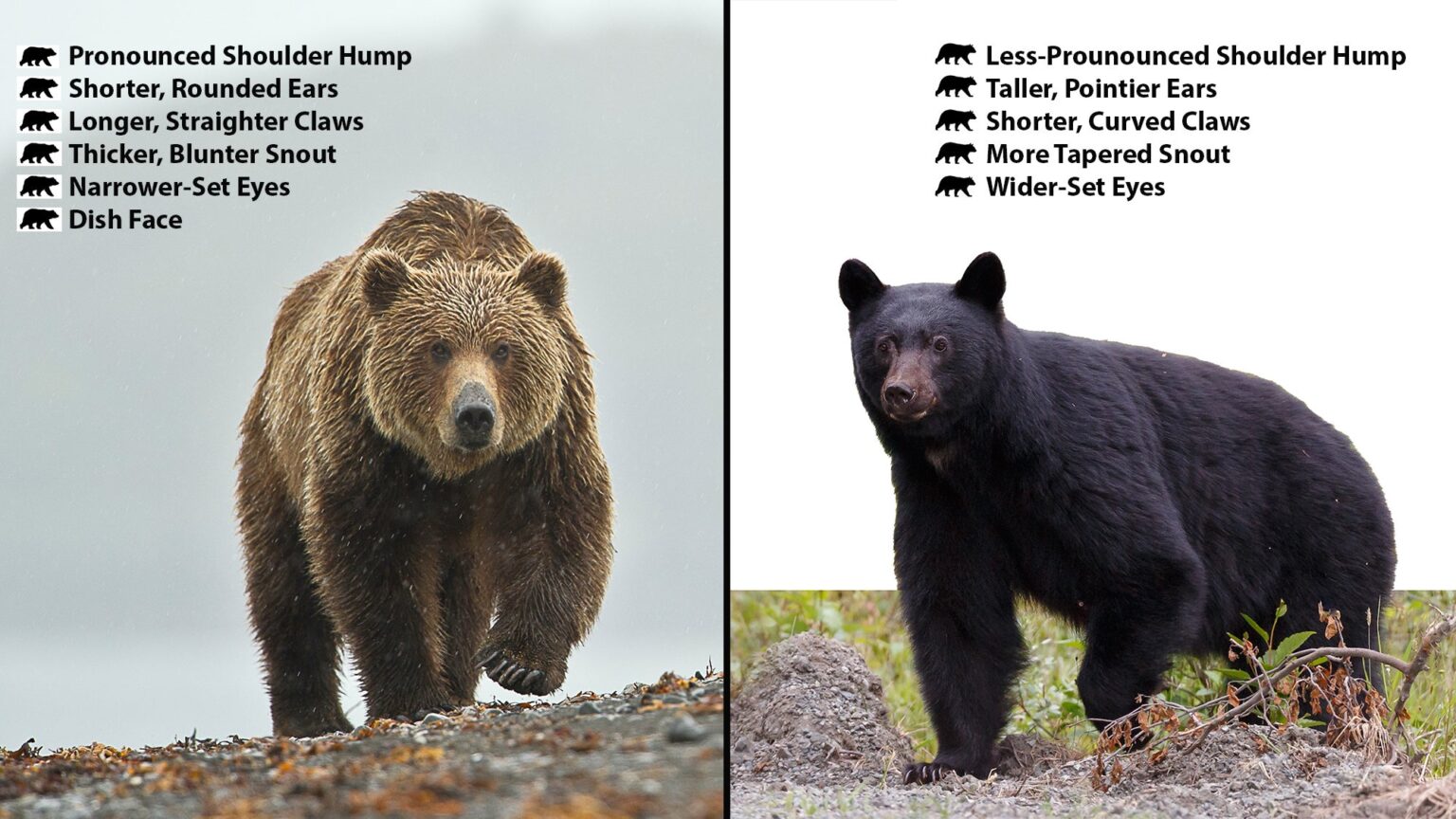
Snout: Viewed head on, a grizzly bear’s nose is noticeably more prominent with a blunter tip than a black bear’s, which appears stubbier and tapers more gradually to the tip. Seen in profile, a brown bear’s nose drops noticeably from the animal’s forehead, creating a “dish-shaped” profile. A black bear’s nose extends directly from its forehead, creating a straight-line facial profile.
Eyes: A brown bear’s eyes are set close together and deep, an appearance accentuated by facial fur that’s shaggier than a black bear’s. A black bear’s eyes are set farther apart, and its shorter facial fur creates a look that is sometimes described as “dog-like.”
Ears: A black bear has tall, pointed ears that appear to stand erect. Grizzly ears are shorter, rounder, and furrier, which makes them appear to blend in more with the head.
Shoulders: Probably the most telltale sign distinguishing grizzlies from black bears is the grizzly’s shoulder hump. Because they spend much time digging and turning over rocks while foraging for food, brown bears have well-developed shoulder muscles. Seen in profile, the hump is the highest point on a brown bear’s body when it is standing on all fours. A black bear’s highest point, on the other hand, is its rump: A black bear’s rump is higher than its shoulders when walking on level ground, while a brown bear’s rump is lower than its shoulders.
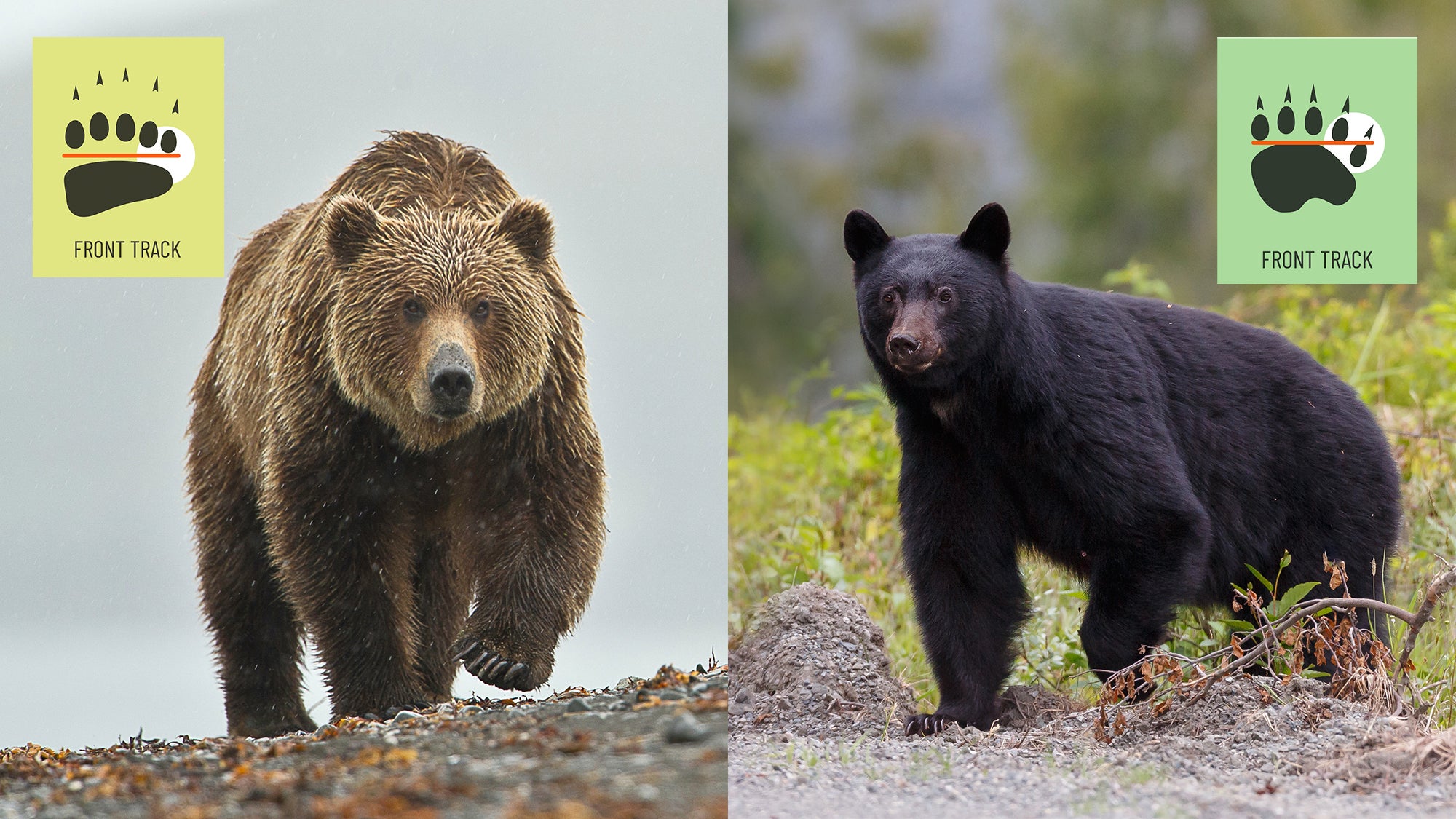
Claws: A grizzly’s light-colored claws are long—sometimes longer than a human finger—and they curve much less than a black bear’s dark claws, which are shorter and more sharply curved. These differences highlight what the species are best at: digging roots and excavating burrowing prey in the brown bear’s case; climbing trees and ripping up rotten logs in search of insects in the black bear’s case. These physical differences in their paws make it easier to distinguish their tracks, too. The claw imprints on a black bear track will be close to the toe and a line drawn between the toes and the pad will cross through the little toe. The same line drawn on a grizzly track will not cross through any toes, and the claw imprints will be much further from the toes.
Black Bear vs Brown Bear: Key Facts
- The American black bear (Ursus americanus) numbers around 60,000 in North America, making it the continent’s most common bear. It is found throughout most of Canada and in 40 of the 50 U.S. states.
- The brown bear (Ursus arctos) is the most widely distributed bear species on the planet, with 55,000 found in North America. But its numbers in the Lower 48—where it’s known only as a grizzly—are limited to about 1,500 in four states. The largest number of U.S. brown bears are found in Alaska.
- Brown bears are more aggressive (and less likely to back down from a fight) than black bears.
- Black bears are excellent climbers and are known to pursue prey into trees, where they often gain an advantage. Brown bears don’t climb as well as black bears, but they climb well enough.
- Bears commonly charge when surprised in the wild, especially when accompanied by cubs or guarding a kill. But they are also stealthy predators that can quietly creep up on unsuspecting prey: Many human victims of bear attacks never hear them coming.
- Bear hunting seasons are offered by more than two dozen U.S. states, several of which also have grizzly bear populations, but as of this writing, grizzlies cannot be hunted in the Lower 48.
When Bruins Brawl: Which One Wins a Fight?
Run-ins between the two bear species are not unheard of. Mature grizzlies often seem to be the aggressors, mauling smaller black bears or digging their cubs out of dens. But black bears can hold their own, sometimes running smaller grizzlies off kills. Both species are equipped with the fangs, sharp claws, impressive bite force, and brute strength to win a fight. As with a lot of conflicts in the wild, size probably matters most, with the bigger, stronger bear usually coming out on top—regardless of species. More often than not, though, that biggest and strongest of the two will be the brown bear.
Read the full article here