





We may earn revenue from the products available on this page and participate in affiliate programs. Learn more ›
If you’re tired of relying on candles and a camp stove during a power outage, or if you need power when you’re off the grid, it’s time to look into buying a generator. But before you can settle on the right kind, the first thing you need to ask yourself is How big of a generator I need? It all comes down to how many appliances you want to run during an outage, or how many appliances you need while camping. From there, you can calculate your power requirements and find the right size unit. Here’s a rough guide on generator sizes and the power draw of most common appliances, plus a few more things to take into consideration when shopping for a generator.
Picking the Right Generator Size: The Basics
To figure how big of a generator you need, you need to add up the wattage of all the appliances you want to use off-grid and match that to the wattage listed on your generator. But, of course, you don’t want the unit to run under a max load at all time. So, should plan your wattage needs to come in well under your unit’s maximum output.
How to Pick the Appliances You Need Off-Grid
If you’re looking for back-up power during an outage, you first should take an inventory what appliances you absolutely need to use. For most, these include heating or cooling, depending on your climate, running a well pump and hot water heater, keeping the lights on, and charging your phone so you can stay connected. Hunters and anglers may also want to consider keeping a freezer or multiple freezers going during an outage. For myself, I can rough it through a power outage with my woodstove and battery-powered lanterns, but I need to keep my freezers and my well pump going. Campers and tailgaters typically need less from a generator. Their needs might be running a fan, a string of LED lights, and a portable refrigerator. Generally, campers like to use smaller units that also tend to be more quiet.
Understanding Min, Max, and Surge Power
Before you can add up the power your appliances will consume, you need to be familiar with minimum, maximum, and surge power. The minimum is the lowest amount of power an appliance will consume measured in watts. The maximum is the most. The surge is the amount of watts an appliance needs to start up. This is usually the most power an appliance will use, and once it’s running, it will settle into to maximum and minimum power. When selecting how big of a generator you need, you need to factor in the surge power of your appliances. Otherwise, this can knock out other appliances, damage your unit, or trip a breaker if you’re trying to use too many things at once.
High Draw vs Low Draw Appliances
The best way to figure out the draw of your appliances is to look at a chart. There are tons of power-draw charts available online, but here are some examples of common high- and low-draw appliances. And remember, you need to account for the surge power when adding up wattages to avoid maxing out your generator.
High Draw Appliances (measured in watts)
- Central Air Conditioner (Min: 2000, Max: 10,000, Surge: 11,250)
- Window Air Conditioner (Min: 1,000, Max: 1,500, Surge: 2,000-2,200)
- Electric Clothes Dryer (Min: 1,800, Max: 5,400, Surge: 6,750)
- Sump-Pump (Min: 600, Max: 1,050, Surge: 1,300-2,150)
- Well Pump (Min/Max: 700, Surge: 0)
- Electric Stove (Min: 2,100, Max: 4,500, Surge: 0)
- Toaster Oven (Min/Max: 1,225, Surge 0)
- Electric Water Heater (Min/Max: 5,000, Surge: 0)
- Electric Heat (Min: 1,125, Max: 1,500, Surge: 0)
Low Draw Appliances (measured in watts)
- Electric Clock (Min/Max: 3, Surge: 0)
- Laptop Computer (Min: 200, Max: 250, Surge: 0)
- Phone Charger (Min/Max: 20, Surge: 0)
- Fan (Min: 10, Max: 150, Surge: 30-450)
- Engine Block Heater (Min: 150, Max: 1,000, Surge: 0)
- CF Lightbulb (Min/Max: 25, Surge: 0)
- Television (Min: 65, Max: 340, Surge: 0)
- Refrigerator (Min: 132, Max: 192, Surge: 1,200)
Traditional Generators vs. Inverter Generators
Another consideration you need to make is whether you want a traditional generator or an inverter generator. Traditional units deliver a constant supply of power once they’ve been started. They are generally cheaper than inverter generators, and they consume more fuel. Inverter generators will throttle depending on the power load. They tend to be quieter and burn less fuel. They’re also more expensive. If you’re looking to save money in the long run and noise is an issue, go with an inverter model. If you who want to save some money upfront, look at a traditional generator.
Generator Size Catagories
Generators come in all shapes and sizes for all kinds of uses. Unit size is broken down by wattage. A good rule of thumb is that you will likely pay $1 per watt. Whichever model you choose, it’s a good idea to have a professional electrician install some way to tap it into your home’s electrical panel should you need it during an outage. It is possible and safe to run one or two appliances from extension cords to a generator, but tapping into your home electrical panel yourself can be dangerous. Let a pro do it. The following categories should cover most models you’ll encounter when you’re shopping.
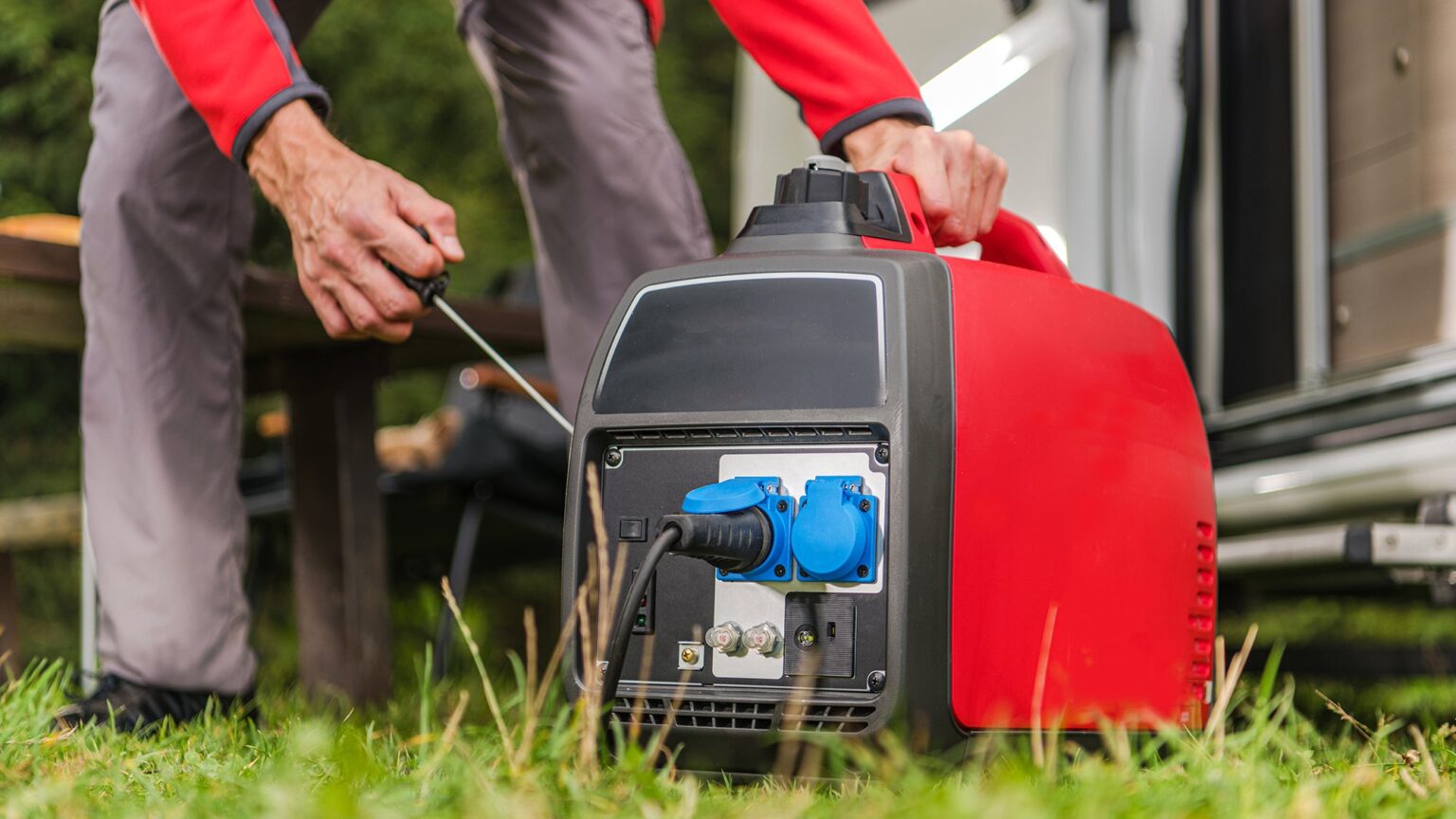
Small/Recreational Generators (2000 watts)
Portable recreational generators are great for those who need to power a campsite or a tailgate party. They can be used in a pinch during an outage to power one or two appliances and keep the lights on, but are too small for running heat and air conditioning. The best thing about small recreational units is how portable and quiet they are.
Best Uses
- Some backup power for the home
- Camping
- Tailgating
What You Can Power During an Outage (may vary)
- Refrigerator
- Around five lights
- Laptop and phone charger
- Electric fan
- Television
Mid-size Generators (3500 watts)
Mid-sized generators are a bit heavier and louder than recreational units, but they are still pretty quiet depending on the make and model. Some come with wheels, but you’ll probably need two people to lift one into a pickup truck. You can power a pretty big campsite or RV with a mid-size model, and they’ll keep a lot of appliances going during an outage. They are still on the small side for things like central air conditioning.
Best Uses
- Backup power for the home
- Camping
- Larger off-grid campsites
- Tailgating and events
- Light duty work for job sites without power
What You Can Power During an Outage (may vary)
- Everything you can power with a recreational generator
- And one of the following: Small window unit air conditioner, space heater, washing machine, or toaster oven
Large Generators (7500 watts)
To move a large portable generator, you need wheels (most come with them) and possibly three people to lift it into a pickup truck. Most large generators are loud, but some are insulated well for noise. Large units also consume more fuel than mid-size and recreational generators. They’re used to power big off-grid job sites and homes during an outage, but they’re usually overkill for camping and RVing.
Best Uses
- Job sites without power
- Backup power for the home
- Off-grid cabins
What You Can Power During an Outage (may vary)
- Everything you can power with a midsize generator
- Well pump
- Sump pump
- Gas or propane furnace
- One burner on an electric stove
Home Standby Generators (up to 20,000 watts)
If you want your home to continue working as normal during an outage, go with a home standby generator. These are installed on a concrete pad next to the home and usually plumbed into a propane tank. Home standby generators are big, and they can be loud (you may have noticed your neighbor’s standby generator humming away during your last power outage). Home standby generators are also expensive, and the cost of installation needs to be factored in when purchasing one. They’re suited best for homes in hot places that depend on central air-conditioning or in cold climates with baseboard electric heat.
Best Uses
What You Can Power During an Outage (may vary)
- Just about everything in your house
Battery Generators
Battery generators are more power banks than generators. They need to be charged ahead of time and can run out of juice if they’re not linked up to solar power or a generator. Some battery power banks are small enough to fit in a backpack while others take up a wall in your home. Battery banks are starting to rival fossil-fuel-powered generators for output, and they are dead quiet. They can be expensive, too. On the small side, they’re great for camping and tailgating and can be used to power a refrigerator or freezer in a pinch. On the big side, they can provide backup power for your home, and when combined with solar panels, they can be used for a long time.
Best Uses
- Backup power for some appliances
- Apartments with no outside space for a generator
- Camping
- Tailgating
- Off-grid cabins
What You Can Power During an Outage (may vary)
- Varies widely depending on size. Check the manufacturer’s recommendations.
Hooking a Generator Up To Your Home
Using a generator can be as simple as running an extension cord, but to get the most out of one, you’ll want to have an electrician install a generator sub-panel in your house. This panel taps into your main power panel and can even be configured to automatically turn a home standby generator on during an outage. Home standby generators need to be used with a subpanel and mid- and large-size generators work better with one. Sub-panels also let you power things that don’t have outlet cords like furnaces, air conditioning, and electric water heaters. They also have circuit breakers to protect your generator during a power surge, and they’ll protect your generator when the power comes back on.
Aside from a sub-panel, you’ll want to find a good place to run your generator away from the home. Gas, diesel, and propane generators have engines in them that produce exhaust, which is toxic in a confined space. Keep your generator away from open windows and doors and make sure you have working battery-powered carbon monoxide detectors when you run your generator.
Other Considerations When Getting a Generator
Noise
Having power during an outage is great, but you have to pay for it with noise. If you can, find someone with a similar generator size to the one you want and listen to how loud it is. Manufacturers also list how low generators are in decibels. Campers might want to lean on the quiet side. It’s more courteous to others camping around you and won’t spoil your time in the woods with a bunch of engine noise.
Portability
Make sure your generator is portable enough to move around should you need to do so. Most heavier generators come with wheels and handles for easy transport. You may also want a clear path or find a hard surface to wheel your generator outside during an outage as storms can turn a backyard into a muddy mess overnight.
Fuel Types and Storage
If you aren’t running a generator on your home’s propane tank, it’s a good idea to have 5 to 15 gallons of fuel stored in case of an emergency. Most generators run on gas, but some can run on multiple kinds of fuel. For my gas generator, I try to buy ethanol-free gasoline or use a stabilizer for long-term storage. Keep fuel in a safe, dry place sealed off from the elements.
Starting
Most generators are easy to prime and start, but some can be a pain. Do your research before buying a generator and make sure yours will start up easily. It’s also a good idea to run your generator every so often even if you don’t need it. This will keep the engine in good condition.
Read the full article here