







One of the greatest advancements in lure making is the incorporation of weight transfer systems in fishing lures. A weight transfer system (or WTS for the purposes of this conversation) is a mechanism that shifts weight within a hard lure to increase the effectiveness of the lure— typically in its castability.
Today, we’re going to talk about how some of these common WTS mechanisms work and look at three bait categories in particular that have benefited greatly from the inclusion of these design concepts.
TYPES OF WEIGHT TRANSFER SYSTEMS
Most of the time, a WTS uses a ball bearing within a chamber to shift weight from one end of a bait to the other. There are a few crankbaits and other lures that use WTS that run side to side, which create a rattle and potentially wider waddle in those baits as the weight shifts left to right. But, most WTS orient from the front to the back of the bait, and the majority of these differ primarily in how the weight is held in place.
Some WTS use a magnet to hold the weight in place when the bait is being fished through the water. This magnet is placed at the optimal point within the chamber to where the bait will be balanced well during the retrieve. The simple action of casting dislodges the weight from the magnet in the backcast, which allows the ball bearing to load up in tail of the bait.
This results in a tail-first, extremely aerodynamic orientation of the bait on the cast, allowing the lure to go much further than it would if it were flailing around and spinning through the air. The accuracy of the cast is greatly increased as well thanks to the WTS.
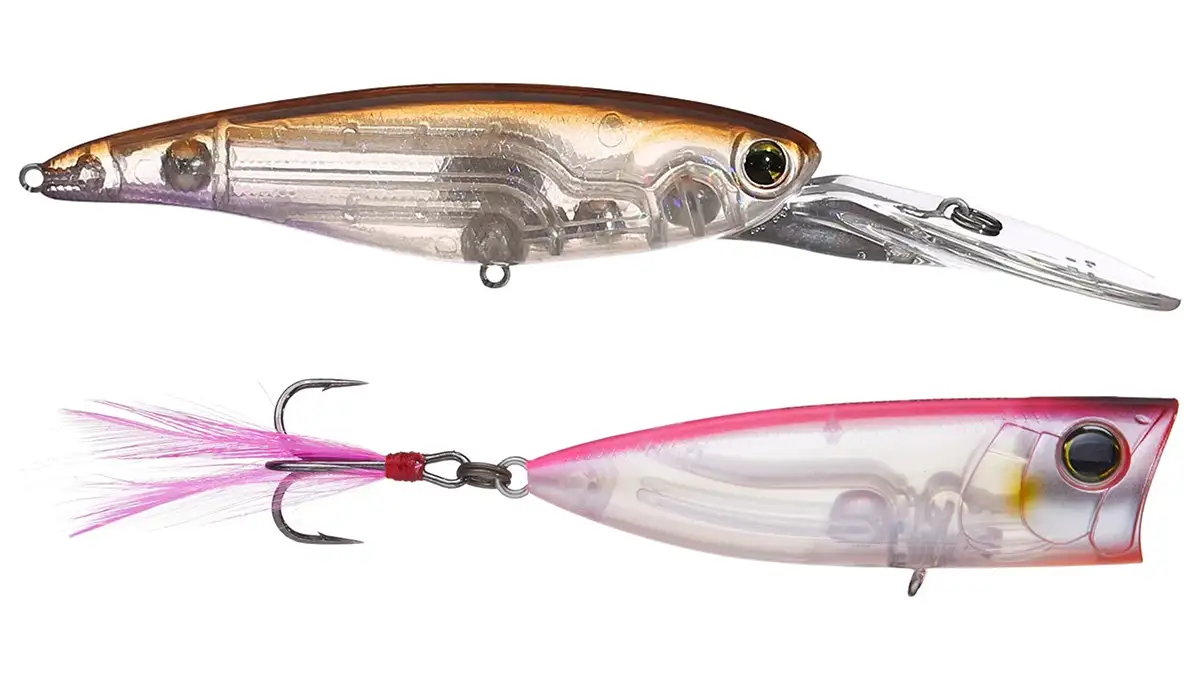
The same effect is achieved in other baits that use a tiered weight transfer chamber. In these baits, there’s a step in the chamber with a little ramp between the lower and upper portions. In the backcast, the ball rolls up the ramp and into the tail-end of the chamber. And then when the bait hits the water, the ball rolls back down the ramp towards the nose of the bait and settles in the lower part of the chamber.
FINESSE CRANKBAITS WEIGHT TRANSFER SYSTEMS
Finesse crankbaits, like a Rapala Shad Rap, have long held a special place in the winter angler’s tackle box. The tight wiggle of these baits make them a primo selection in cold water. But the achilles hill of this genre of bait has always been its castability. These lures are typically light, thin and oblong. Trying to throw one of these any considerable distance with a baitcaster is like trying to cast a potato chip. So that limits you to a spinning rod and reel or BFS road and reel setup to fish these.
The obvious answer, and only remedy for ages, was to swap over to spinning gear to increase the castability of finesse crankbaits. But over the last decade, there have been several baits in this genre, like the Jackall Soul Shad for instance, that offer a similar profile and action, while adding a WTS to help with the castability. The result is a lure that can be casted likely twice as far with baitcasting gear as compared to other finesse crankbaits, and even further still with finesse gear if you choose to stick with the spinning setups.
FINESSE TOPWATER WEIGHT TRANSFER SYSTEMS
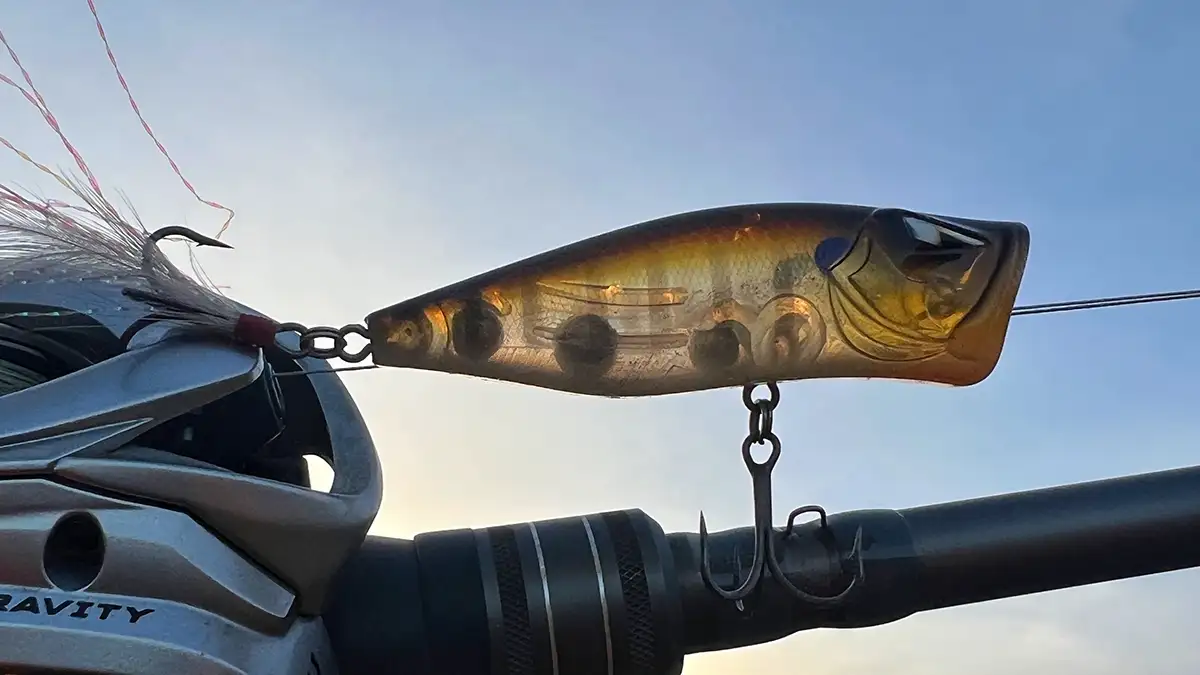
Finesse poppers make up another bait category that was relegated for years to spinning gear, due to the similar difficulties that arose when casting these baits. But this is another fantastic example of the difference a WTS can make in a bait.
Take the ARK Z-Pop for instance. This sub-3-inch popper can be casted with great accuracy at greater distances than most topwaters its size, thanks to the WTS that runs through the latter half of the bait. Now, with baits like the Z-Pop, anglers can confidently upgrade to more capable baitcasting gear without sacrificing casting distance and accuracy.
Like with other baits in this conversation, in the back cast, the ball loads in the tail of the Z-Pop. But with this particular system, the weight stays in the tail on the pause, resulting in a tail-down orientation on the pause, which gives a bass a better shot at getting the hooks. This is just another added benefit of a WTS in a finesse popper.
JERKBAIT WEIGHT TRANSFER SYSTEMS
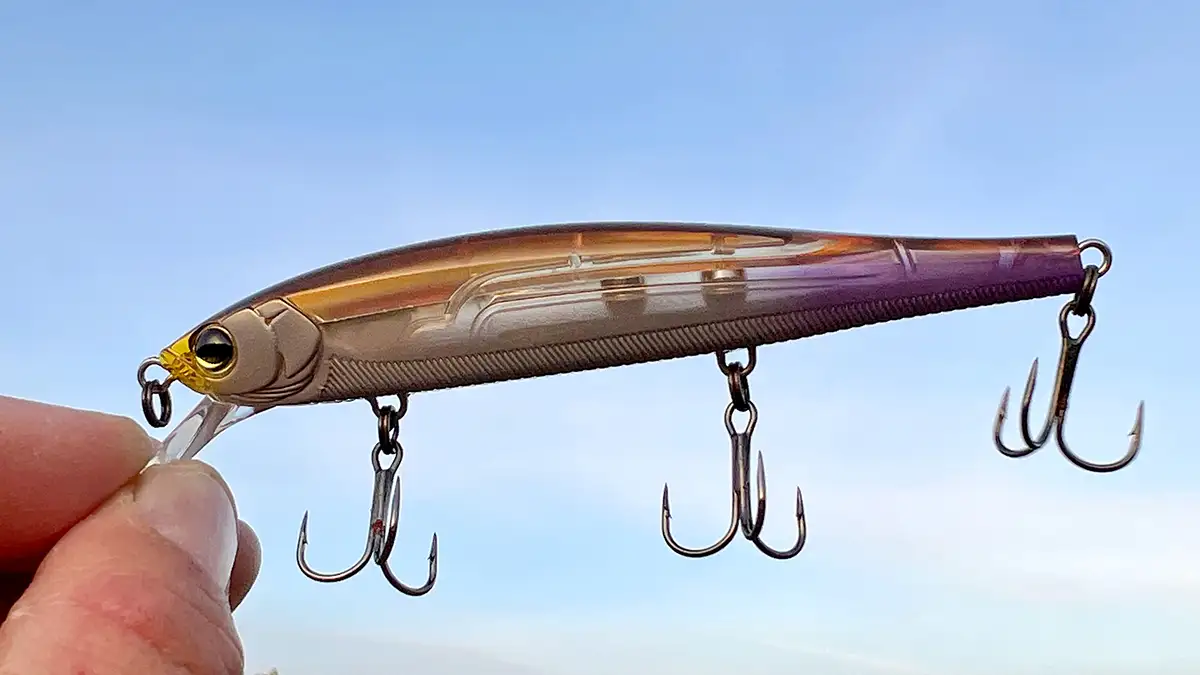
Though most jerkbaits are bigger than finesse crankbaits and finesse poppers, their light-weight bodies and oblong shapes can still make them hard to cast. If there’s no concentration of weight in the tail end of the bait, a jerkbait spins through the air on the cast and won’t go far. As for the typical spinning gear remedy employed with other light baits, the repetitive twitching that is needed when using a jerkbait makes effectively fishing these baits nearly impossible to fish without a baitcaster.
Adding to the issues, balance is also imperative with jerkbaits, since these lures are intermittently paused on the retrieve. The desired result on the pause is for a jerkbait to either sink or float slowly, or suspend in place; but to always be oriented horizontally or with the nose down in any of these three instances, since this looks the most realistic to the fish. So, a fixed weight placed in the tail of a jerkbait to help with casting is no-go, as it will completely throw off the balance of the bait. This is where a WTS fixes everything.
With a WTS, you can again have the best of both worlds. Look at the Yo-Zuri 3DB Series Jerkbait SP 110 for a good example of how a tiered WTS works. With this specific bait, there are two ball bearings within the stair-stepped chamber that are allowed to roll freely and load up in the tail of the bait for long and accurate casts, and then return to the belly of the bait upon the first twitch of the retrieve.
FINAL THOUGHTS ON WEIGHT TRANSFER SYSTEMS IN LURES
Whether casting finesse crankbaits, jerkbaits, finesse poppers or any other lure that uses a weight transfer system, the impact of an WTS is immediately evident. The ability to shift the weight to the tail of a bait, especially a smaller or oblong one, makes the lure much more aerodynamic on the cast. This greatly increases the accuracy of the cast and the distance the bait can be thrown, which ultimately and undeniably results in more opportunities to catch fish.
So, pay close attention when companies boast of “internal weight transfer systems” in their product descriptions, especially when trying to rationalize the price difference of a lure with a WTS as opposed to one without. You may have already understood the importance of a weight transfer system. But if you didn’t, hopefully now you can appreciate the importance of one of these mechanisms within a bait.
As an Amazon Associate, we may earn income when you click on an Amazon link. Thanks for helping us do what we love.
Read the full article here