

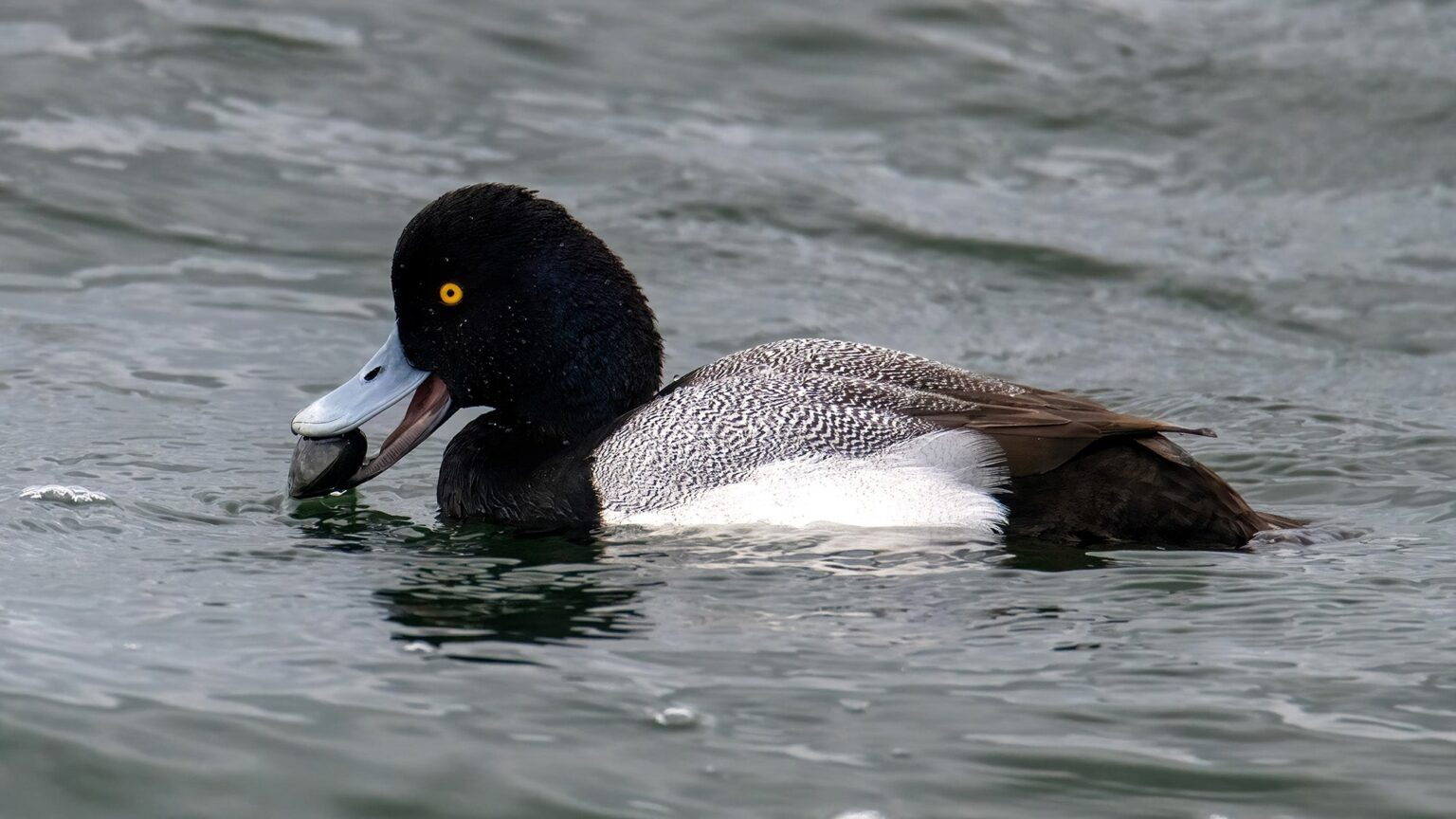

The lesser and greater scaup are better known as bluebills. As the nickname implies, both subspecies have blue bills, and the two birds are very difficult to differentiate. Each is part of the diving duck family, where they forage for food well below the water’s surface. The bluebill duck is also one of the most popular diving ducks pursued by hunters due to their nationwide distribution.
Although they don’t garner the same respect as the coveted drake mallard or gorgeous wood duck, bluebills are still fine-looking birds. They offer hunters opportunities across the entire country as well as a challenging target on the wing. Lesser and greater scaup both decoy extremely well and, if shown care in preparation, can rival some puddlers on the table. Below is an all-around guide to help locate, identify, hunt, and cook bluebill ducks.
Appearance and Vocalization
Two subspecies of scaup—the lesser and the greater—can be found in the United States. Both are predominantly black and white from bill to tail and can be difficult to tell apart, particularly in flight. However, there are differences. The greater scaup is the larger of the two, measuring between 20 and 22 inches in length. They sport white shading from the breast area to the tips of their primary/secondary feathers.
The lesser scaup (16-18 inches) has the same white shading but only to the midpoint of the wing. In the right light, the greater’s head glows with a green iridescence, while the lesser’s shines a dark purple. Both have heavy blue bills, hence their nickname. However, the greater’s bill is broad, while the lesser’s is narrow and slightly hooked. This is why greater scaup are also referred to as “broadbill” in regional areas of the country like Long Island. Hens of both lesser and greater will range in coloration from brown to grayish-brown, with the same wide, heavy bill and a white facial patch at the base.
Like many divers, bluebill ducks are generally quiet. However, the drakes of both subspecies make what might be best described as a brief low whistle during late winter and spring courtship. Hens make a deep growling burrrrr in flight, a sound that carries surprisingly well over the water and one that hunters often reproduce in hopes of attracting attention to their decoy spread.
Habitat and Distribution
Bluebills spend much of their time in shallower water, usually anywhere between eight and 25 feet. Open water is the domain of the bluebill. That’s not to say good numbers can’t be found on smaller tributaries, bays, and impoundments from coast to coast, especially during periods of high winds and rough water.
Scaup are widely distributed and can be found in varying numbers in all four major flyways, with an estimated 60 to 70 percent along the East, 20 percent on the West Coast, and the remainder sprinkled in the interior of the country. In the Atlantic Flyway, the famed Chesapeake Bay holds excellent numbers of bluebills throughout the entire hunting season. So does the St. Lawrence River, New York’s Finger Lakes, and portions of Lake Erie. The Mississippi River has always been a hotbed for bluebill hunting, as well as the Missouri River System. To the far West and the Pacific Flyway, the Columbia River plays home to vast rafts of bluebills—both lessers and greaters—and has, in recent years, become a popular destination for hunters seeking scaup.
Diet for both subspecies depends greatly on location. The most common food for these divers is fingernail clams, aquatic insects, crustaceans, and a variety of vegetation like wild celery, eelgrass, and salicornia.
Population Statistics
Be it climate change, habitat loss, poor nesting success, low recruitment, drought, man-produced contaminants, or any of a dozen other explanations or causes, the fact remains that scaup populations are declining. They have been for roughly the past 40 years, with numbers falling from more than six million individuals in the 1970s to 3.5 million in 2023, according to Ducks Unlimited’s most recent population survey. This (3.5 million) is a four percent decrease from just a year ago, putting the overall scaup population almost 30 percent below the long-term average.
Why the decline? Waterfowl biologists have been digging for several years, with the aforementioned possibilities leading the way. However, the reason behind the decline remains a mystery. In response to the falling numbers, waterfowl managers have implemented steps to reduce harvest, including shortened bluebill-specific seasons. In some states, this means a season within a season and a limit of one or two scaup daily (as part of the entire daily bag).
How To Hunt Bluebill Ducks
Ninety-five percent of waterfowlers targeting scaup do so in an open-water environment, typically from a seaworthy mobile boat blind or a low-profile one- or two-man layout boat. Some even hunt scaup from stationary (permanent) box-style blinds along the East Coast, most notably in Chesapeake Bay. These blinds are usually positioned in areas of predictable high bird numbers. Some geographic dry-land features, such as points pushing out into open water or narrow belts between deep-water roosts and food sources, can lend themselves to shore-based opportunities.
A flock of bluebills can number into the hundreds of individuals. Due to their gregarious tendency, scaup are typically gunned over spreads of 50 to 200 or more decoys. Such mega-spreads help to attract attention in the open-water setting preferred by these divers, as does the commonplace usage of high-white drake-only rigs. Like puddlers, bluebills decoy into the wind. Hunters will typically first position the blind or layout boat and then set the spread slightly downwind, leaving runways that serve both as boat travel routes and bird funnels. This allows for rapid deployment and pick up of the large spreads.
Aside from the boats and piles of decoys, bluebill fanatics will typically pack a familiar 12-gauge afield, with plans to fill it with quality 2 or 4 non-toxic shot. Scaup are tough customers, particularly heavily feathered and well muscled. Small shot has no place here, except for a handful of 5 or 6 steel shot swatter loads designed to subdue cripples. Calling can be effective, with diver-specific calls being used to “growl” birds into range. Black flags are sometimes used to attract attention at a distance.
How To Cook Bluebill Ducks
I’ve eaten good bluebills and not-so-good bluebills. I can also say the same about mallards and wigeon. Here in southwest Washington, where I make my home, it’s been my experience that scaup taken on the Lower Columbia below the town of Cathlamet are better eating than are those taken from the city of Longview upriver to the Vancouver/Portland metropolitan area. My guess is the taste has to do with dietary differences between the two segments of the Columbia population. You are what you eat, as they say.
For the table, I pluck my scaup whole, singe the hair-like feathers, dress, and wash them thoroughly. Then I soak them overnight in a brine of orange soda—yes, you read that right—and garlic, rinse, and roast them for roughly an hour at 400 degrees with the quintessential strip of bacon draped over the breast. Short of this, I breast the birds, remove all traces of fat, thin-slice them, and quick-fry the slices in olive oil as part of a stir fry. They are some of the best-tasting divers around.
Read the full article here