




After being charged in a sting operation, the Pennsylvania drone operator is appealing his case — even as the state moves closer to legalizing drones for deer recovery
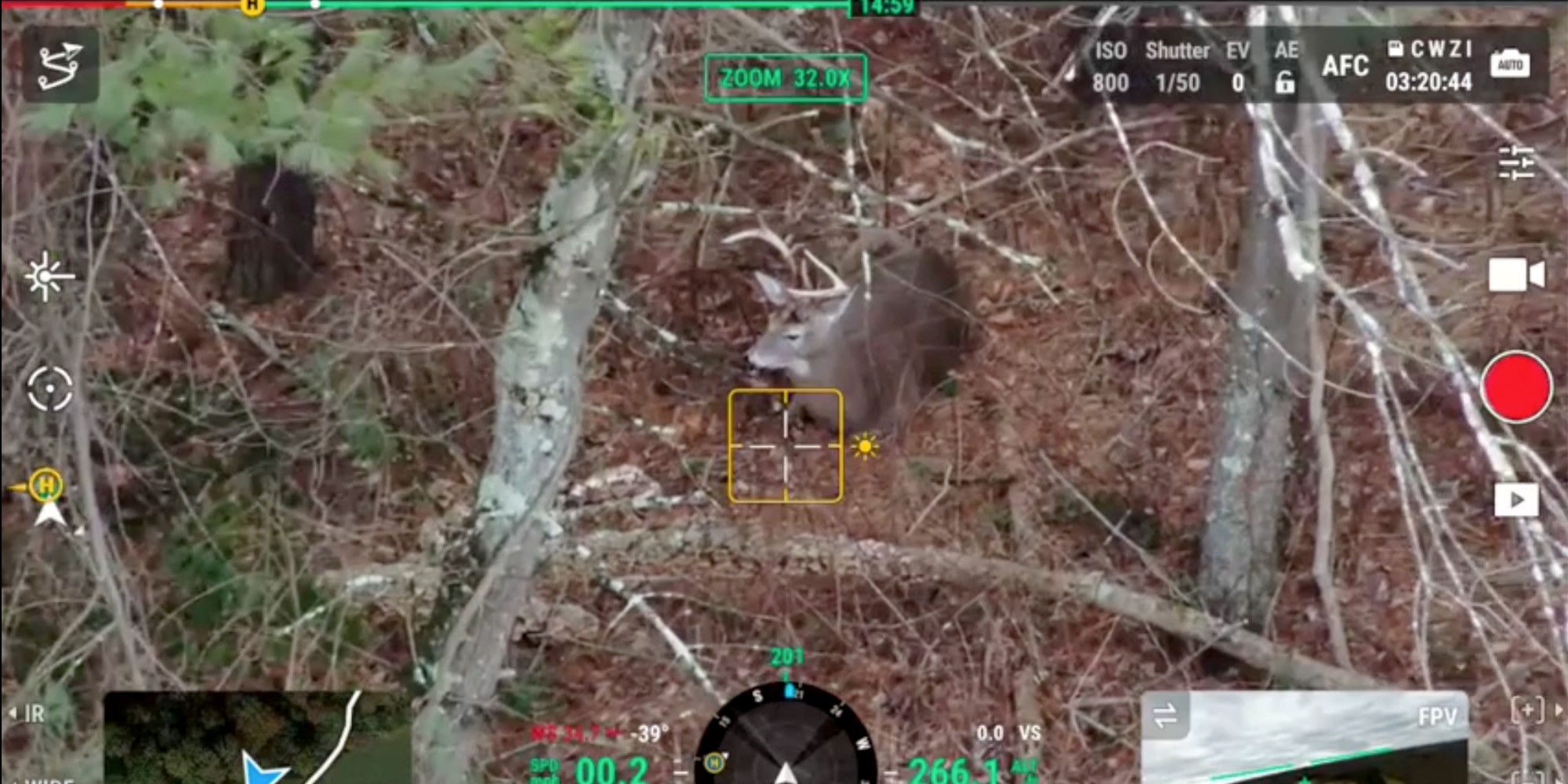
A screenshot from a video that shows one of Wingenroth’s drones in action during a deer recovery mission. Photo by Wingy Drone Services
Pennsylvania resident Joshua Wingenroth was convicted of multiple wildlife violations in Lancaster County District Court on Thursday for using a drone to help recover a deer. It’s the first time anyone in the state has been cited and tried for using the technology to recover a game animal. Wingenroth, who owns Wingy Drone Services, tells Outdoor Life that he plans to appeal the decision at the state court level.
The four charges against Wingenroth stemmed from a December sting operation by the Pennsylvania Game Commission in which an officer called Wingenroth pretending to be a hunter who had wounded a deer and needed help recovering it.
Read Next: Drones Could Revolutionize How Hunters Recover Lost Deer … If They’re Not Banned First
The conviction was delivered even as a bill to legalize drones for deer recovery works its way through the Pennsylvania legislature, and as other states grapple with how to regulate drones during hunting season. The judge acknowledged this lack of regulatory guidance in his ruling last week.
“The Legislature needs to address this,” Magisterial District Court Judge Raymond Sheller said while delivering his verdict, according to the Associated Press. “Everyone is playing catchup to science.”
Even so, Judge Sheller found Wingenroth guilty of two counts of using illegal electronic devices during hunting, one count of disturbing game or wildlife, and one count of violating regulations on recreational spotlighting. Wingenroth was fined $1,500.

Because he plans to appeal, Wingenroth declined to provide additional comment on the court’s decision. Instead, he shared a statement from his attorney Michael A. Siddons. A guilty verdict was expected, says Siddons. But he explains that the larger issue of whether drones should be allowed to recover dead game was overshadowed by “bombshell” testimony by two PGC game wardens that he says “could have profound and draconian consequences for the hunting public.”
The two game wardens were involved in the sting operation against Wingenroth, which took place at the Welsh Mountain Nature Preserve in Lancaster County on Dec. 6. Wingenroth responded to the warden’s request for help recovering a deer and flew the area with his drone; when he shined one of the drone’s lights on a live whitetail, the second officer arrived to seize Wingenroth’s drone and issue the four citations against him.
“Both the arresting officer and the undercover officer — both a game warden for over 30 years each — testified that it is illegal to recover downed game at night without a weapon,” Siddons writes. “This position is against all known conventional understanding of the hunting public, [and] the requirements under the Game and Wildlife Code regarding a hunter’s legal obligation to use all best efforts to recover downed game animals.”
Siddons says their testimony proved that PGC doesn’t seem to have a uniform position on the difference between hunting an animal and recovering it. He argued during the summary trial that Wingenroth was using his drone with the sole intention of recovering a dead deer.
PGC did not immediately reply to requests for comment, but PGC communications director Travis Lau told Lancaster Farming on Friday that the agency views recovery as part of the hunt. He clarified that hunters are permitted to track downed game after dark, but that they’re asked to notify the agency first.
“Our position has been unified that hunting and recovery are the same. The definition in Title 34 includes tracking and pursuit,” Lau said. “Tracking a wounded animal would be hunting under the letter of the law.”
In his written statement, Siddons argues that by citing Wingenroth on Dec. 6, the agency was enforcing its laws inconsistently and “further confounding the situation.” He says that during the trial, neither game warden could recall ever citing a hunter for trying to recover downed game at night — nor could they point to a single section of the state’s game code that supported their position. That code was amended in 2018 to allow the use of tracking dogs when recovering deer and other big game.
Under the “recreational spotlighting” section of Title 34, the Pennsylvania Game and Wildlife Code explicitly prohibits the use of a spotlight “to search for or locate for any purpose any game or wildlife anywhere within this Commonwealth at any time during the antlered deer rifle season and during the antlerless deer rifle season.” It is not immediately clear if this applies to dead or wounded game, since Title 34 does not explicitly address the use of lights or flashlights for recovering game. Another section prohibits hunters from using artificial lights of any kind while carrying a firearm or other weapon, but there is no mention anywhere in the game code of prohibitions against recovering or tracking downed game at night.
“Having such an inconsistent and ambiguous position with respect to the enforcement of the Game and Wildlife Code should give every hunter who is faced with recovering downed game at night grave concern,” Siddons writes.
As Wingenroth awaits a decision on his plea to appeal the guilty verdict, at least one state lawmaker has been seeking clarity on the controversial issue of drones and deer recovery — one that revolves around whether the technology violates the principles of fair chase.
In response to the December sting operation, State Sen. Jarret Coleman (R-LeHigh) proposed new legislation in January that would amend Title 34 of the Pennsylvania Game and Wildlife Code to legalize drones and other electronic devices for deer recovery. Many drones used for deer recovery, including Wingenroth’s, are equipped with thermal imaging, and several states have already legalized these devices for deer recovery.
“The state of Ohio permits the use of drones in the recovery of downed game. Unfortunately, the Pennsylvania Game Commission appears to be taking a hostile view of the use of drones in game recovery,” Coleman wrote in a Jan. 2 memorandum seeking co-sponsors for his bill. “Pennsylvanians deserve better. With the advent of drones, hunters have an additional tool to use and reduce the amount of dead game that goes uncollected.”
Coleman also told the Philadelphia Inquirer last month that he thinks using drones to recover deer is “common sense” and that the state shouldn’t overthink regulations around the technology.
Read the full article here