




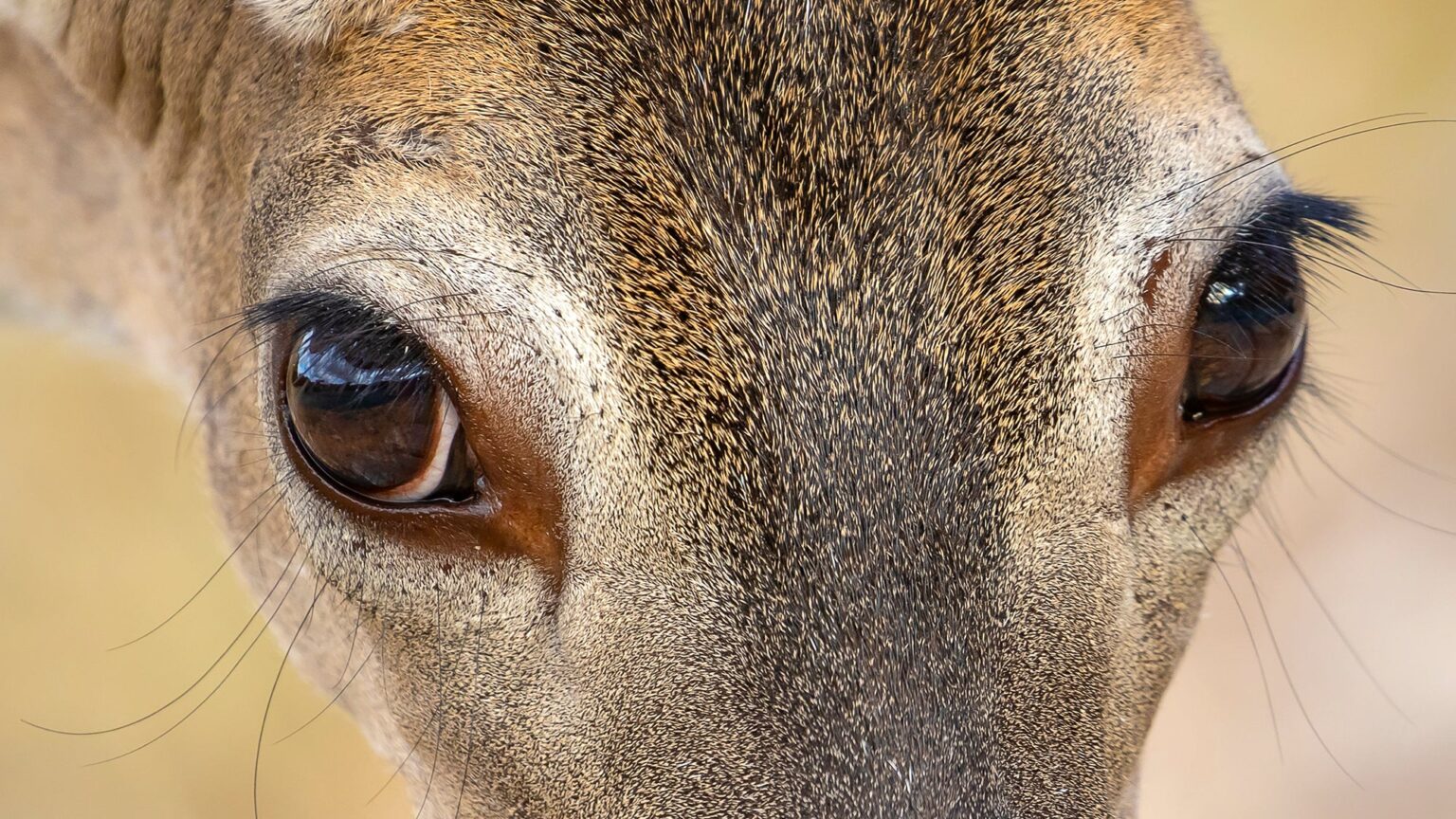

Whitetail deer are famous for their ability to detect and avoid danger, with their nose, ears, and eyes combining to form a trifecta of defense mechanisms. But while their eyes are pretty sharp, deer do not see things the way humans do. A deer’s eye sees colors and spots movement differently than the human eye, and understanding those differences can make us better hunters. So, what colors can deer see? What colors can’t they see? And how do other aspects of deer vision compare to ours? Here’s a breakdown.
What Colors Can Deer See? Hint: Don’t Wear Blue
Just like the human eye, a deer’s eye contains rods and cones. Rods work to absorb light and cones are for seeing color and distinguishing details. The human eye is packed with cones, which helps us see a pile of different colors and spot fine detail. A deer’s eye is packed with rods, which help the animal see in low light, but it has far fewer cones, so a deer’s ability to see some colors—like blaze orange—is compromised, and they won’t spot details (like the brand label on your camo) like we can.
It’s tempting to think that since a buck sees your hunter-orange coat as a drab yellow-ish gray that he’s color blind. Not so. Colors are seen in wavelengths, and reds and oranges sport long wavelengths that the deer eye doesn’t pick up on. But the shorter wavelength colors, like blue or green, are easy for deer to spot. This is especially true in the dim light of dawn or dusk, which is when deer are most active. According to the National Deer Association deer can actually see blue nearly 20 times better than humans. So if you’re in a tree stand wearing your favorite blue jeans, you’d better hope the buck you’re after doesn’t look up.
Deer See Way Better Than Humans in Low Light

It’s not just the high number of rods in a deer’s eye that allow the animals to see well in low light. There is also a light-reflecting membrane in the back of their eyes, which bounces any light not initially absorbed by the eye back across the rods, where it has a second shot at being absorbed. Consequently, according to the NDA, deer see about 18 times better than humans in low-light conditions.Deer eyes also get a boost because the pupils are bigger in relation to the overall size of the eye and therefore let in more light.
Deer Vision is About 20/60, But Picks Up Movement Better
These large pupils also spot movement better than ours can, an important adaptation for a prey species that’s always on the lookout for danger. Biologist have determined that deer vision is roughly 20/60—so not great when compared to the 20/20 vision of a sharp-eyed human. On the other hand, Research at the University of Georgia Deer Lab concluded that deer detect and process images four times more quickly than humans, deer process visual information four times faster than humans, which allows them to spot movement very quickly and be beating a retreat before you realize that you shouldn’t have been sitting still.
Can Deer See Blaze Orange? And Does Camo Matter?
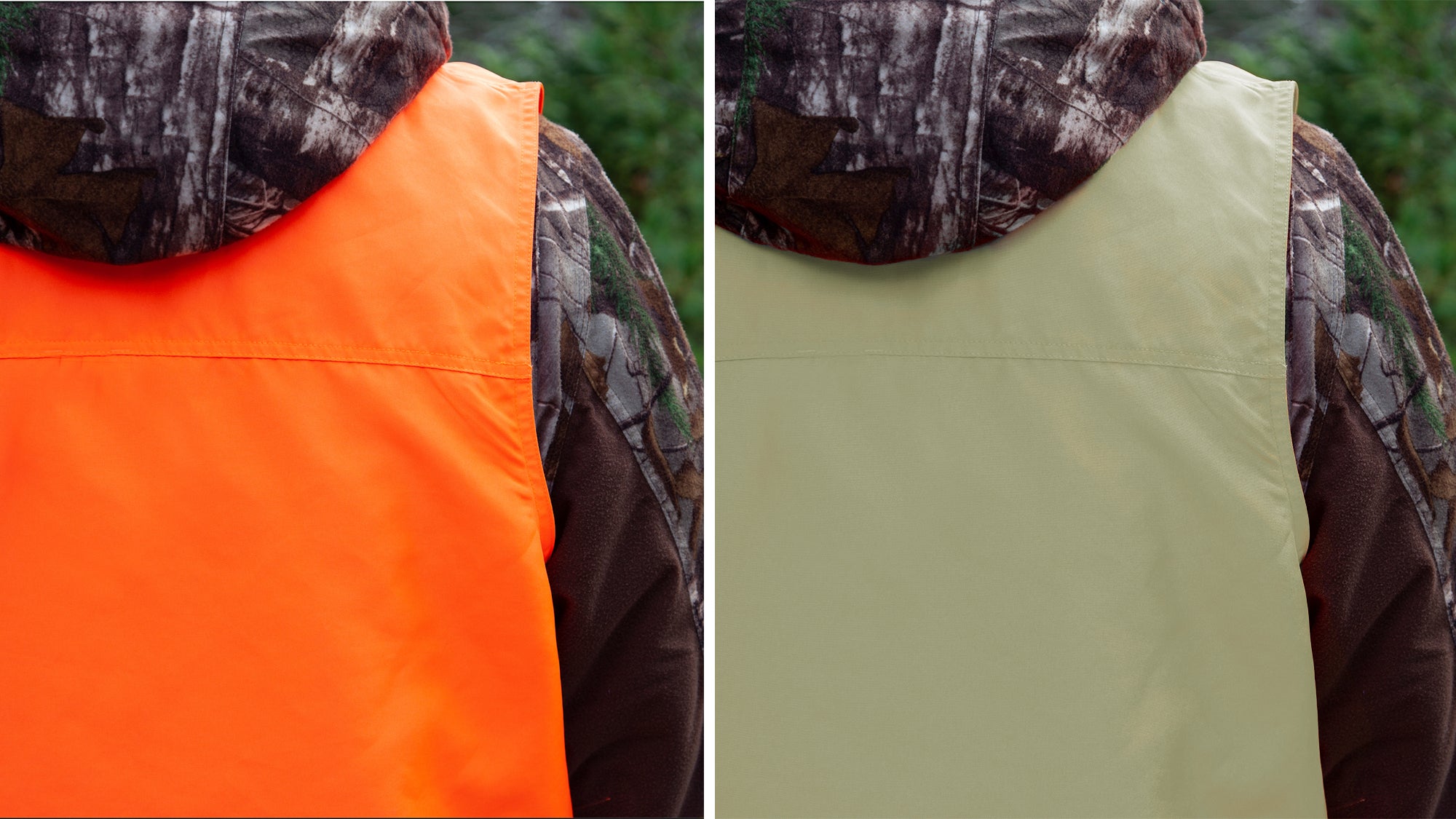
Hunter orange isn’t invisible to deer, of course. But to them, it’s not the vivid, almost-neon color we see. Instead, they see a dull, yellow-ish gray color that typically blends in reasonably well with mixed woods. As for camo, I always remember a day in deer camp when folks were arguing over the best camo pattern. Finally, after listening to the banter for awhile, one of the old timers (not coincidentally, one of most successful hunters in the bunch) said “If you’re not moving, your camo pattern doesn’t matter. And if you DO move, it also doesn’t matter.” That shut everyone up for a few seconds, and the University of Georgia study mentioned above largely back him up.
A deer’s eyes are tuned into movement more than colors or patterns. So while camo may help hide your silhouette to a degree—it won’t save you if you move. Even a small movement and is apt to be spotted by a deer if you are in it’s cone of vision. And if that staring deer doesn’t immediately feel threatened and flee, my experience is that it will try to verify what it has seen by circling downwind or engaging in a stare down that you will likely lose.
Why It Can Seem Like Deer Have Eyes in the Back of Their Heads
Speaking of a deer’s cone of vision, If it seems like deer are busting you when they’ve got no business doing so, it’s probably because those eyes aren’t positioned like ours, which, of course, are in the front of our face. But a deer’s eyes are on the sides of its face, which creates a much wider field of view. While humans have about a 180 degree field of vision, deer are closer to 300 degrees; this means unless you’re exactly behind a feeding buck’s tail, he can still see you move. Plus, his eyes can rotate about 50 degrees and in opposite directions, according to the NDA, even when he’s munching clover, so if you’re gonna draw your bow on a feeding buck, make sure you move slowly, or have some cover between you.
Read the full article here