





We may earn revenue from the products available on this page and participate in affiliate programs. Learn More ›
The 9mm and 10mm are cartridges with only a millimeter of difference in bullet diameter, but very different histories. The 9mm, otherwise known as the 9mm Luger or 9x19mm Parabellum, is the single most popular semi-auto handgun cartridge in the world today. It was invented in 1901 and has been fielded in just about every military conflict and law enforcement application since that time. Modern bullet and firearm design has only strengthened its position as top dog.
The 10mm cartridge is a relative newcomer. Like myself, it’s a product of the 1980’s. It soon faded into obscurity as a law enforcement cartridge due to its robust recoil. But like ugly sunglasses and mullets, it’s made a strong comeback in the past decade. The 10mm Auto has gained favor in many backcountry defense applications and, in recent years, manufacturers have pumped out more 10mm pistols than ever. Both 9mm and 10mm pistols are in vogue right now, but which is better? If a shooter is considering 9mm vs 10mm, the best choice will be determined by a number of variables.
9mm vs 10mm: Factors to Consider
In a perfect world, you shouldn’t have to choose between buying a 9mm or a 10mm. Just get both. However, even then, you’ll likely recognize that they’re each suited for different tasks. Here’s what to consider in the 9mm vs 10mm debate.
- What’s the application? Is it self defense, hunting, or recreational shooting?
- Do you want a full-sized pistol or concealed-carry pistol?
- Can you manage handgun recoil well?
- How much are you planning to shoot?
- What features and functions do you prioritize in a pistol?
Sometimes the Choice Is Clear, Sometimes It Isn’t
There are some circumstances in which the decision between 9mm and 10mm is easy. If you’re primarily concerned with which is more powerful, or are going to use it for hunting, the 10mm is your jam.
On the flip side, If you’re wanting to do high-volume shooting and plinking, need a micro-sized pistol, or are looking for the most affordable ammo, 9mm is the obvious winner.
Weighing 9mm vs 10mm when it comes to the many potential self-defense applications requires a deeper dive if you really want to pick the best tool for the job. Remember that each advantage that a cartridge offers comes at some cost. For example, the 10mm is certainly more powerful than the 9mm, but the 10mm also has much snappier recoil and is harder to control. Sometimes the tradeoff will be worth it, sometimes it won’t.
9mm Specs and Features
This 122-year-old cartridge has served most of its existence firing 115- and 124-grain full metal jacket bullets at around 1,150 and 1,050 feet per second respectively, but modern high-performance bullets are what keep it relevant. Critics have long considered the 9mm underpowered for duty and self-defense purposes but, after a stint with the 10mm followed by the .40 S&W, the FBI is back to the 9mm. They’ve found that modern defensive bullets allow the 9mm to perform adequately compared to even the .45 ACP. Here are the basics on the 9mm.
- Bullet Diameter: .355 inches
- Maximum Cartridge Overall Length: 1.169 inches
- Bullet weights in factory ammo (grains): 65, 90, 115, 118, 124, 125, 135, 147, 150
- Velocity range (approximate): 1,000 to 1,730 fps
Types of 9mm Ammo
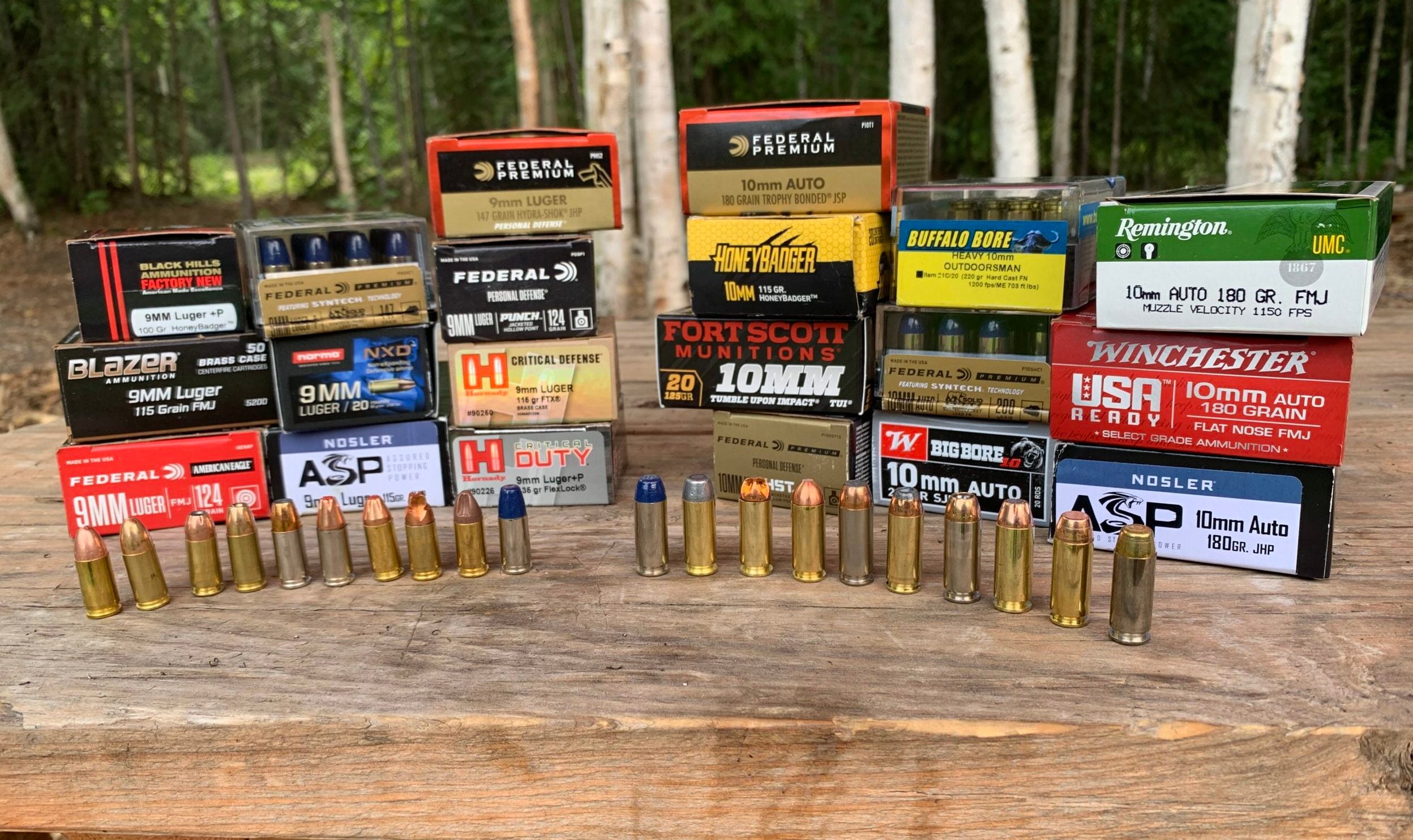
There is a type of 9mm ammo for just about every application, and 9mm ammo is now widely available on store shelves. Options range from full metal jacket and synthetic-jacketed ammo to jacketed hollow points, to frangible, to monolithic hollow points, and monolithic solids. At the extreme, ammunition like the Norma NXD uses a non-expanding 65-grain solid bullet that’s fluted to create a dramatic wound cavity, while penetrating hard barriers. It leaves the muzzle at over 1,700 feet per second! Lehigh Defense makes similar monolithic bullets that are loaded by several companies including Black Hills Ammunition. Heavier 147-grain defensive loads are common, and companies like Buffalo Bore and Federal Premium have solid cast bullet offerings intended for backcountry animal defense. The average 9mm ammo uses a bullet that weighs between 115 and 124 grains, fired at a velocity of 1,050 to 1,150 feet per second.
Types of 9mm Pistols
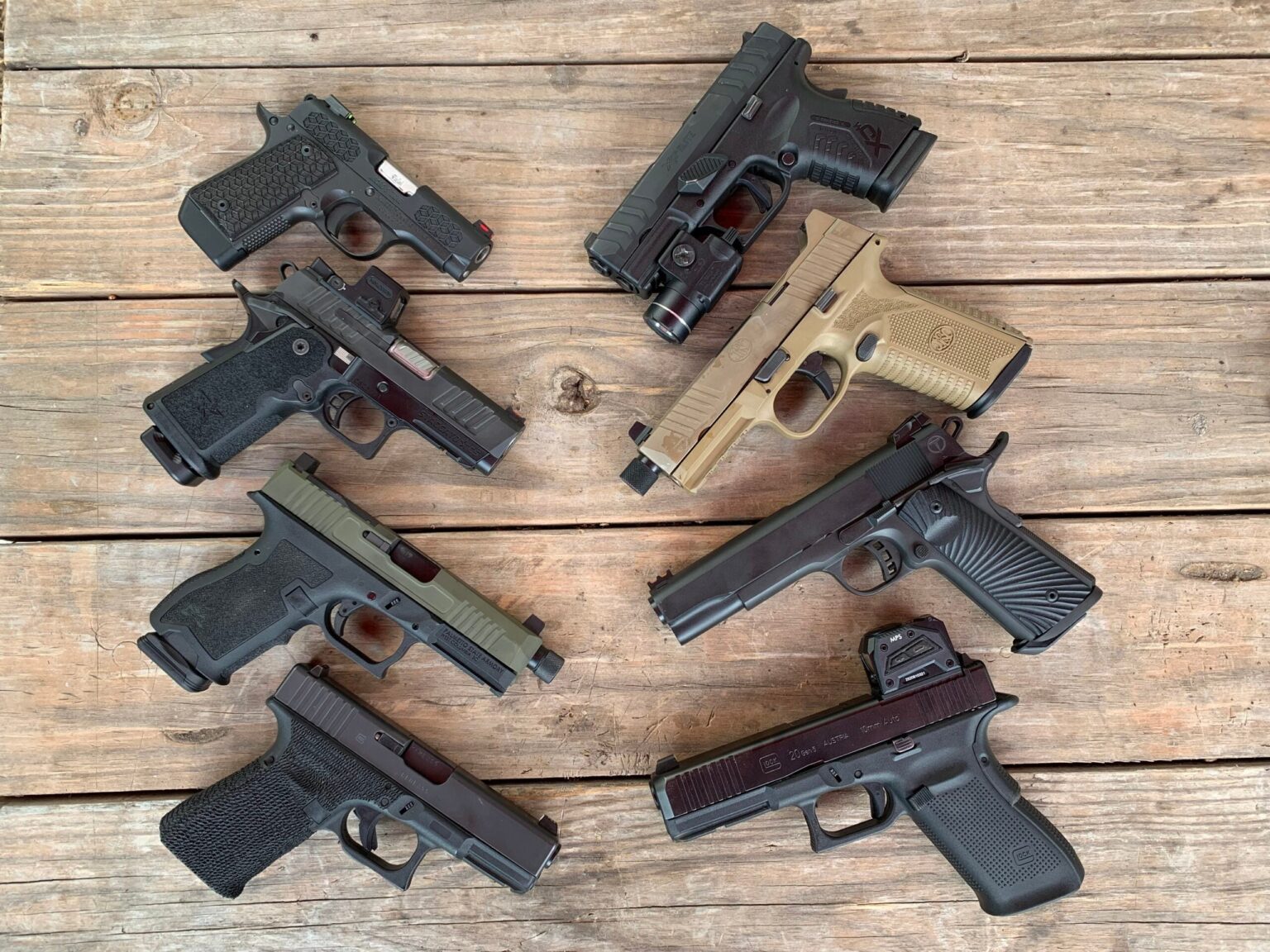
You can find just about any type of pistol chambered in 9mm. It’s far-and-above the most widely-available pistol offering in the world, and every company’s flagship pistol comes chambered in it. This includes anything you can imagine from high end 2011 pistols that cost thousands of dollars down to the booming field of tiny micro-compact 9mm’s. Standard full-sized pistols typically carry 17 rounds in the magazine, compacts carry 15 to 16 rounds, and micro compacts carry between 7 and 13 rounds. A major advantage that the 9mm has over any challenger is simply the variety of pistols that are available—there’s truly a great option for everyone. Read my full review of best 9mm pistols here.
10mm Specs and Features
The 10mm Auto served a short stint with the FBI before being trimmed down to the .40 S&W which is, quite literally, just a 10mm short. Although it enjoyed a multi-decade tenure, the .40 S&W is essentially pushing up daisies these days while the 10mm basks in a renaissance. Trademarks of the 10mm Auto are notably sharper recoil than the 9mm and .45 ACP and the truncated-cone flat-tipped full metal jacket bullets. The payoff for its higher recoil is a cartridge that’s faster and has more energy than the .45 ACP. It’s ballistically similar to the .357 Magnum.
- Bullet Diameter: .400 inches
- Maximum Cartridge Overall Length: 1.260 inches
- Bullet weights in factory ammo (grains): 115, 125, 140, 150, 180, 200, 220
- Velocity range (approximate): 1,000 to 1,600 fps
Types of 10mm Ammo
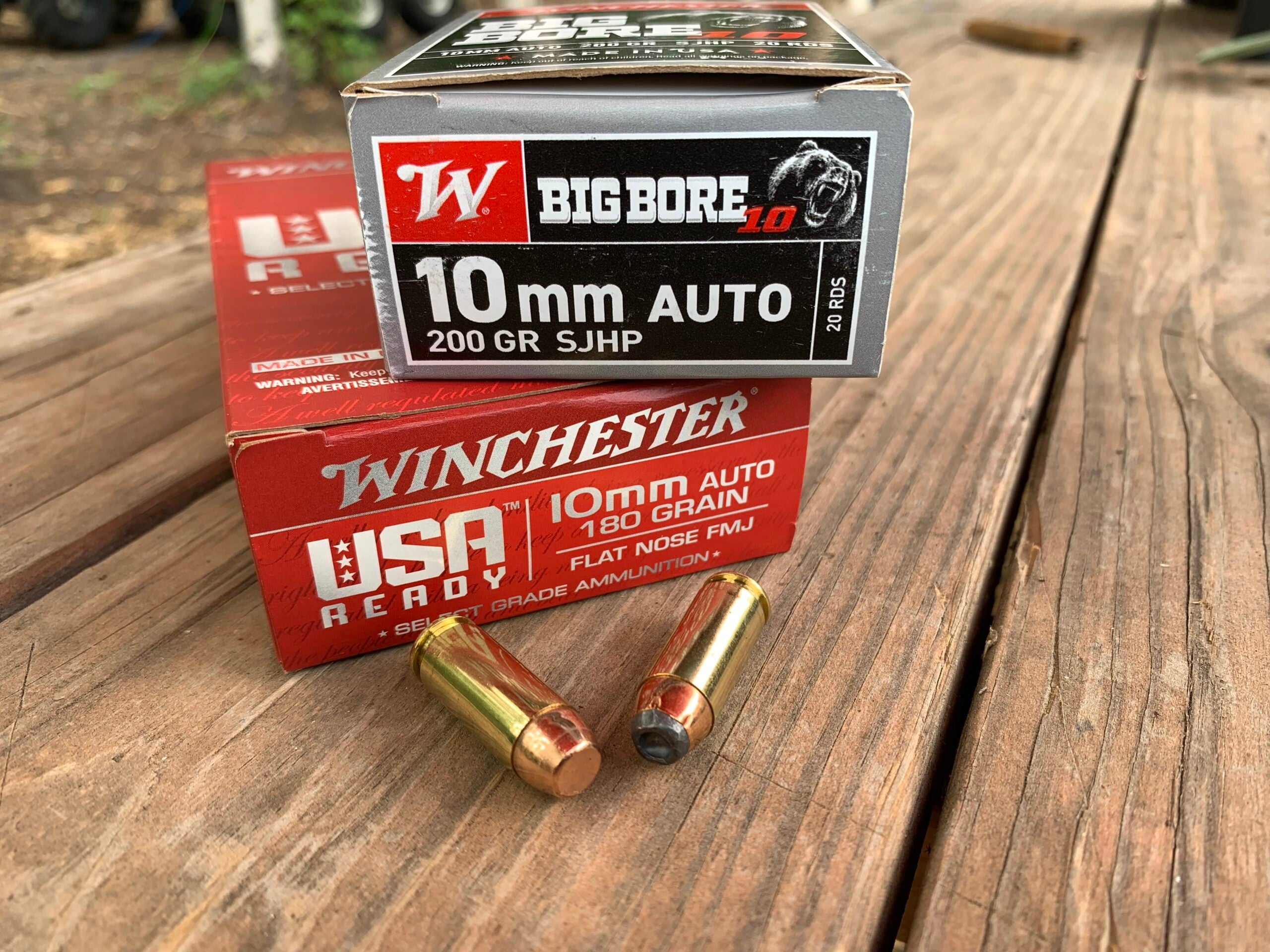
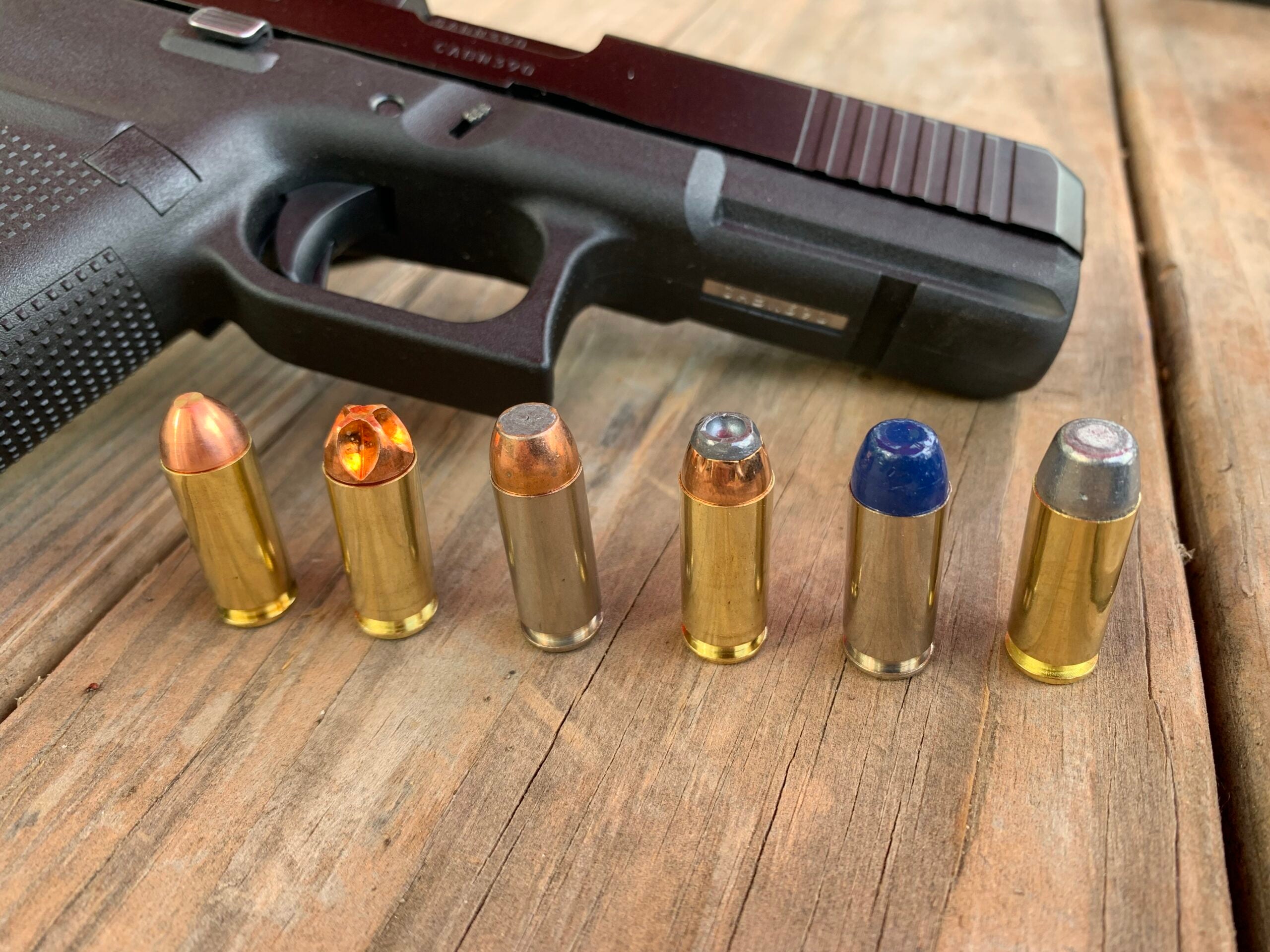
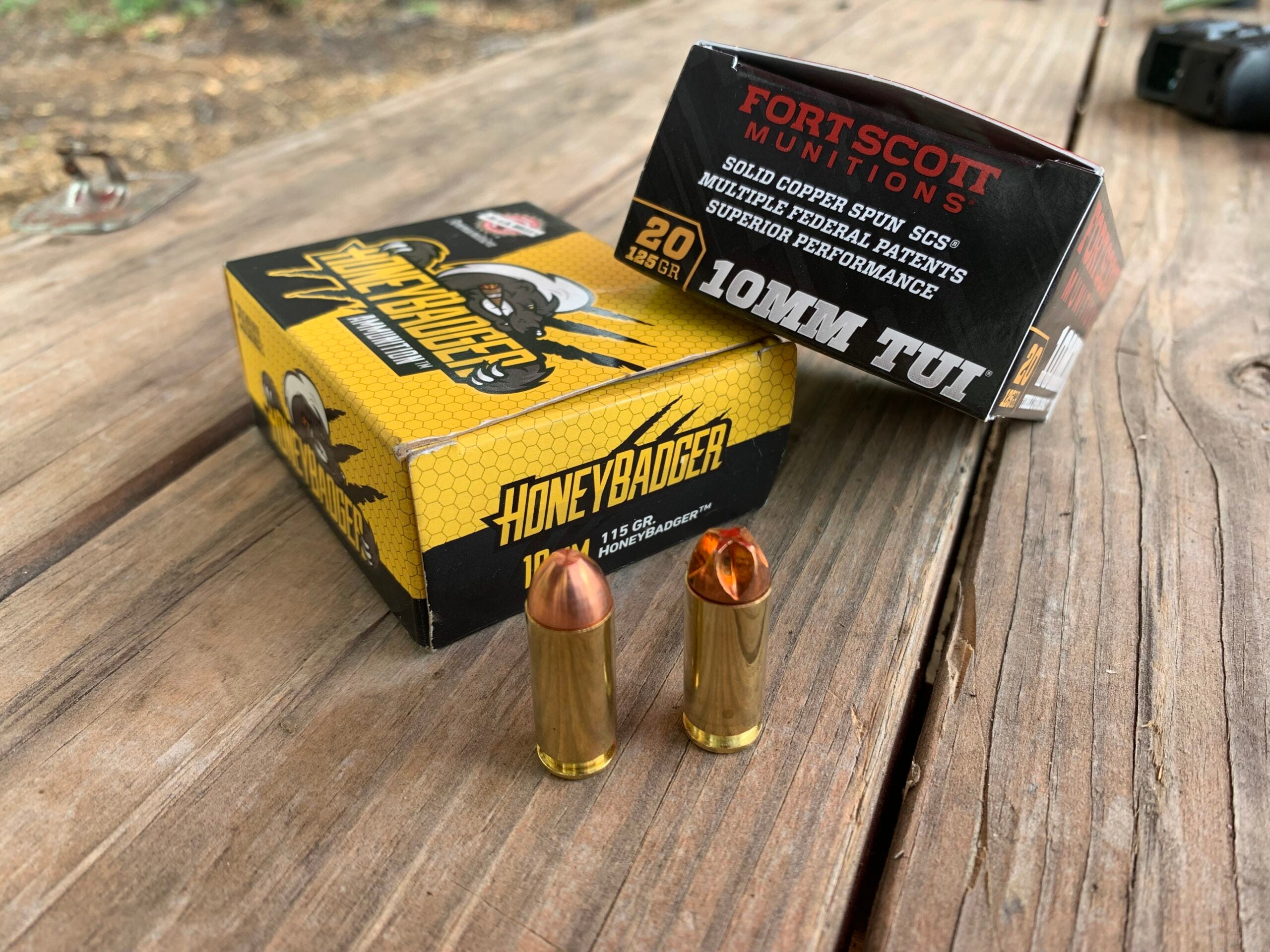
The surge in popularity of the 10mm has spurred ammunition manufacturers to produce a wide variety of 10mm bullets and ammo. You’ll find 10mm ammo in just about every category, including light-loaded full metal jacket loads, defensive hollow points, controlled-expansion hunting ammunition, and a strong showing of deep-penetrating bear defense loads. Here you can see a more in-depth guide on the best 10mm ammo. Internet gripers will claim that no one loads full-power 10mm ammo like in the good old days, but that’s not true. Some 180-grain ball ammunition is loaded to “FBI Lite” specs, which is about 1,050 feet per second, but virtually all defensive ammo is loaded above that. A good example of full-power practice ammo is Winchester’s USA Ready 180-grain full metal jacket, which zips along at 1,250 feet per second. High-velocity ammo like the Black Hills 115-grain Honey Badger, which uses a Lehigh Defense Extreme Defense bullet, has a muzzle velocity of 1,550 feet per second. That’s 24 percent faster than standard 10mm ammo. As a result, it produces a ballistic gel wound cavity that’s identical to a 240-grain JHP fired from a .44 Magnum revolver—while producing less recoil than heavy 200-grain 10mm bullets.
Types of 10mm Pistols
Though the field of 10mm pistols is much more limited than that of the 9mm class, it gains depth every year. Initially, 1911-style pistols like the Colt Delta Elite and Browning Hi-Power-type pistols like the Bren Ten populated a limited field of 10mms. The Glock G20 was introduced in 1991 and was one of the few common 10mm pistols. The Gen 5 G20 is still one of the best. In the past few years, just about every manufacturer has jumped on board. Now we have everything from the Sig Sauer P320 XTen to the FN 510 Tactical. Most of these are full-size pistols, but there are a few compacts like the Glock G29 and, one of my favorites, the Springfield XD-M Elite Compact. The average full-size 10mm striker-fired pistol has a magazine that holds 15 rounds, and compact versions usually hold 10 or 11 rounds. Most 1911 10mm’s have a magazine capacity of 8 rounds.
9mm vs 10mm for Self Defense
When considering any firearm or caliber for self defense, you need to account for your surroundings and what you might be defending yourself against. The 10mm cartridge is an excellent self defense performer, but extra power isn’t always an advantage. Are you primarily concerned with defense against bad guy attackers, rogue aggressive dogs on your jogging route, bears on a backcountry hunt, or something else? Do you want to have both a 9mm and 10mm for different applications, or just one gun? Is the recoil of the 10mm too detrimental to your shooting confidence?
Defense Against Bad Guys
The 9mm cartridge has some clear advantages when it comes to defense against human threats. As mentioned before, a much wider array of 9mm pistols is available to choose from, practice ammo is cheaper, and recoil is softer. The 9mm pistol options are a much better fit for everyday concealed carry. Both experienced shooters and novices will be able to shoot a 9mm more accurately, quickly, and with more confidence than the beefier 10mm. Any 9mm pistol of a given size will have greater ammunition capacity than its 10mm counterpart, too.

Modern 9mm defensive ammunition is superb, and the differences in the terminal performance of 9mm vs 10mm aren’t terribly far apart. With good shot placement, you’re just as well off with a nine. For most people the 9mm will be a better choice for EDC self defense, but the extra power of the 10mm is certainly worth considering. Defensive 10mm ammo is just as good as 9mm ammo, and designed to reduce over-penetration. The 10mm might not be the best choice for most, but it’s never a bad choice. If you can shoot it proficiently, it will serve you well.
Defense in the Backcountry
A huge boost to the popularity of the 10mm is the trend of foregoing the traditionally accepted .44 Magnum (or larger) revolver in favor of the lighter, higher-capacity 10mm for bear defense. The 10mm has generated a pretty good track record of defense against grizzlies and brown bears, and a 10mm is much easier to carry and shoot accurately. Not only that, the 10mm is more affordable and pleasant to practice with.
Any pistol used for backcountry defense is essentially just better than nothing. Sure, pistols are very effective when used appropriately, but that requires practice and situational awareness. Compared to a rifle—even everyone’s favorite punching bag, the 6.5 Creedmoor—all handguns offer inferior terminal performance. They are harder to shoot accurately and simply lack the velocity to do real rifle-like damage. That being said, the 10mm has a clear advantage over the 9mm when it comes to one of the two most important factors for a bear defense handgun: penetration. Ideally, we want a big wound cavity and penetration, but we usually have to settle for penetration alone. The other most important factor is shootability. Yes, the 9mm is easier to shoot than the 10mm, but in comparison to large revolver cartridges, the 10mm is a sweetheart to shoot.
Read Next: Springfield Armory Echelon, Tested and Reviewed
Heavy, hard-cast bullets are the classic option for bear defense. However, that has changed a bit with the new monolithic, fluted bullets. They weigh less and have higher velocities. Since they don’t deform, they penetrate well and produce good wound cavities.
Go With the Gun You Can Shoot Well
Some people struggle to stay proficient with a harder-kicking cartridge like the 10mm. For them, the 9mm might be the best option. Remember, you can’t stop a bear if you can’t hit it. Sometimes you’ll need to hit a bear multiple times to stop an attack. I know of three instances here in Alaska where a 9mm was successfully used to kill an aggressive brown bear. If you must go that route, shoot a heavy, deep-penetrating cast or monolithic bullet.
FAQ
Is 10mm more powerful than 9mm?
Yes, the 10mm is more powerful than the 9mm. A 10mm has roughly 45 to 68 percent more kinetic energy depending on the loads used.
What is better 9mm or 10mm?
For some applications, 9mm is better. For others, 10mm is better. Proficient and accurate shooting is always the most important factor.
Is a 10mm more powerful than a 45?
Yes, the 10mm fires a bullet with similar mass, but at much higher velocity.
Is 10MM faster than 9mm?
The average full-power 10mm 180-grain load is faster than most 9mm ammo.
Final Thoughts
Both the 9mm and 10mm are excellent cartridges, and I shoot both extensively. I favor the 9mm in EDC-type situations where I simply want a compact gun that I can shoot well. For me, the 10mm is a better option for carrying on hunting or fishing trips where a problematic bear encounter might occur. Each cartridge has advantages and disadvantages, but what’s really important when you’re pondering 9mm vs 10mm, is that practice, proficiency, and proper ammunition selection are far more important than which cartridge you choose.
Read the full article here