

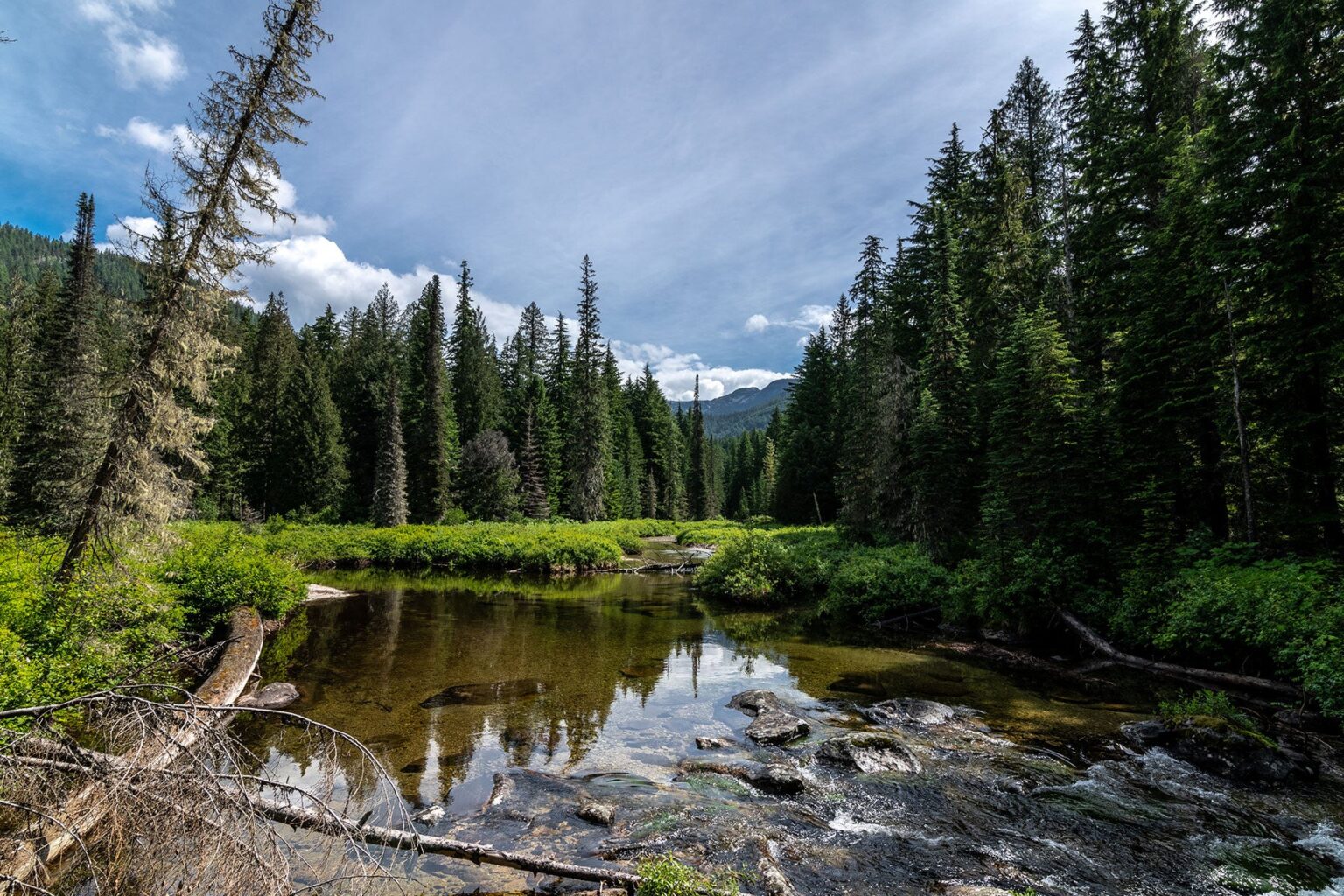

On May 25, 2023, the Supreme Court of the United States (SCOTUS) issued a ruling that could ultimately rescind federal protections from more than 50 percent of the nation’s wetlands. With its 5-4 ruling in a case known as Sackett v. EPA, SCOTUS declared that the Clean Water Act—a measure long-regarded as the most impactful clean water safeguard ever enacted—no longer applies to isolated wetlands that aren’t visibly connected to larger water bodies by continuous, surface-level flows. According to sportsmen’s groups, the ruling will leave these isolated wetlands unprotected from development, drilling, and other sources of pollution. While the decision will be a boon to the homebuilding and extraction industries, it could have far-reaching and detrimental repercussions for wildlife species that rely on cold, clean water sources—like trout and waterfowl.
“It’s bad news for hunters and anglers,” Alex Funk, Director of Water Resources and Senior Counsel for the Theodore Roosevelt Conservation Partnership (TRCP), tells Field & Stream. “Everything from ducks to cold-water fish species like trout rely on headwater streams and headwater wetlands, like fens, to help maintain water temperatures—those are at risk now.”
What is the Clean Water Act?
The Clean Water Act (CWA) was enacted in 1972 during the Presidential Administration of Richard Nixon. Since then, it has served as a model for other nations around the world looking to clean up severely polluted waterways. In the decades since its passage, “we made fantastic progress in cleaning up our waters and restoring some of the greatest fisheries in the world,” noted F&S contributor Hal Herring back in 2019.
In its original incarnation, the Clean Water Act granted the Environmental Protection Agency (EPA) and the Army Corps of Engineers sweeping authority over construction and development of any kind in and around isolated wetlands—like those found in the prairie potholes region, a veritable duck factory that stretches across parts of Montana, Minnesota, and the Dakotas, where more than 50 percent of America’s waterfowl is reared. It also applied to all of the nation’s ephemeral streams—including those that run bone-dry in the summer months—because it was generally understood that such streams are continually connected to other watersheds by year-round, sub-surface flows.
The Clean Water Act’s stated goals were beautifully simple: Make America’s rivers and wetlands “swimmable and fishable” again. For fifty years, throughout the administrations of six different U.S. Presidents, the federal rule worked well. And it reversed some of the country’s most egregious environmental sins. Then, in 2001 and again in 2006, SCOTUS began taking court cases with huge implications for the future of the Clean Water Act. Its rock-solid protections were eroded by unfavorable court decisions, and the clarity that had made the CWA such an effective safeguard for so many years was muddied.
Enter Waters of the U.S. Rule
In response to the confusion brought about by these court cases, the Obama-era EPA proposed the so-called Waters of the U.S. Rule—commonly known as WOTUS. This 2015 rule sought to clarify and re-establish lost protections for hundreds of thousands of miles of ephemeral streams and tens of thousands of acres of wetlands. It was widely supported by the vast majority of America’s hunting and angling conservation groups.
But its opponents had immense power in the mining, agribusiness, and development sectors. That lobby’s boisterous campaign to undermine WOTUS was widely successful, and in 2019 President Trump decried the rule as “horrible”, scaling back its protections for ephemeral streams and isolated wetlands once again. Then, when current President Joe Biden took office, his EPA administrator rebuilt WOTUS, restoring its protections to pre-Trump levels. That’s more or less where the rule remained until yesterday.
Sackett v. EPA
Now, with its most recent ruling, SCOTUS may have sounded the Clean Water Act’s death knell once and for all. The ruling hinges on a court case that’s been winding its way through the judicial system for more than 15 years.
The defendants, Michael and Chantell Sackett, own a piece of property near Idaho’s Priest Lake. When they broke ground to build a dream home on their property back in 2004, the project was halted by the EPA because their lot contained a wetland connected by sub-surface water to Priest Lake. The couple sued the EPA, saying they had every right to backfill the wetland on their property with 1,700 cubic yards of sand and gravel. And yesterday, the highest court in the land decided that the Sacketts were right.
“The wetlands on the Sackett property are distinguishable from any…waters [that are covered under the CWA],” wrote Justice Samuel Alito, because they aren’t visibly connected to them. Writing for the majority, Alito went on to say that, in order to be eligible for federal protections under the Clean Water Act, a wetland must have a “continuous surface connection with water, making it difficult to determine where the water ends and the wetland begins.”
What it Means for the Future of Clean Water in America
“The Court is basically making the assumption that water only flows on the surface,” Trout Unlimited President and CEO Chris Wood tells F&S. “They’re making the assumption that there’s no such thing as groundwater, no such thing as sub-surface flow. It totally flies in the face of the scientific reality, and it’s a dangerous reading of the Clean Water Act.”
Wood says the SCOTUS decision could have implications that extend far beyond isolated wetlands like the one found on the Sackett’s half-acre lot in the north Idaho panhandle. “I live on a river in West Virginia that goes dry in the summer. It goes sub-surface,” he says. “Does this now mean that if I want to build a road through that river, I can now do that without a permit? If I wanted to store a bunch of nasty chemicals down in that river—because it does not have a continuous surface connection to a larger water body—I guess I could do that now.”
According to TRCP’s Funk, the onus will now fall on individual states to enact whatever clean water protections they see fit. “Most states don’t have the resources to set up clean water programs and enforce those safeguards,” says Funk. “The whole model of the Clean Water Act was that the feds would provide that cooperative base level of protection for the states. With this ruling, that base just dropped considerably.”
It’s not just trout, salmon, and waterfowl that will bear the brunt of the Supreme Court’s decision to narrow and weaken the scope of CWA protections, Funk says. “It’s not going to just impact the angling community but really the hunting community at large, given how many species rely on these non-adjacent wetlands that just lost federal protections,” he says. “This impacts big game, like mule deer and elk, in places like Utah and Arizona. These species spend a portion of the summer foraging or utilizing intermittent streams or wetlands systems as part of their grazing and supplemental food supply. That habitat is now at risk.”
Related: Will a Colorado Supreme Court Case Open Thousands of Miles of “Private Water” to Public Fishing?
Given the power of the Supreme Court, there’s little recourse for sportsmen like Wood and Funk who worry about the precedent that SCOTUS just set with its ruling in Sackett v. EPA. “I do think there’s a path through the woods for the EPA, but it’s become a lot darker and a little scarier for people who care about clean water,” says Wood. “With the court saying that there has to be a continuous surface connection, that’s a much tougher standard. What we’re dealing with here is gravity. Water flows downhill, and it may not always flow on the surface, but it’s still flowing. [The Biden Administration] will have to make a scientific argument about how gravity works cheap, and it never takes a day off.”
In the meantime, Wood says, hunters and anglers who disagree with the Supreme Court’s decision should voice their opposition.
“Going forward, we’re going to have an increasingly hard time caring for and recovering trout and salmon and waterfowl, and other game species that depend on isolated wetlands and high elevation streams that may occasionally run dry,” he says. “Sportsmen and women who care about quality hunting and fishing, who care about clean water in general, we need to make our voices heard, or we’re going to wake up one morning and these pursuits that we’ve come to enjoy over the years are going to be gone.”
Read the full article here