



We may earn revenue from the products available on this page and participate in affiliate programs. Learn more ›
Many little kids start out fishing with a closed-face, push-button reel before learning how to cast a spinning reel. They’re great for beginners, but by the age of 5, I had both of my kids using a spinning reel. Spinning reels are available in a huge variety of sizes, and there’s not a species of fish on the planet that can’t be effectively targeted with a one—from tiny bluegills to the big tuna.
Unlike fly reels and baitcasting reels, the mechanics don’t change with a spinning reel no matter what you’re casting, so once you learn the basics, it’s like riding a bicycle. For the rest of your life, whenever the opportunity to fish presents itself, you’ll be ready. To start, let’s break down the key parts of a spinning reel. Then we’ll dive into the mechanics of how to cast a spinning reel.
Table of Contents
- Parts of a Spinning Reel
- How to Make Your First Cast
- Choosing the right Line
- How to Tune the Drag on a Spinning Reel
Read Next: The Best Spinning Reels of 2023
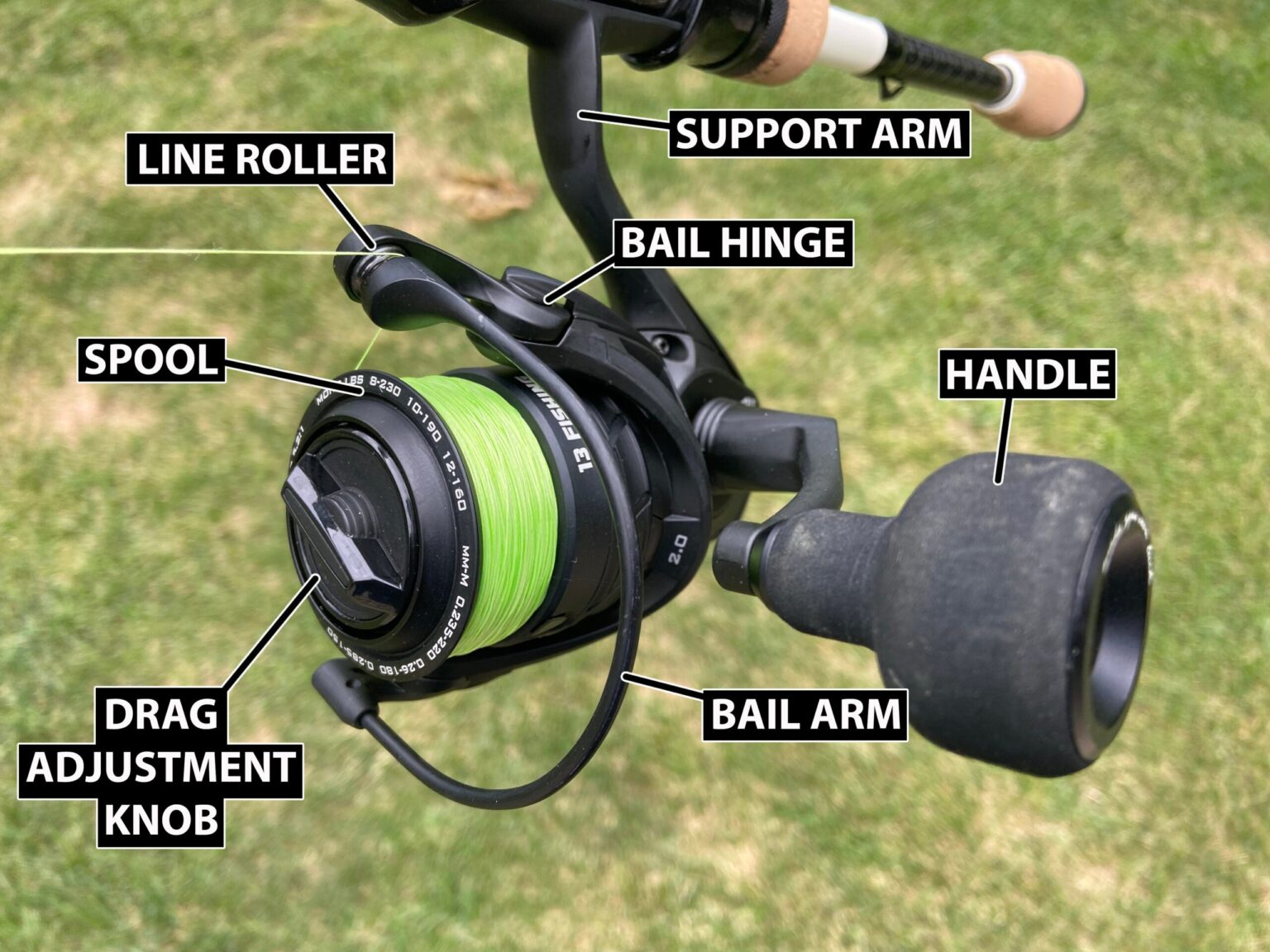
Parts of a Spinning Reel
Though we’ll examine how some of these parts function in making a cast, it’s good to familiarize yourself with the layout of your reel before we get into the mechanics.
How to Make Your First Cast
Now that you’re a bit more familiar with the parts of your spinning reel, let’s assume it’s spooled up with fresh fishing line and is ready to go. By the way, the spool should only be filled to just shy of the lip around the front edge of the spool. If you overpack the spool, it will cause wind knots and tangles. If your spool is filled correctly, you’re probably just dying to make that first cast. So, let’s just get you up to speed on how to cast your spinning reel. Tie on a medium-weight lure and follow this step-by-step breakdown:
- Reel the lure up until it’s dangling about a foot from the rod tip
- Grab the line just forward of the reel with the index finger on your dominant hand (the hand holding the rod) and pull it back toward your hand. Don’t let the line slip from your finger
- With your other hand, open the bail arm until it clicks into place. It shouldn’t snap back shut when you let it go.
- Bring the rod over your shoulder and whip it forward in a smooth stroke. Just as the rod gets in front of you, release the index finger holding the line.
- After the lure lands, turn the reel’s handle to re-engage the bail arm.
Congratulations! You just learned how to cast a spinning reel.
Choosing the Right Line
No matter what kind of lure or rig you’re casting from this point forward, the mechanics won’t change. The only difference will lie in the weight of what you’re casting and the diameter of your line. The heavier the lure, bait, or rig, the farther you can cast it. Likewise, the thinner your line, the farther your lure will travel. Keep in mind that distance will be hindered by trying to cast too light of a lure or rig on line that’s too heavy. Here’s a quick reference guide for choosing the best fishing line for your spinning reel.
- Bass: 8- to 10-pound test
- Catfish: 10- to 12-pound test
- Inshore Saltwater: 15- to 20-pound test
- Muskie: 30- to 40-pound test
- Panfish: 2- to 4-pound test
- Pike: 12- to 15-pound test
- Trout: 4- to 6-pound test
- Walleye: 6- to 8-pound test
How to Tune the Drag on a Spinning Reel
Knowing how to cast a spinning reel is obviously important to your angling success, but if a big fish grabs your bait or lure, it’s also critical that your drag is set properly if you want to land it. On the front of your reel’s spool, you’ll find the drag-adjustment knob. This controls how much force it takes for a fighting fish to engage the drag. Drag is the ability of the spool to spin—thus allowing the fish to take line—when the bail arm is in the closed position. It’s important for maintaining proper tension during the battle. If the drag is too loose, the fish will be able to pull line off too easily, which can stop you from keeping proper pressure on the fish; if the drag’s too tight and the fish runs, the pressure may be too great and cause the line to snap or the hook to pull.
Naturally, you’ll have to readjust your drag based on your target. If you’re fishing for panfish or small stream trout, you can keep the drag pretty tight as these species don’t usually have enough power to engage it. If you’re targeting large catfish, trout, or bass, you want them to be able to take some line if necessary. Starting with the drag knob loose, make four tightening turns and then pull some line off the reel by hand. It’s not an exact science—and you can always adjust on the fly—but the goal is to set it so it takes a fair amount of pressure to engage the drag. Keep working in four-turn increments until you feel it’s not too loose and not too tight.
Read the full article here