



We may earn revenue from the products available on this page and participate in affiliate programs. Learn more ›
Compared to spinning reels and conventional reels, fly fishing reels are rudimentary tools. There are far fewer guts, gears, and moving parts under their hoods. Yet people often perceive fly fishing as being so much more complex than spin fishing that they’ll pine over trying to select the best fly reel, concerned that they won’t have the perfect one for the job.
If anything, fly fishing is more forgiving in terms of having exactly the right reel. You can get away with a reel that’s a size too big or small most of the time, and once you understand the basics of fly reel design, you’ll quickly see there’s no need to overthink or overcomplicate the process of buying one. All that really matters is your budget. But believe me when I tell you: Aside from perhaps better, stronger, materials used to make one versus the other, the design principles are the same with an $80 5-weight fly reel and an $800 5-weight fly reel. So, if you’re in the market, you can narrow down your choices by answering these two simple questions.
How Strong Are the Fish I’m Targeting?
Whenever someone asks me for a fly-reel recommendation, it catches them off guard when I bring up fish strength before fish size. The reality is that the two aren’t as related as most people assume. As an example, a 20-inch brown trout and a 20-inch bonefish are going to require very different reels, as the bonefish is significantly stronger than the trout.
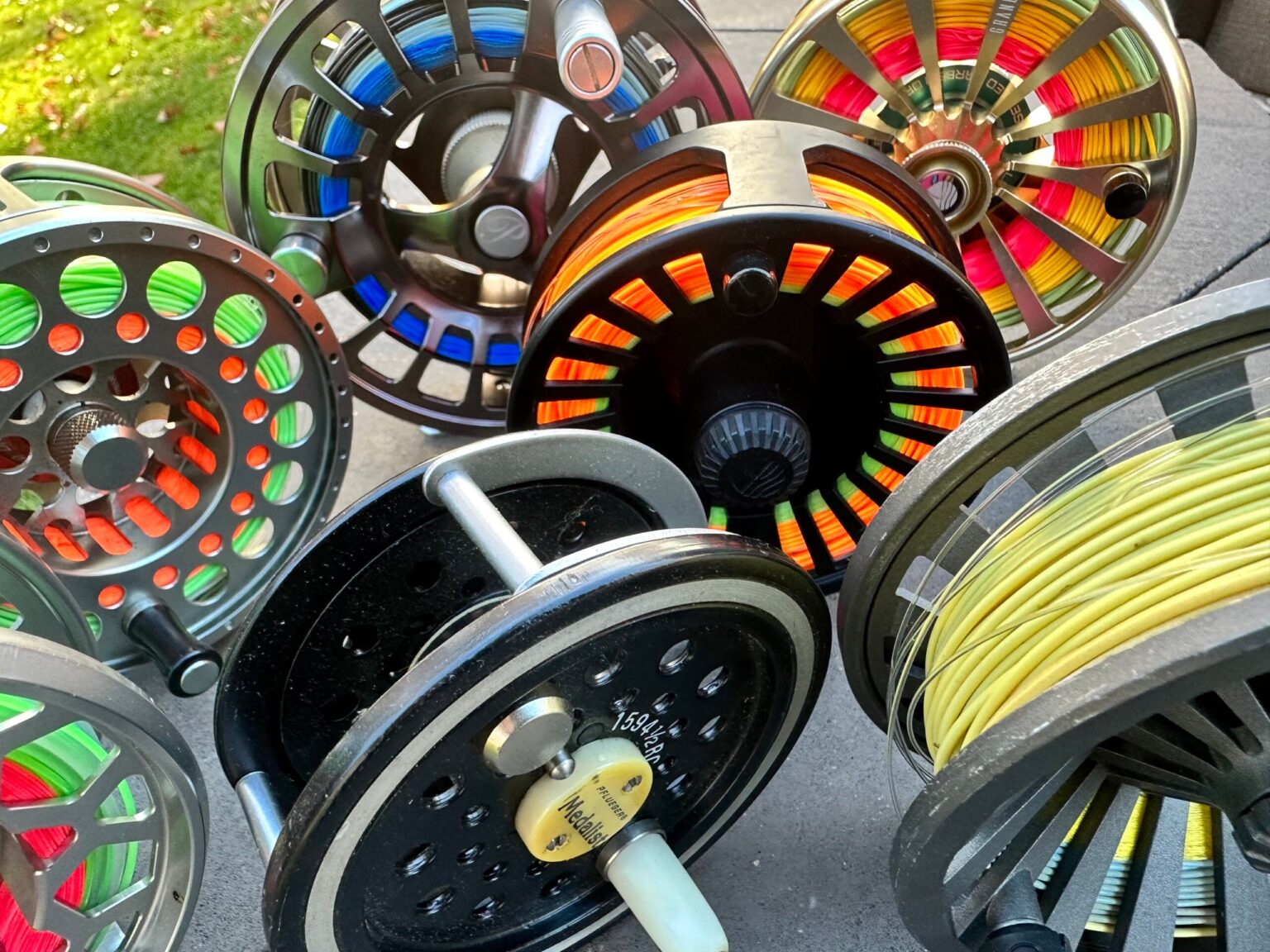
The strength of the fish you’re trying to catch will determine if you need a fly reel with an adjustable drag or a click-and-pawl drag. The latter is less expensive, but it’s also perceived as less “cool” and “modern” than an adjustable drag or sealed disk drag. Click-and-pawl reels have been around practically since the dawn of fly fishing, and while some allow you to adjust their settings a bit, most feature a simple internal gear and tooth under spring tension that creates some resistance when line is pulled off the reel. With many click-and-pawl reels, it’s up to the angler to adjust drag pressure by palming the spool during the fight. Modern disk drag reels, meanwhile, can be cranked to apply massive pressure with the turn of a dial. So, which one do you need? Most likely not the one you want.
The hard truth is that a click-and-pawl reel you buy at a flea market can land the most targeted freshwater fish in this country. A Pflueger Medalist is a prime example of a classic click-and-pawl, and there’s a reason why they’re a dime a dozen at yard sales; they were made for years because they were dependable. Though we like to imagine a trout ripping 300 yards of line downstream, or a largemouth zipping across the lake, or a bluegill eating our fly and running into a logjam, none of these fish will dump your spool. Heck, they won’t even take enough line for you to see your backing, so targeting them with a reel that could stop a runaway train is complete overkill. Conversely, if your primary target is big carp, steelhead, muskie, or inshore saltwater species, a reel with a quality, adjustable drag offers an advantage.
How Far Away Are the Fish I’m Targeting?
Another variant on fly reels is arbor, which refers to the width of the spool. With spinning and conventional reels, spool width increases with reel size, but that’s not the case with fly reels. In other words, you can have a small fly reel with a wide arbor and a large fly reel with a narrower arbor. Most people assume the primary purpose of a large arbor is to hold more line and backing, but there’s more to it than that.
Yes, a wider fly reel spool has a higher backing capacity, which is a plus if you’re targeting species like bonefish, tarpon, or redfish that can peel off hundreds of yards of line during a fight. More importantly, however, the larger the arbor the faster that reel can pick up line when you’re reeling, and you don’t need to be targeting speed demon fish for this to be useful.
Let’s say you’re wading a trout stream and fly fishing with nymphs. In that scenario, you’re generally making short casts and drifting very close to you, so when you get a strike, there’s not much line out. You lift to set and you’re tight. A larger arbor reel isn’t going to offer much advantage here. If you’re making long casts with streamers or dry flies, on the other hand, and a trout blasts your fly right away, you might need to pick up line fast to keep tension on or compensate if that trout eats and runs toward you. A large arbor fly reel will pick up more fly line per handle turn, thereby helping you maintain better control of the fish. As a general rule, if you’re rarely casting farther than 30 feet at fish that aren’t going to take very much line, you don’t need a large arbor reel.
In saltwater settings—or when you want to get a muskie or steelhead in the net as fast as possible—large-arbor fly reels make the play more smoothly. I once made the mistake of casting at a school of 30-pound jack Crevalles with a standard-arbor reel and it’s a miracle I landed any because I simply couldn’t take in line fast enough when they came screaming at the boat.
Read the full article here