





Here’s how to make sure you’re picking the perfect spinner

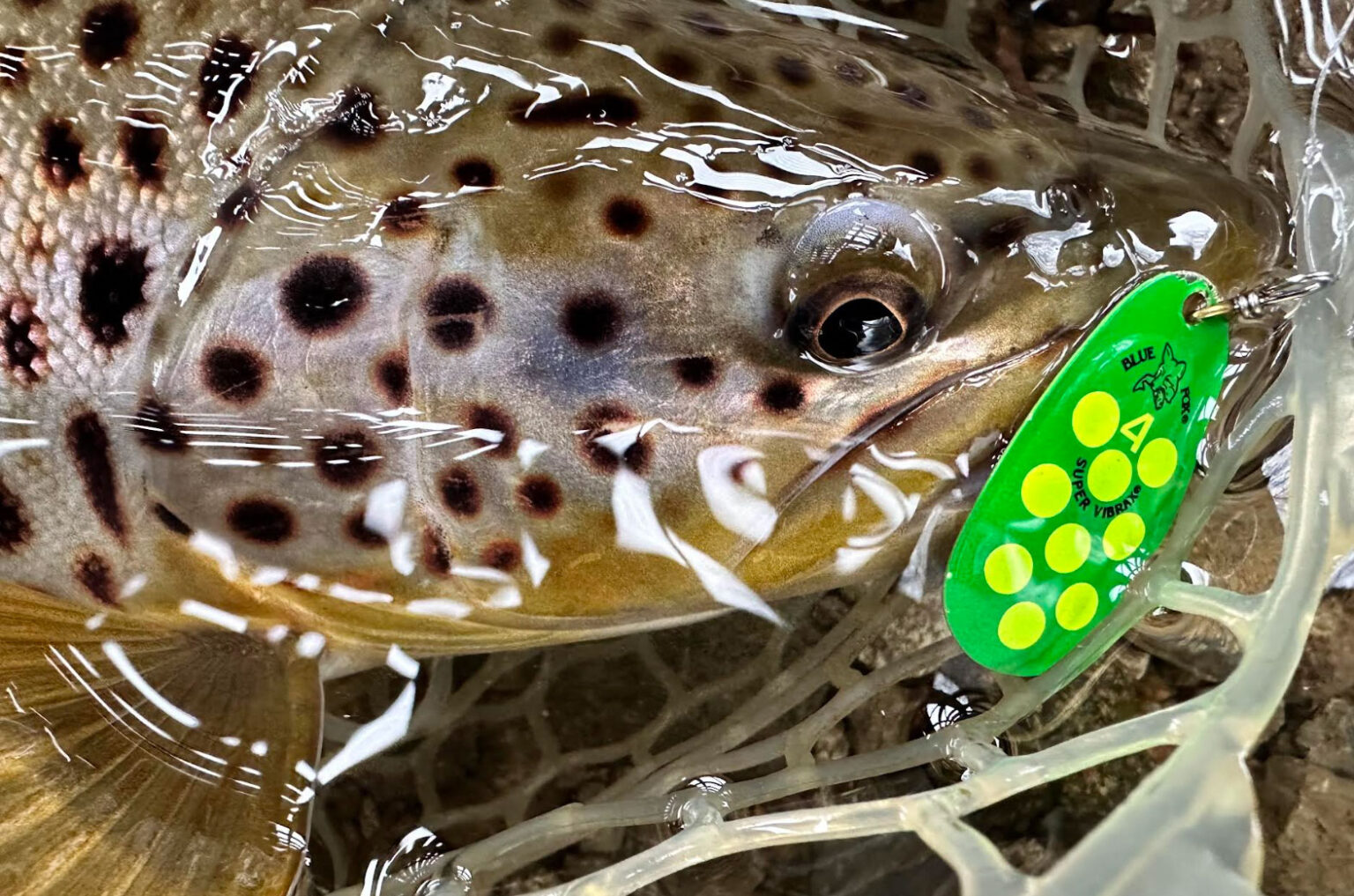
Inline spinners are excellent lures for trout, pike, and bass. Photo by Joe Cermele
We may earn revenue from the products available on this page and participate in affiliate programs. Learn More ›
French angler Andre Meulnart invented the inline spinner in 1938 while working for a company called Manufacturier d’Engins de Precision pour Peches Sportives. You probably know the brand by its acronym—Mepps. The Mepps spinner is still one of the most popular and widely sold lures of all time, mostly because it’s so versatile.
Today there’s a plethora of inline spinners on the market made by many brands, and they’ll catch almost any freshwater predator species that swims. Perhaps most appealing, anglers of any skill level can use one effectively. There’s no finesse tactics or nuance; just cast, reel, and hold on. But just because these lures are simple to use doesn’t mean they’re all created equal. A basic understanding of their design and components will help you select the best inline spinner for the conditions you’re fishing and the species you’re chasing.
Understanding Inline Spinner Blades
Naturally, the size of an inline spinner’s blade will vary with the overall size of the lure. As an example, a spinner designed for pike and muskies will have a much larger blade than one designed to target stream trout. You can use Mepps’ sizing guide for picking a blade size based on the species you’re targeting.
However, regardless of the size of your spinner, you need to consider the width and depth of the blade.
As the blade spins it’s producing visual flash and vibrations, the latter of which are often most important. Fish see the flash of the blade, but they feel the thump and vibration with their sensitive lateral lines. The wider the blade the deeper and lower in tone its vibration will be because a wider blade rotates at a slightly slower rate due to an increase in water resistance. Conversely, a narrower blade spins at higher RPM and emits a higher frequency vibration. Likewise, the deeper the “scoop” of a blade—meaning its concave, bowl-like shape—the deeper its vibration.
In clear or shallow water, a spinner with a thinner, narrower blade that rotates quickly is often a smarter choice because fish will rely on sight more in these conditions. In deeper or stained water, a wider blade will emit a stronger vibration fish can feel. Predatory fish’s ability to home in on this vibration can make inline spinners lethal in cloudy or muddy water. It’s not uncommon for them to be the only lure that works well in situations where fish can’t see their prey clearly or from far away.
Understanding Inline Spinner Body Types
Inline spinners rely on weighted bodies to achieve casting distance, as blades alone aren’t very heavy. Bodies are usually made of lead to add weight, though some spinners have tungsten or aluminum bodies, and some feature bodies made of plastic beads. What’s worth paying attention to, however, is the shape of the body, as it can alter the lure’s delivery and presentation.
A body shaped like a teardrop maximizes casting distance and accuracy. That’s because the shape positions the bulk of the body weight at the bottom of the spinner, therefore, the heaviest part is leading as the lure flies through the air. This is especially useful with small spinners designed for trout streams, as the body style makes it easier to achieve pinpoint casts to pockets behind boulders or distant pools with light line in closer quarters. A teardrop body will also sink faster once it splashes down because it’s bottom heavy.
Spinners with more evenly distributed body weight, on the other hand, will fall flatter after they touch down and sink a bit slower, which can be helpful in shallow water. By reducing the rate of fall, the odds of getting hung up in the bottom before you engage the reel and get the lure moving are lessened. This makes a spinner with a cigar shaped body a great choice in stream riffles or shallow, weedy ponds where it’s necessary to retrieve the lure over vegetation.
Read Next: Best Spinnerbaits
Understanding Line Twist
An inline spinner is under constant rotation during your retrieve. Not only is the blade spinning around the post, but the post and body are rotating as well. If you tie a spinner directly to the end of your line, the lure can create line twist, which is especially frustrating if you’re using monofilament or fluorocarbon that has memory. A spinner can kink, twist, and coil your line so badly that it becomes necessary to cut away significant portions. There is a simple solution, however, that lets you avoid this problem.
When I was a kid, my dad always connected his spinners to his main line via a snap swivel, which consists of a barrel swivel and a clip for fast lure changes. This solves the line twist issue, but it also changes the presentation of the spinner by adding a rather bulky piece of terminal tackle to its front end. The better solution is to tie a micro barrel swivel on the end of your main line, then add a 1- to 2-foot length of leader material to the open end of the swivel and finish with the spinner. The tiny swivel ahead of the lure is difficult for fish to see, but it counteracts line twist while still allowing your spinner to have a natural, unencumbered presentation.
Read the full article here