


We may earn revenue from the products available on this page and participate in affiliate programs. Learn more ›
There’s long range shooting, and then there’s long range hunting. The former is undeniably fun and harmless. The latter is a trickier issue. Over the past decade or so, going long has virtually taken over rifle shooting for sport, and now many would say that it’s doing the same thing to rifle hunting. This has some folks in an uproar. Other hunters are fine with it. And some are all in. Wherever you stand, it’s hard to get around the fact that one result of the long-range craze is that our understanding of rifle shooting and ballistics, as well as our equipment, has outpaced the limitations of the average shooter—and that requires a little extra discretion on our part as hunters.
Any competent shooter with a decent setup and a ballistic calculator can land a bullet at least somewhere near an animal at long range these days. But just because we can do this, does it mean we should? I spent over a year in the long-range shooting world trying to figure that out. I dipped my toes in competitive shooting, took lessons from snipers, and took what I learned into the field. Below is an overview of long range hunting, plus all the things you should consider, as well as pitfalls to avoid, when deciding just how far you should be shooting in the field.
What is Long Range?
One Army Ranger sniper I spoke with recently said that, for him, long range is anything past 1,000 yards. Ask a hunter, and he may say it’s anything past 400 yards. What I’ve found from hunting and shooting around the country is that everybody has a different idea of what long range actually is. Most feel that it’s a shot that requires some kind of ballistic and wind compensation to put your bullet where you want it. But that, of course, depends on where your rifle is zeroed and what cartridge you’re shooting, among other things.
One way to look at long range for hunting purposes is to think in terms of your maximum point-blank range (MPBR). This is the farthest distance that your bullet can hit a target without adjusting for some kind of holdover. Target size matters here, so for hunters, let’s say the target is the kill-zone of a deer or elk. More than anything, though, it has to do with your cartridge. Different cartridges have different MPBRs. There are MPBR calculators online to help you figure out what it is for your cartridge. These same calculators will tell you how to zero your rifle to maximize that distance. For example, zeroing a 6.5 Creedmoor at around 3.5 inches high at 100 yards should allow you to hit targets without adjusting your reticle out to 300 yards. (Specifics will vary for different bullet weights, muzzle velocity, etc.) Beyond that distance, you’ll need some way to adjust your reticle for bullet drop, and you could say you’re in long-range territory.
How Far Can You Shoot?
Knowing what your cartridge and rifle can do is one thing. But how far can you shoot with it? This is a question you’re bound to hear from a lot of western hunting guides. When I worked as a guide, I asked it, too. Deep down, I knew most clients probably didn’t know because, to be honest, I didn’t really know how far I could shoot at the time. But they still would come up with a number—usually based on previous hunting experience, a bit of ego, and sometimes how far they were willing to roll the dice.
If you don’t know how far you can shoot, that’s OK. There’s an easy way to get a rough idea, and all you need is a 100-yard range. The first thing to do is get off the bench. Shooting benches give you a better idea of what your rifle can do rather than what you can do in the field. When you’re hunting, you’ll either take shots from prone off of a backpack or bipod, sitting or kneeling with a tripod, resting on a tree, or even offhand. That’s why it’s important to shoot from these positions when gauging how far you can shoot.
Take five shots from each position you usually shoot from at five different targets, marking which position you used on each target. Then, measure each group size. The group size in inches will give a rough idea of your abilities from various positions. That’s because group size roughly increases by a factor of 1 every 100 yards. A 3-inch group at 100 yards will be about a 6-inch group at 200 yards. At 300 yards, it will be about 9-inch group. And at 400 yards, it will be roughly a 12-inch group. If you compare that group size to the size of a kill zone on the animal you’re after, you’ll eventually find a range at which you cannot shoot without possibly wounding or missing the animal.
But you aren’t done yet. Before calculating distances, you should add an inch or two to your original group size as a margin of error for the wind. The wind moves bullets around when they’re in flight. Compensating for it is something most shooters get wrong, and if you don’t know how far you can shoot, you probably can’t dope the wind. So, play it safe, and add a bit.
Now comes the most important part. At this point, you have a rough idea of how far you can shoot. But to be sure, you need to back it up with practice at ranges beyond 100 yards before you go hunting. Whatever distance you end up with, you should be able to make consistent hits out to that distance under real-world conditions before taking it to the field. My personal rule is if I can’t hit from certain distance and position 95 percent of the time in practice, then I won’t try it in the field.
Long Range Hunting: Building a Solid Shooting Position
If you’ve completed the process above and found out that you shouldn’t be shooting anywhere near a far as you thought you could, it’s probably because you’re not good at building a shooting position. The most important thing I picked up on my long-range shooting journey is how to tell when I’m steady enough to shoot. Competition shooters for field-style matches like NRL Hunter practice various positions until they are rock-solid no matter what. Rock solid means that your crosshair shouldn’t move beyond the edges of your target when you’re aiming at it. The less it moves, the better your shot is going to be.
Wobble is the enemy of precision shooting. If your crosshair is moving outside the target, you’re not steady, and you shouldn’t shoot. No matter how much you think you can time the shot perfectly for when the crosshair moves in front of the kill zone, you can’t. And at long range, you really can’t.
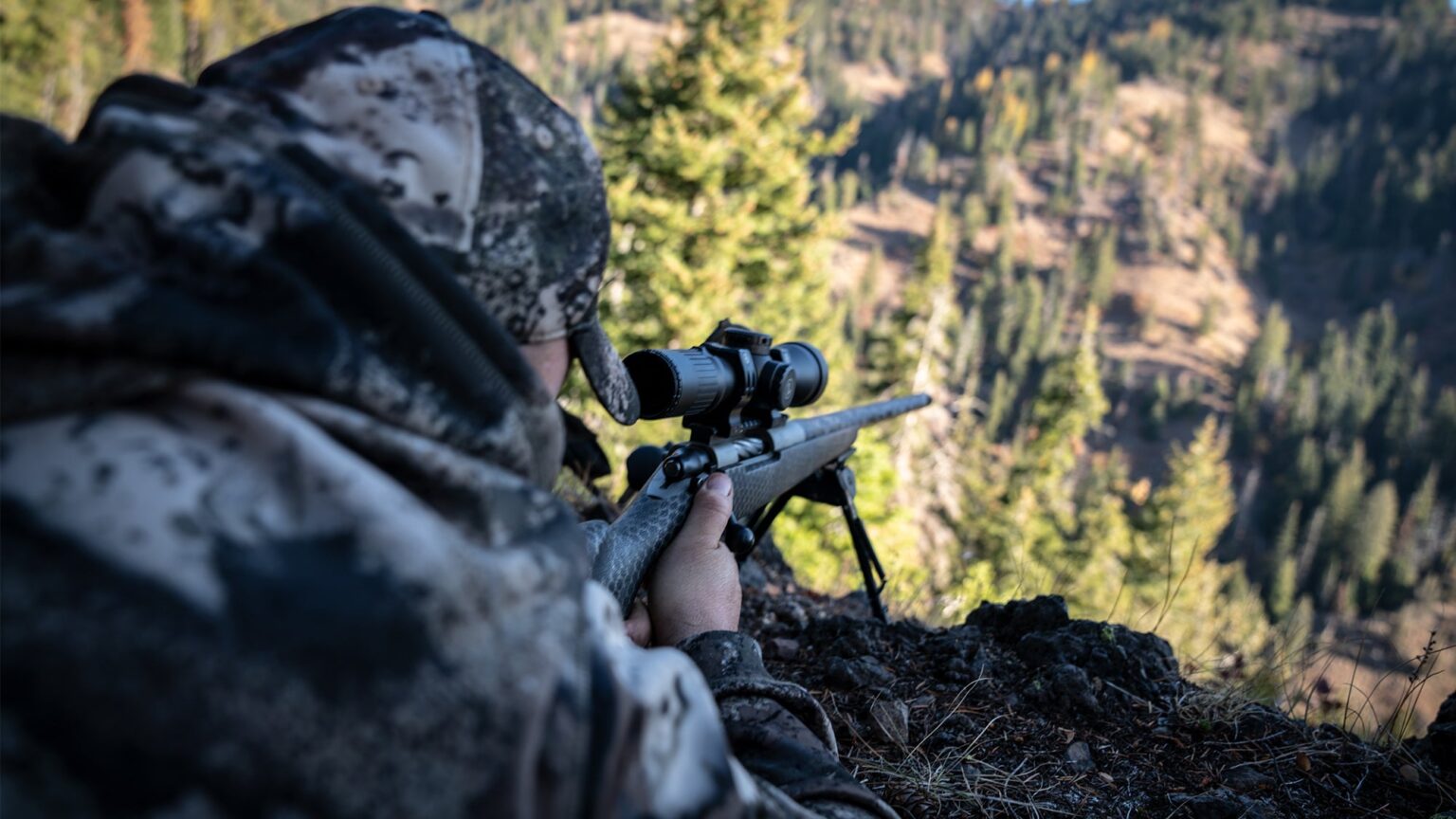
Wobbly shooters can get steady with the help of tools like rear bags, bipods, and tripods. When I was at CR2’s Mountain Rifleman course, we spent hours in the field using these tools to steady ourselves on everything from boulders to tree branches. We timed how quickly we could put the tools into action, and we did dry-fire practice from those positions before putting rounds downrange. It’s a little like a game of Tetris for your body, rifle, shooting aids, and the environment around you. You need to find the combination that supports your rifle and makes your crosshair stop wobbling.
Another key to tame wobble is to simply relax a little. Shooters often death-grip their rifles, causing them to shake even more. Instead, you should try to find a happy medium with enough pressure to steady the gun and still absorb recoil to stay on target after the shot.
Don’t Be Pressured Into Long Range Hunting
If you’re with me so far, you know how far you can shoot, based on your abilities and your cartridge’s abilities. You also know a bit about building positions to help you shoot farther. But how far you can shoot has nothing to do with how far you want to shoot. No matter how much someone is whisper-yelling in your ear to pull the trigger, you don’t have to.
Shooting game from one mountain top to the other doesn’t trip everybody’s trigger. You might want to sneak a little closer so you’ll be even more certain that the shot you’ll take will be a good one. Or you might want to get closer because stalking is more exciting to you than sniping.
Whatever it is, your reasons for shooting an animal should be personal. It shouldn’t have anything to do with what everybody else is doing. Don’t let anyone push you out of your comfort zone or take away what you enjoy about hunting just because you’re holding a rifle that’s capable of shooting to the horizon.
Related: The Best Long Range Rifles, Tested and Reviewed
Long Range Hunting Ethics
Is long range hunting good or bad? It’s impossible to say, because it depends on the abilities of individual shooters. It’s bad when a person’s desire to go long causes them to shoot farther than they should. On the other hand, if better equipment, a better understanding of ballistics, and more practice allows you to stretch things out a little, more power to you.
It really boils down to an honest assessment of how good of a shot you are. Shooting ability is not something you get from birth. It’s also a perishable skill that needs constant upkeep. Personally, with the help of an expert spotter, I’ve made hits out to 1 mile on steel. Does that mean I’m a sniper? Of course not.
I’ve met shooters who no doubt could hit an animal at almost any feasible distance 85 to 90 percent of the time. But they’re outliers and very well-trained. Top-level competitive riflemen shoot so much they burn multiple barrels out a year. Snipers shoot the same round day in and day out and keep meticulous log books. They know exactly how their bullets will perform under any conditions, and sometimes they still miss. Ask either of them, and they’ll say judging the wind is the most difficult part of long-range field shooting, and it takes years to master. The average hunter or shooter with a precision rifle (and I’d include myself in this group) is like a Sunday driver in a Formula 1 car. Sure, you can go fast, but you might be all over the road.
Hunting ethics are a personal code. It’s ultimately up to you whether you’re going to pull the trigger or not. It’s also up to you to be honest about your abilities. Take time putting rounds downrange to figure this out, and don’t be sad if you’re not the next Chris Kyle. At the end of the day, most will agree, hunting is not the time to get lucky with a trick shot or test out a math problem. That’s what the range is for.
But long-range shooting is not bad for hunting. The skills you’ll learn shooting to 1,000 yards and beyond can be used at any distance. For those interested, I’d suggest getting involved with something like NRL Hunter, CR2’s Mountain Rifleman course, or Chris Way’s RifleKraft program. With these experiences, you’ll learn things like creating better shooting positions and absorbing recoil, so you can watch how an animal reacts to your shot, and you’ll have a chance to test out your abilities in realistic environments. Practicing at long range makes shots at shorter field ranges easier. Combine that with a sober understanding of your abilities, and you’ll be a lot more deadly in the woods.
Read the full article here