


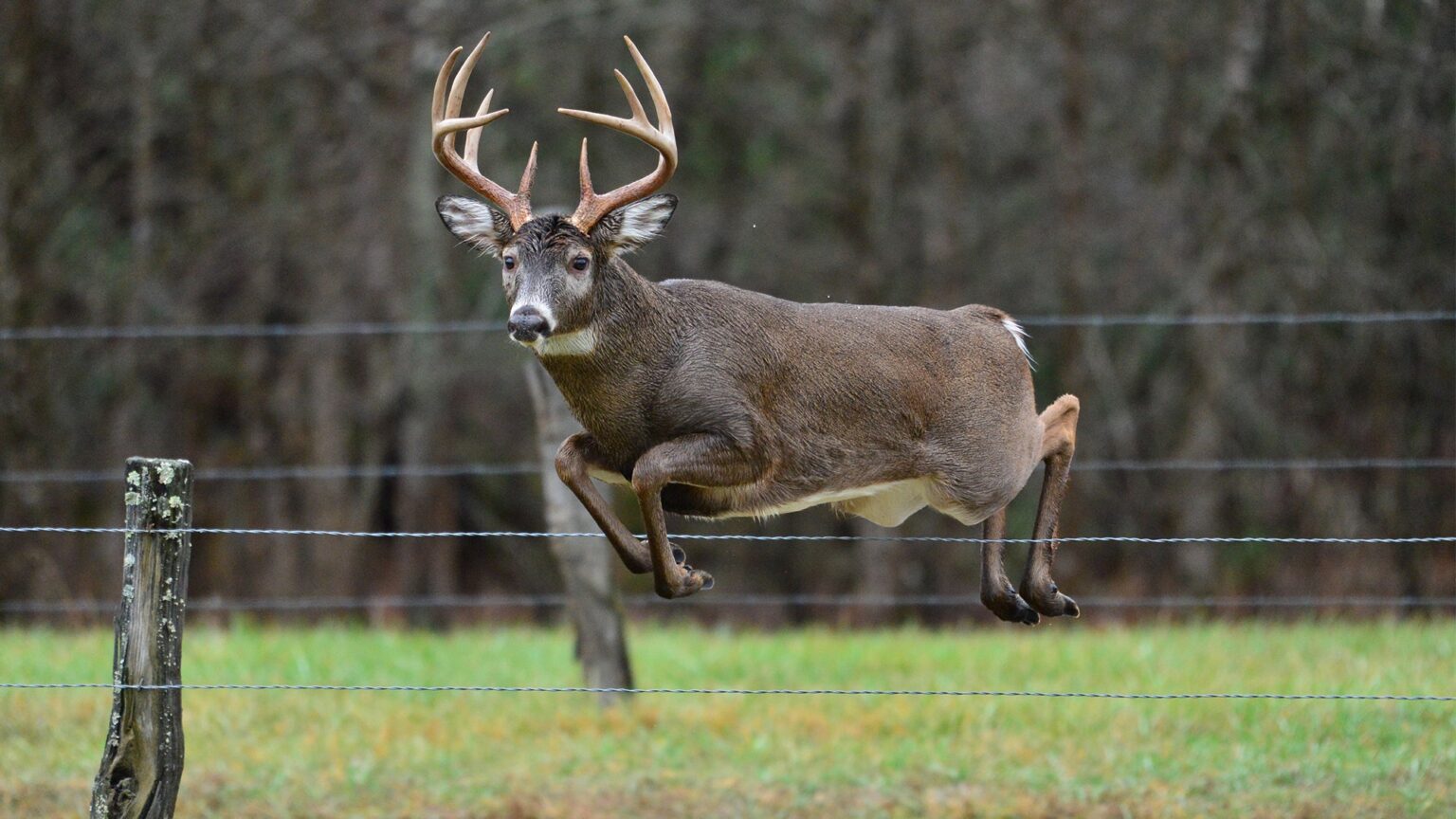

Most of us know from first-hand observation that whitetail deer are impressive leapers and bounders, but do you know just how high a deer can jump? Given the deer’s overall athletic ability (whitetails can run 30-plus miles per hour for a short distance, execute an almost 90-degree turn in full flight, and have been documented swimming distances over 2 miles), it should come as a shock to no one that even without a running start, a whitetail would beat most Olympic high jumpers.
Most experts agree that a whitetail could clear an 8-foot high-jump bar (or garden fence) from a standing start without too much difficulty. Give that same deer a running start, and you can add 25 to 50 percent to that height, making a 12-foot leap entirely possible. It should be noted that a deer probably has to be motivated by danger (a coyote, a vehicle, a gardener running after him while shaking a hoe) to clear the higher obstacle, but we’re still talking about serious leaping ability here.
How High a Fence Do You Need to Keep Deer Out?
Know how high a deer can jump is more than just a fun fact; it’s also useful information for anyone looking to keep deer out with a fence. Whether you’re a gardener trying to keep deer out of your veggies, a highway department working tired of cleaning up carcasses, or a hunter trying to keep summer deer from devouring you food plots beforo the fall season starts, erecting a 7- to 8-foot fence will discourage all but the most determined deer. Even though they’re capable of jumping higher, deer will typically seek the path of least resistance and will avoid a fence of this height if there are other foods available. Some fence-builders claim that angling the top of a fence slightly toward the anticipated intrusion will create the illusion of an even-higher obstacle and further discourage deer.
Of course, building a fence is hard work and not cheap. That’s why it’s useful to know that there are other ways to keep deer out of gardens or food plots that have nothing to do with how high a deer can jump. A bad odor can be just as effective at keeping deer out as metal, wire, or wood. A product called PlotSaver, for example, is nothing more than a single ribbon of fabric held up on simple fiberglass posts, at a hight of under 4 feet. But once you spray it with an egg-smelling liquid concoction, deer will largely stay away. (You can read a full review of PlotSaver deer fence system here.)
The Real Question is: High Will a Deer Jump?
After years of hunting deer around fences and other obstacles, I believe that when it comes to hunting deer, it’s far more important to understand what a whitetail wants to do rather than what it’s capable of. While incredibly athletic, whitetails are no different than dogs or cats or people; they don’t want to work any harder than they have to and will invariably find the easiest way to get from point A to point B. You can exploit this when hunting around fences. Wherever you find a low spot or a gap in a fence, you can bet you’ve found a good crossing. What’s more, on your own property, or with permission, you can create a low spot or gap in a spot that give you the advantage. For example, I asked a landowner recently if could use a bungee cord to lower the top wire of a high-tensile a few inches. He agreed, I did so, and it funneled deer that were hopping the fence basically anywhere in a 60-yard stretch down to a single crossing—which, of course, I’d chosen because there was a great stand tree within an easy bowshot of the spot.
Create an Obstacle to Steer Deer
Of course, you can use the same process in reverse. You can create an obstacle that deer won’t want to jump to steer them toward a stand. Just this spring, I hung a stand in a spot with trails that crossed a ravine. Unfortunately, one of the best crossings was just out of bow range from the stand tree I’d selected. Rather than wish for luck or resign myself to watching too-distant deer use this crossing, I simply blocked it; I fired up the chainsaw, cut some big limbs off a nearby oak blowdown, and dragged them between two trees that grew on opposite sides of the trail. The tangle of limbs I created has steered deer away from this once-popular route and toward a crossing that’s only 20 yards from my stand tree.
And here’s the thing. My obstruction is, at most, 4 1/2 feet high—a height that any healthy deer could clear without breaking a sweat, especially if spooked or being chased by a coyote. But a buck, walking normally and going about his business, will take one look at a 4-foot wall of brush in his path, sigh a bit, then look for an easier route. And if things go well, I’ll be in that stand on a November morning, waiting for that lazy buck to take the short detour that will place him in easy range of my stand.
Read the full article here