




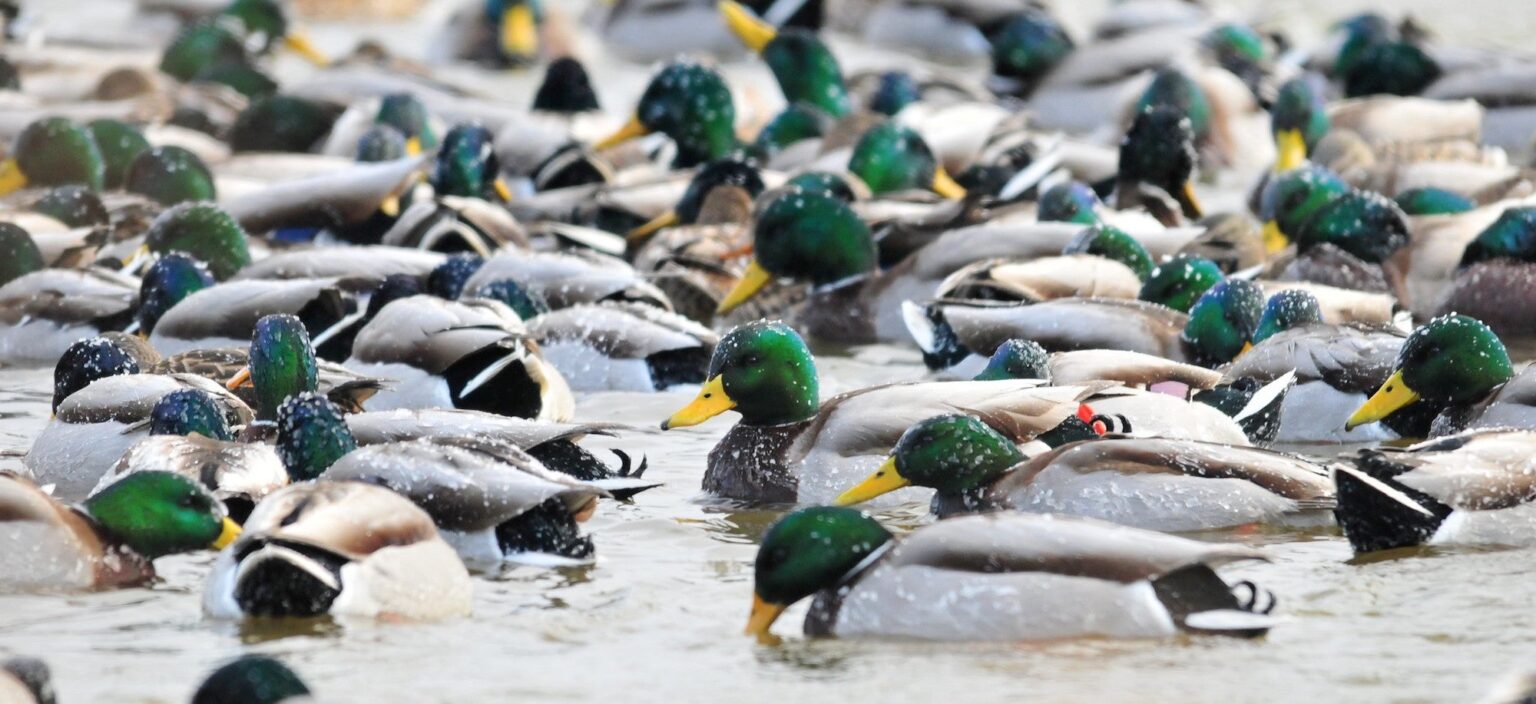

The U.S. Fish and Wildlife Service published its final rule setting frameworks for the 2023-24 migratory bird hunting season late last week. The announcement followed months of public comment and consultation with the four Flyway Councils, and it includes some good news for waterfowlers on the East Coast. The bag limit for Eastern mallards in the Atlantic Flyway is going back to four birds, only two of which can be hens.
This welcome change comes roughly five years after the federal agency cut mallard limits in half across the flyway. In its 2018 decision, which went into effect during the 2019-20 hunting season, the USFWS cited overall declines in the Eastern mallard breeding population as the primary reason for the change. Long-term survey data showed bird populations in the flyway peaking around 1999, and then steadily declining by around 50 percent between 2000 and 2017. Harvest data from the 17 states that make up the Atlantic Flyway showed similar declines.
The reasons for the decline were harder to nail down. Researchers pointed to shifting migration patterns, and the fact that Eastern mallards are harder to count because there are two separately surveyed populations: ducks that nest in Maine and eastern Canada, and those that nest in the eastern U.S. from New Hampshire down to Virginia. There was also a lack of historical data because mallards aren’t native to the Eastern Seaboard and haven’t been studied as closely there as they have in the other three flyways.
Many waterfowlers weren’t happy about the bag reduction. Some wondered if officials had a decent grasp of Eastern mallard populations and called for more research. A few years later, as some of this research bore fruit, some of those same hunters began to ask the question: Was this bag limit reduction even necessary?
“We were pretty vehemently opposed to the two-bird limit,” Delta Waterfowl’s chief policy officer John Devney tells Outdoor Life. “I don’t want to be unnecessarily taking opportunity from hunters when it isn’t supported by the best available science.
“But this is an example of learning, understanding, and reflection,” Devney continues. “Improvements to [the USFWS’] model and improvements in data have gotten them to the understanding that this is a sustainable strategy. It’s not like they went out and tried to get to four. This is just what the science suggested was a reasonable pathway.”
The Role of Eastern Mallards in Setting Hunting Regs
Pat Devers is the Atlantic Flyway representative for the USFWS. He paints a fuller picture of how Eastern mallard management has changed since the late 1990s.
At that time, Devers says, the USFWS as still using mallards as the baseline duck species that the hunting season frameworks revolved around. (Mallards always have and still do “run the show” in terms of setting season length and bag limits in the other three flyways, says Devney.) But as Eastern mallards continued their decline through the early 2000s, the agency started to rethink the way it managed ducks in the Atlantic Flyway.
“There was always some concern that Eastern mallards didn’t really represent all the birds that were being hunted from Maine to Florida. And when you coupled that long-term concern with a more recent concern that something was going on with Eastern mallards, we figured it was a good time to change how we set hunting regs,” Devers says. “So, we made a switch to what we call a multi-stock adaptive harvest management framework. It considers the status of ringnecks, wood ducks, goldeneyes, and green-winged teal—and then we set hunting regulations based on the status of those populations.”
This new framework strategy, which the USFWS formally adopted in 2018, meant that Eastern mallards would now be managed individually in the Atlantic Flyway with their own separate harvest strategy.
“What we really needed then was an interim strategy that would allow us to set a good bag limit for mallards that we thought was sustainable, and then we could let the season length be set by the multi-stock framework,” Devers explains. “So, we did a simpler analysis that we call a potential take level analysis, and that told us we could have a two-bird daily bag limit for a 60-day season … at least until we could get a new harvest strategy developed.”
Better Science, More Birds, or Both?

Developing a new strategy took time. And over the next five years, the USFWS homed in on the science surrounding Eastern mallards and re-built its harvest models to bring in more available data. This includes the waterfowl surveys that are conducted annually in the Atlantic Flyway—and are a joint effort between more than a dozen U.S. states, the USFWS, and the Canadian Wildlife Service—along with data from the Harvest Information Program and pre-season banding, which together help managers estimate overall harvest rates.
They also worked in another component: post-season banding data. This requires state agencies to trap and band mallards after hunting season ends, and it gives them a better idea of mortality levels during the rest of the year.
“The other major advancement is what we call an integrated population model. This allows us to put all this data into our model at the same time to get the best estimates of survival,” Devers says. “By sharing info across all those different parameters, it’s kind of like a tug of war. If our population data shows an increase, but our survival and harvest rate and reproductive rates don’t show as much of an increase, it’s going to balance between all those data sets to settle on the best estimate.”
Importantly, this new management framework—and the model that supports it—would allow the USFWS to adjust its harvest strategies annually in response to what the population surveys showed each spring. And in 2022, when the Atlantic Flyway Council officially adopted the new framework, Devers says something fortunate happened: They found more birds.
“Luckily when we got back up after COVID and conducted surveys last spring, that mallard number in the eastern U.S. and Canada had popped up to a pretty high number,” he says. “It was our highest count since 2012. That’s what is allowing us to go back to the four-bird bag limit this year.”
Devers adds that in the years to come, the USFWS will continue to rely on the new management framework to set individualized bag limits for eastern mallards, while allowing the other East Coast ducks to drive the overall season length and regs. He calls the four-bird limit over a 60-day season the “liberal” option, as opposed to the more “moderate” two-bird limit and the “restrictive” one-bird limit.
Read Next: How Far Can Ducks Migrate in a Day? About 2,000 Miles
“When populations are good and numbers are high, you’re going to be able to have that four-bird bag limit,” Devers says. “But when they’re low, we’re either going to move into the moderate or restrictive package.”
For duck hunters up and down the Atlantic Flyway, this means that each year’s waterfowl survey will play an even bigger role in managing Eastern mallards. And with the 2023 survey showing a continued decline in mallard numbers across the four flyways—along with a four percent decline in Eastern mallard populations compared to 2022—there’s a chance that mallard bag limits could be reduced again in the future. All we can do is take it one season at a time and let the data dictate the rest.
“We manage these populations with the best available science, and that’s something that every duck hunter should be incredibly proud of,” Devney says. “But science can always improve, right?”
Read the full article here