




We may earn revenue from the products available on this page and participate in affiliate programs. Learn more ›
Vying with the Remington 870 for the title of “most popular shotgun ever made” the Mossberg Model 500 is a masterpiece of industrial design. Before the Model 500, O.F. Mossberg—then of New Haven, Connecticut—was known mostly for its .22 rimfires, including the Model 42 and 44 rifles used by the U.S. military during World War II as marksmanship trainers. Mossberg also made a few bolt-action shotguns and one very strange-looking pump with a full rifle stock and box magazine: the Model 200. When comparing the Mossberg 500 vs 590, we have to first look at how the 500 blazed the trail.
In 1960, the company moved to a new, bigger factory in nearby North Haven, where it cut most of its inventory to make room for a new gun that they believed would be the company’s future. The Model 500 pump was introduced in 1961. Mossberg’s bet paid off, as the gun became a runaway success. The 500 was designed to undercut every other pump on the market, and that included the Remington 870, which in turn had been designed to outcompete the Winchester Model 12 and Ithaca 37 in price. Unique among pumps of the time, the Model 500 had a thumb safety on top of the receiver, accessible to left- and right-handed shooters alike.
Like the 870, the Model 500 featured stamped, investment cast and pressed parts to cut manufacturing costs. The gun also had an alloy receiver unlike the steel frames of the 870, Model 12 and Ithaca 37. While alloy receivers are common now, they were viewed with suspicion in 1961, especially on a pump gun made for hunting in tough conditions. Yet, the Model 500 had the last laugh. It turned out to be the gun that could made the most inexpensively and still offer outstanding ruggedness and reliability. In the 2000s, the 870 and the 500 engaged in a race to the bottom to see which gun could be made at the lowest price and still work. The 870s from that early 2000s era are horrible. It undersold and outlasted the Winchester Model 12 and the Ithaca 37, which is still made, but as a high-end/low-volume gun. Eleven million units later, the Model 500 is still made today, and while it faces competition from inexpensive Turkish guns, it remains a great, reliable buy.
Along the way, the gun did lose the jeweling on the bolt, and the metal top safety was replaced by a plastic part, both in the name of cutting costs. On the other hand, while the originals had only a single-action bar connecting the slide to the bolt. Remington’s patent on twin-action bars expired in 1970, and Mossberg added a second to the Model 500 to prevent twisting and binding when the user cycled the gun.
Birth of the Model 590
The Model 500 was a hit with budget-minded hunters, as well as law enforcement. The first Model 500s designed specifically for non-sporting use were 18 1/2-inch barreled riot guns that didn’t appear in the consumer catalog but were offered to law enforcement in 1965, just four years after the original was introduced. Those earliest guns were used by private contractors operating armored trucks. Many police departments adopted the gun, both the original 18 1/2-inch version and a 20-inch barreled gun that could be used to launch tear gas. By the mid-70s, Mossberg was selling a lot of Model 500 riot guns, both to police and to civilians, and the “Persuader” line had expanded to five different models. The “Cruiser” line followed in 1981, and the first security/field combo set, with an 18 1/2- and a 28-inch barrel, came out in 1983.
Beginning in 1979, Mossberg began providing Model 500s to the military as the 500 MILS. The guns passed the stringent MIL-S 3443D requirements of firing 3,000 rounds of buckshot with no more than 0.1-percent malfunction rate, heat and cold endurance tests, strength tests, drop tests and more.
When the military adopted new standards with MIL-S 3443E in 1986, Mossberg was already at work on a new version of the M500 to meet its requirements. The revised military specs did not permit any plastic parts, so the gun had a metal safety and an alloy trigger group. In addition, the Navy requested barrels with thicker walls to better withstand banging into shipboard steel hatches and bulkheads. The most obvious difference, however, was the magazine cap. Military requirements demanded a “clean out” cap that enabled easy access to the magazine tube for maintenance. The Model 500 features an integral takedown screw in the barrel ring that fits into a threaded hole in the closed magazine tube. The Model 590 has a separate magazine cap and an open-ended tube (the spring is held in place by a sheet metal spring retainer). The 590’s system makes it very easy to take the gun all the way down in the field and clean out the mag tube, which can collect a lot of field debris.
The 590 has served with all branches of the armed forces and with the militaries of several U.S. allies and partners. Even as other designs replace it, the 590 remains in use as a breacher and in law enforcement. There are also several models on the civilian market.
Mossberg 500 vs 590
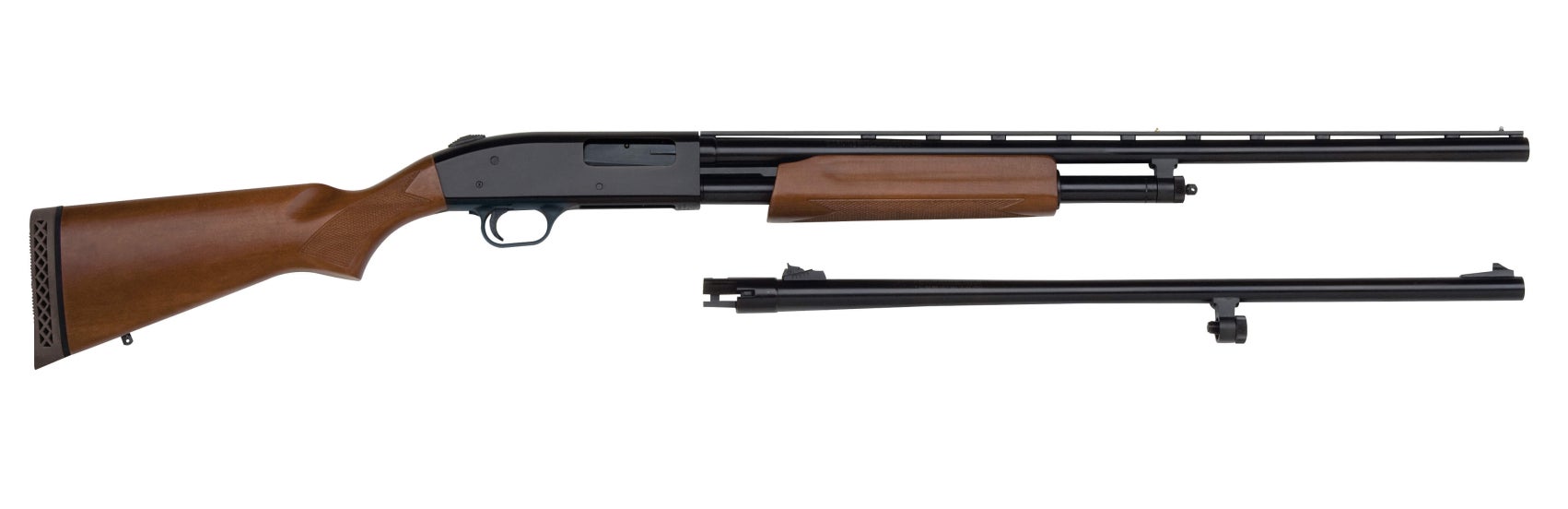
The simplest way to differentiate between the Mossberg 500 vs 590 is to say that the 590 is a tactical/defensive shotgun only, and the 500 is both a field and tactical/defensive gun, which, broadly speaking, is true. Currently, the Mossberg catalogs some 34 Model 590s as well as one 14-inch barreled model available only to holders of Class III licenses. The 590 has recently made in 20-gauge and .410 models and the “S” 12-gauge version is made to operate with both 2 3/4- and 3-inch shells as well as with 1 3/4-inch MiniShells that often don’t cycle in other pumps.
Meanwhile, it’s virtually impossible to list every variant of the Model 500 ever made. It’s been made in all gauges but 10 and 28, and in special configurations including trap models, a bullpup, youth guns, rifled-barrel slug guns, muzzleloaders, turkey guns, general-purpose field guns and versatile multi-barrel combo packs. Mossberg currently offers over 40 different models and combo packs including hunting, tactical, youth, deer, and turkey guns.
Forced to choose between the two, I’d take a M590 if I needed a defensive shotgun. I prefer the heavier barrel contour, the traditional magazine cap and the maintenance advantages it offers, and the metal safety. As a hunter, however, what I would really like is a field model 590, as its advantages would carry over just as well into the field as they do in tactical, home-defense, and military applications. I would definitely change out the plastic safety to a tactical, aftermarket model (I did exactly that with my Model 835 turkey gun, which combines features of both guns with some of its own) if I were to buy a Model 500 for hunting.
Both guns are very reliable, as evidenced by their military and law enforcement records, and both remain affordable to almost anybody who wants one. And, chances are good you’ll find at least one Mossberg pump in almost anyone’s gun safe.
Read the full article here