


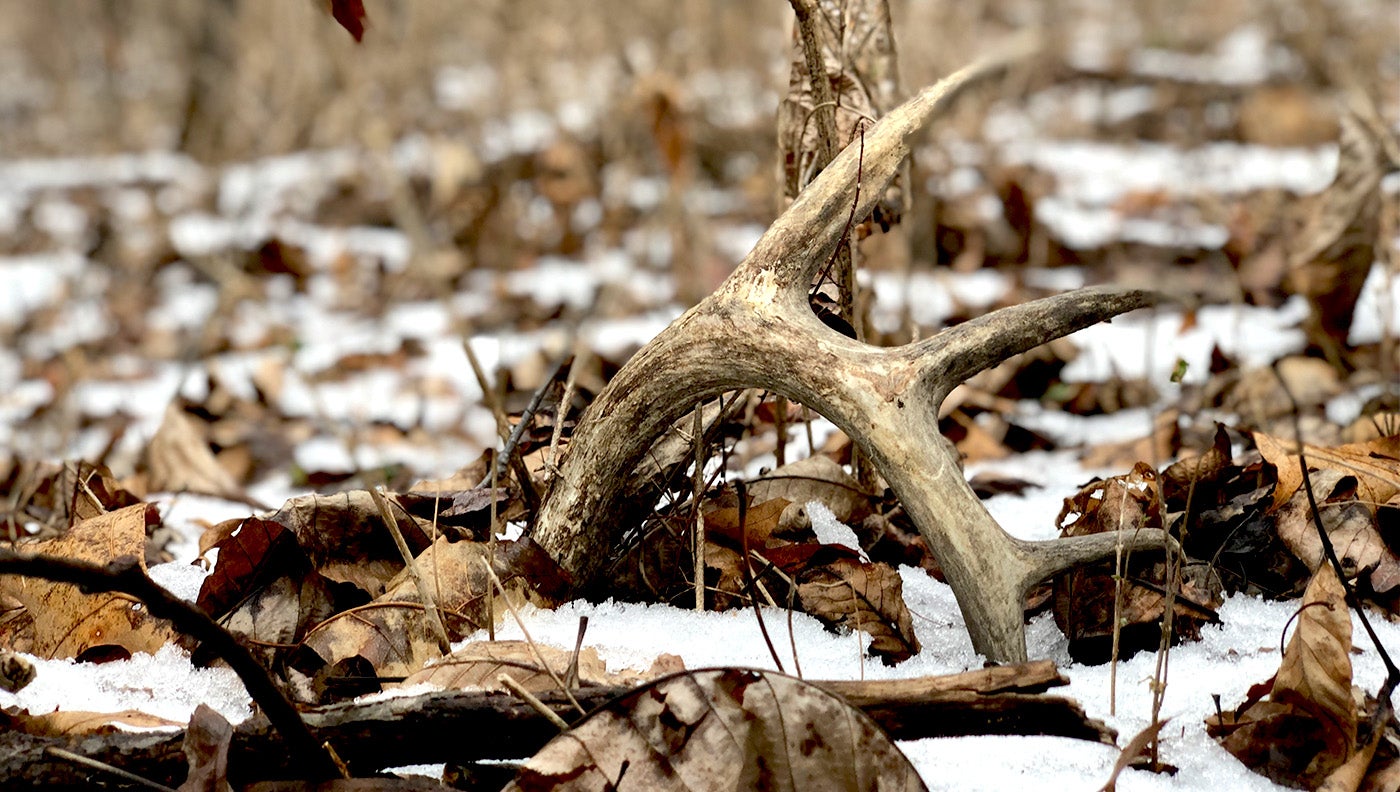

We’ve all got busy schedules, so when it comes to maximizing our shed-hunting efforts, it’s natural to ask, When do deer shed their antlers? and want as precise an answer as possible. The problem, of course, is getting the deer to work with our schedules. Every year, people share trail-camera pictures of bucks shedding their antlers in December, accompanied by a flurry of theories as to why such “early shedding” happened. On the other end of the spectrum, I’ve seen plenty of bucks carrying their headgear strong into March. So, when is the absolute best time to go looking for sheds? Is it even possible to really pin down an answer to the question, When do deer shed their antlers? To find out, I spoke to a couple whitetail experts.
When Do deer Shed Their Antlers, Generally?
The general answer to when deer shed is anytime from late December and into April in some cases. But we can safely narrow that down a bit for different parts of the country. Because the rut runs much later is parts of the south, and because southern deer don’t have the same weather-related stress as northern deer, the former tend to shed a little later in the spring. In the mountain west, mule deer typically shed from January into March, but elk (which we will bring into the mix here because shed hunting for their antlers is so popular) shed later, typically from March into April. Here’s a general breakdown of shed timing across the lower 48.
Why Do Deer Shed Their Antlers?
Let’s start by looking at the annual growth cycle of deer antlers. Doug Roberts is owner of Conquest Scents Deer Farm and has literally been living with deer for decades and observing this process. According to Roberts, a lack of testosterone during summer, triggered by photoperiod, causes a buck’s antlers to begin growing. A whitetail buck needs antlers for several reasons, and the bigger the better. Antlers help a buck establishes breeding rights and defend his territory. Once late summer hits, a buck’s testosterone levels rise, which constricts blood flow to the velvet-covered antlers until, typically in early September, the antler hardens and pulls away from the velvet, causing an itchy sensation that encourages bucks to rub that velvet off. From this time through the rut, buck testosterone continues to rise, keeping the antlers securely fixed to their heads, where they’ll stay as long as there are does coming into heat. But once breeding is done, bucks simply do not need their antlers anymore. With daylight or photoperiod increasing, their body will decrease testosterone production and shedding will begin.
When Do Deer Shed Their Antlers? Key Factors
When conditions are normal, the annual antler drop will take place from January through March in most states and is fairly consistent from year to year. But there are a number of factors that can cause deer to shed early or late. One is health. According to Roberts, if a buck has a bad injury, his body may go into ketosis to save itself and swiftly decrease testosterone levels. This will cause a buck to shed early, possibly in December or earlier. Another factor is age. Roberts says that when some bucks reach age 6 or older, they can become less active in the breeding cycle. Essentially, he says, “they get too old for this,” and not needing their antlers late into the breeding cycle, they may drop them early.
Major stress on a deer herd can also cause bucks to shed early, according to Kip Adams, National Deer Association’s Chief Conservation Officer and wildlife biologist. A week-long cold snap won’t do it, he says, but something like a drought followed by harsh winter conditions and nutritional depletion could cause an early shed across the board in a given area.
On the flip-side, good nutrition and moderate weather conditions can create a later antler drop, as can a prolonged rut. If does in a certain area are still unbred past the first rut, or if yearlings come into estrus a month later during the second rut, this will keep a buck’s testosterone high, and keep his antlers tightly affixed for breeding purposes regardless of age. Both of these factors can play into those March (or later) sightings of antlered bucks. Finally, according to both experts, individual genetics as well as a regional “timestamp” of sorts, can play a role.
Related: The Biggest Whitetail Shed Antlers Ever Found
When Do Deer Shed Their Antlers, by Region?
Even with the factors above and the variability they can inject into the timing of the annual antler drop, Adams says that you can make some regional generalizations about the best time to look for cast antlers. Deer in the northwoods of Maine, for example, are simply not on the same basic schedule as those buried deep in the swamps of Mississippi. It’s always important to pay attention to specific factors in your area, but here’s what you can generally expect to see from region to region within whitetail range.
Northeast Antler Drop
January to March: You can expect older bucks to shed before smaller, younger deer. Here ruts tend to be quicker, with few fawns coming into estrus their first year. Bucks therefore don’t typically need antlers much beyond the first rut, and will therefore tend to drop a little on the earlier side.
Midwest Antler Drop
January to March: Plan on older bucks carrying longer here compared to the Northeast, however, due to more doe fawns reaching that critical 70 to 80-pound mark, which allows them to come into estrus a month after the first rut, keeping buck testosterone high and antlers on.
Southeast Antler Drop
February to Late March: A wider range of rut dates, often stretching into into December and January, keeps antlers on longer in the Southeast. Not months, but weeks. Expect shedding to extend a little later here compared to the Northeast and Midwest. Keep in mind, too, that the southeast has sub-regions when it comes to rut dates that you need to factor into the equation.
When Do Deer Shed Their Antlers? The Best Time to Hit the Woods
So, now that you know when deer typically shed in your area, all you have to do is apply a little woodsmanship to figure out when to go looking for the white gold of the woods. To that end, our experts offer a tip and word of caution. Roberts emphasizes using trail cameras on travel corridors to give you exact timelines. When you start getting multiple pics of half-rack bucks, it’s time to get serious about finding some sheds. And keep a journal of your observations. This can help you hone in on general shed timing in your area and even particular deer from year to year. Adams is as enthusiastic a shed hunter as anyone, but he also advises caution when it comes to venturing into the post-shed deer woods. Basically, use your head and don’t over-pressure deer when they have their lowest energy reserves (in March), especially if it’s been a harsh winter. After all, you want those deer to make it through to spring—and you want those bucks to grow nice, big antlers for the coming fall.
Read the full article here