


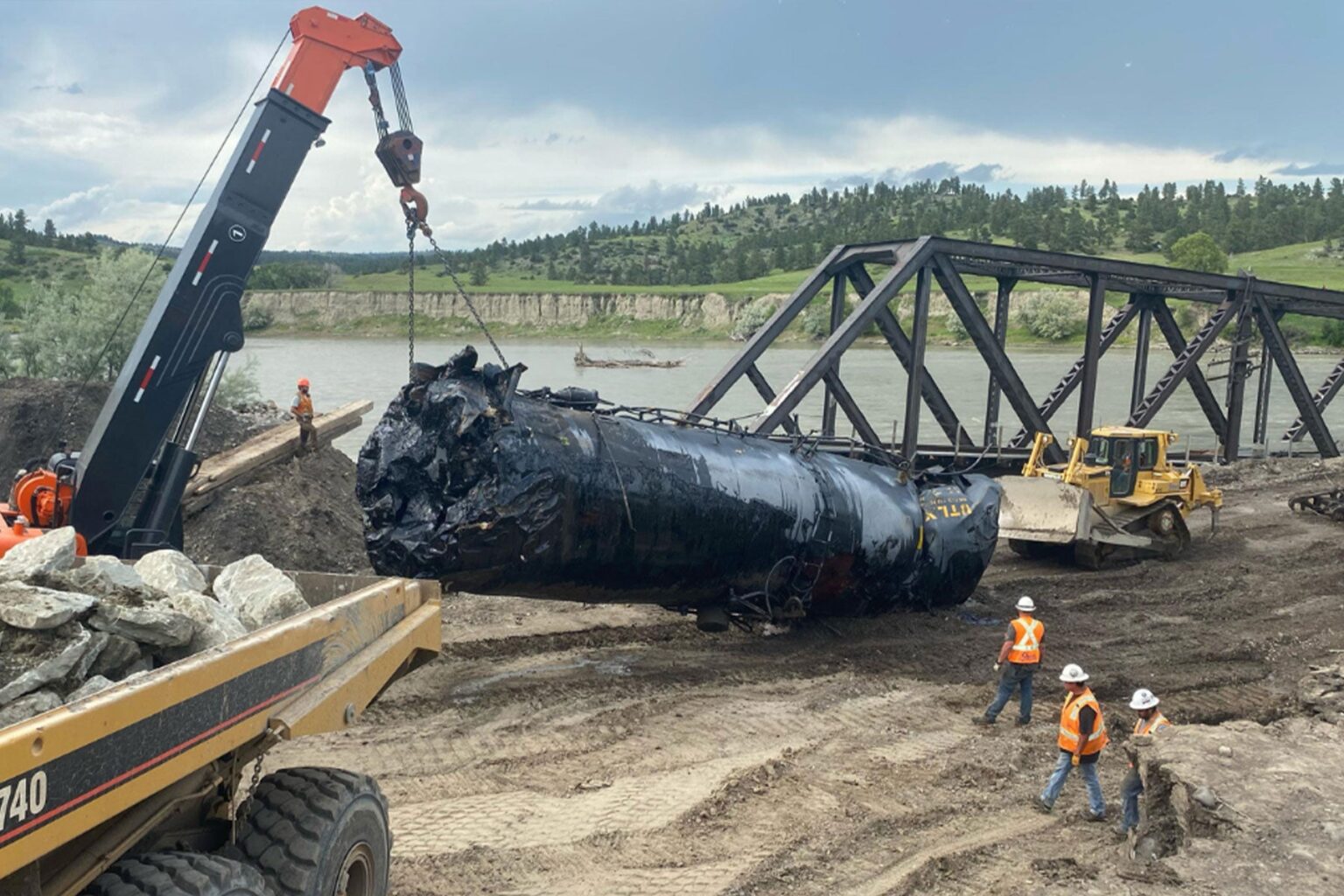

On June 24, 2023, a freight train carrying asphalt, molten sulfur, and other hazardous materials left the tracks on a faulty bridge spanning a section of Montana’s famed Yellowstone River. Ten of those cars entered the Yellowstone River that day, spilling an estimated 419,442 pounds of asphalt, and prompting Montana Fish, Wildlife & Parks to initiate an emergency river closure between the towns of Reed Point and Columbus. Now, FWP and two other Montana agencies have announced that the brown trout, rainbow trout, mountain whitefish, and other species that call the river home are no longer fit for human consumption.
In a press release issued yesterday, FWP said that it tested trout, suckers, and whitefish both up and downstream of what’s being called the Stillwater Train Derailment site by the U.S. Environmental Protection Agency (EPA). “Multiple [fish] species showed levels of various PAHs high enough to warrant an advisory to avoid all consumption,” the press release states.
PAH is an acronym that stands for polycyclic aromatic hydrocarbons. According to FWP, both the EPA and the International Agency for Research on Cancer have flagged the same types of PAHs that are now showing up in the flesh the Yellowstone’s fish as “possibly cancer-causing for humans.”
“This is not a routine test that we do,” Montana Fish, Wildlife & Parks spokesperson Chrissy Webb tells Field & Stream. “This testing was done as a follow-up to the train derailment. We were looking specifically for PAHs, knowing that that class of chemicals exists in products like asphalt.”
According to the EPA, approximately 230,000 pounds of asphalt were removed the Yellowstone River in the wake of the June derailment. That leaves nearly 190,000 pounds of toxic asphalt unaccounted for. Those cleanup efforts were spearheaded by the EPA in coordination with the Montana Department of Environmental Quality, Montana Rail Link, and other state agencies.
While the asphalt and other materials that spilled into the Yellowstone back in June could be a potential source of the recent PAH contamination in fish, FWP stopped short of definitely linking the elevated levels to the Stillwater Derailment. “We’re all very curious at this time,” says Webb. “This could be an accumulation of a variety of different sources. There is a pretty heavily traveled interstate that runs nearby this stretch of the Yellowstone, and we have a number of refineries further downstream of this stretch, so there’s a variety of potential sources.”
She says there are certain types of PHAs that can occur naturally in some rock formations as well—some of which are found in the Yellowstone River Basin. “We need to do additional sampling to hopefully pinpoint a source,” Webb says. “We plan to do some follow-up testing at sites significantly further upstream to get a better idea of the full extent of this PAH contamination.”
Read Next: Freight Train Derails Spilling Hundreds of Cases of Beer Into Famed Montana River
Some of the fish with elevated PAH levels were sampled more than six miles upstream of the derailment site. But trout in particular are known to migrate upstream during warm summer months, and there’s a possibility that those fish were exposed to the chemicals somewhere closer to the derailment area before being tested further upstream.
Webb says the stretch of the Yellowstone from the Indian Fort Fishing Access Site near Reed Point to the Highway 212 bridge in Laurel is still open to anglers. “It’s not closed in any capacity to recreational fishing,” she says. “We’re just advising that anglers don’t harvest and consume any species of fish caught in this stretch of the river for the foreseeable future.”
Read the full article here