




Who doesn’t love smallmouth bass? They’re aggressive. They thrive in still and moving water across the country. They smash a wide variety of bass lures and flies. Thanks to the popularity of professional bass fishing, the mighty “bronzeback” ranks high on the list of America’s favorite gamefish. This perception, however, has a way of clouding our ability to consider that in some cases, these lovable brawlers are unwelcomed guests.
Not long ago, biologists feared that smallmouths that escaped Lake Powell—an impoundment of the Colorado River—would establish in the Grand Canyon and quickly wipe out native and endangered species like the humpback chub. Of course, anglers didn’t get too fired up over the potential loss of a species with no rod-and-reel value. The same can’t be said for the province of New Brunswick in Canada.
Since 2008, officials have been trying to rid sections of the Miramichi watershed of invasive smallmouths, which is home to prized Atlantic salmon and wild brook trout. Just recently it was announced that eradication efforts were officially ending. The plan ultimately failed, which speaks to the fact that while eradication sounds like a fix for getting rid of fish we don’t want, it’s fraught with logistical issues that make it nearly impossible. Eradication also isn’t a novel idea, but even historically it was never very successful.
The Winner’s Circle
According to the story on the website of the Toronto Star, a team called the Working Group on Smallmouth Bass Eradication composed of Indigenous and non-governmental organizations abandoned efforts to rid the Miramichi of smallmouths due to a combination of pushback and the failure of the provincial government to take the lead on the project. Those involved in the effort leaned on rotenone, a controversial chemical that effectively kills everything in the water where it is dumped. It was originally believed that the chemical could be used in small pockets where the bass established without overly harming the watershed as a whole. Unfortunately, despite a few rotenone treatments, smallmouths were captured outside the area being targeted. Furthermore, the effort killed more Atlantic salmon than anticipated. When residents living on a lake targeted for treatment protested by blocking the group’s ability to operate, it was decided—in essence—that the smallmouths won.
They’re not the only victors. Myriad exotic and invasive species in Florida have won. Snakeheads and Asian carp have won. In cases like the snakehead—despite massive government efforts to eliminate them in Maryland and Virginia in the early 2000s, plus an edict that anglers should kill them when caught—they persist and are expanding their range. The un-winnable fight eventually led fish and wildlife agencies to simply accept them, even lifting catch-and-release restrictions and adding them as state-record qualifiers.
Efforts to blockade the expansion of Asian carp in the Midwest having been ongoing for years, and while some battles may have been won, the war has not. Long before any of these modern invasives, people went to great lengths in the 1930s to get rid of native alligator gar with a custom boat called the Electric Gar Destroyer that would zap the fish with high voltage. They did this not for environmental concerns, but more so because ignorance made people believe gar were monsters that would snatch children and livestock. Today, the range of these fish has shrunken significantly, but they’re still here.
Unless we’re trying to eradicate a species in a relatively small, closed system, expecting any group or agency—whether government funded or volunteer—to eliminate any fish from a larger system is impractical. But that doesn’t stop people from assuming we have the technology and manpower to easily do so.
Bounty Hunting
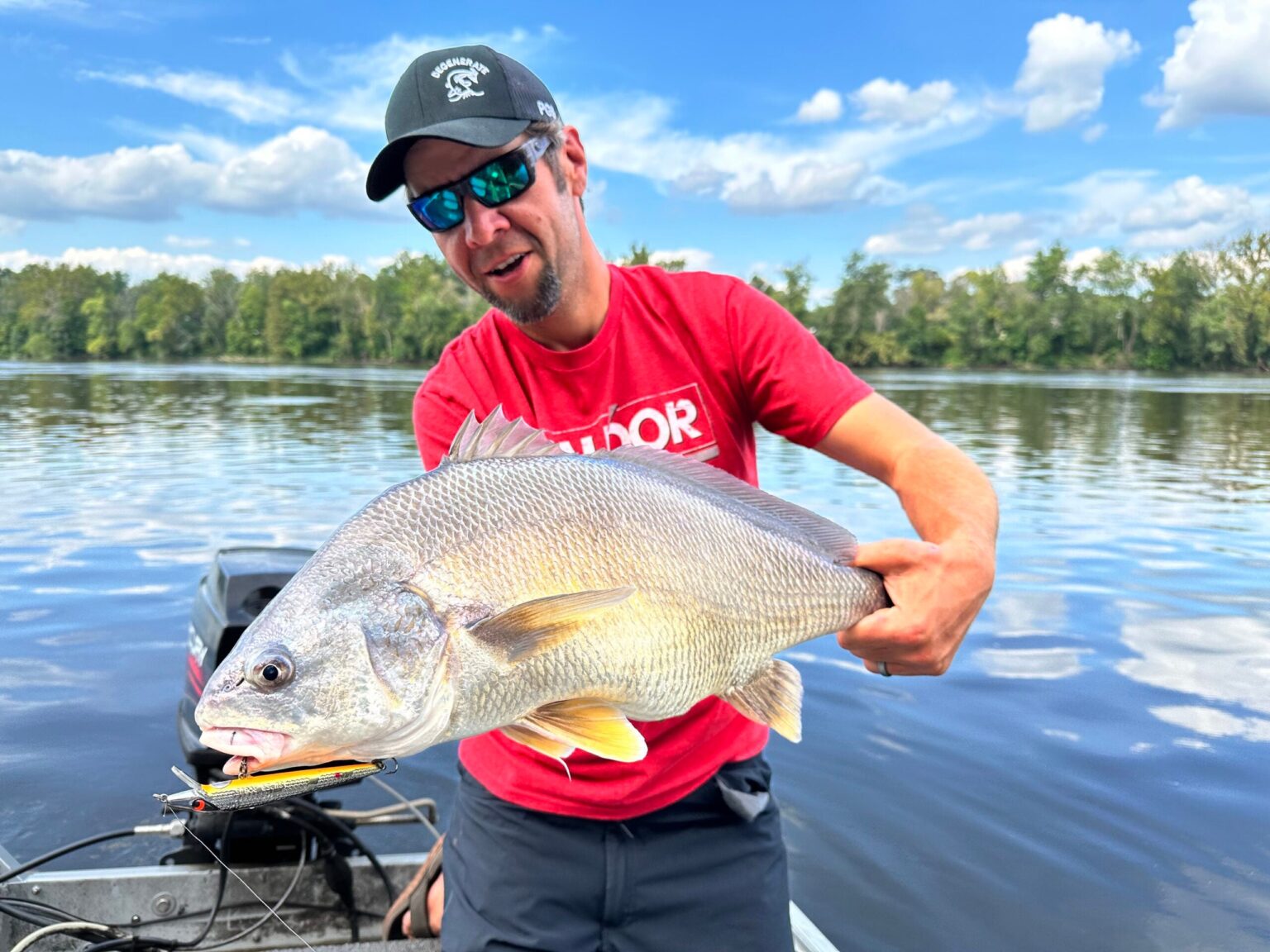
Just this past summer, I caught one of the most confounding fish of my life right in my own backyard. While smallmouth fishing on the Delaware River, my stickbait got walloped by something with a lot more energy and heft than a smallie. I was certain it was a flathead catfish or striped bass, but what I ended up landing was a mature freshwater drum.
I was flabbergasted because I do not live within in the native range of these fish. For weeks I researched and turned up very little information about drum in the Delaware. It wasn’t until I posted the photo on social media that I learned I wasn’t the only local angler that had been catching them. Within a few days, the Pennsylvania Fish & Boat Commission released a statement acknowledging the new presence of drum in the river, as well as the increasing population of invasive blue catfish. The drum pose a threat to native freshwater mussels, and the catfish pose a threat to much more like crab populations and native channel cat populations, but for now, the best PFBC can do is advise anglers to kill both if they’re caught. I’d suspect nothing more will ever happen, not necessarily due to a lack of desire, but due to a lack of resources.
The amount of time, energy, people, and money it would take to properly study these fish let alone come up with a reasonable plan to eliminate them is huge. Anglers might make a small dent if they heed the call to kill upon capture, but this hasn’t made much difference elsewhere.
Hundreds if not thousands of snakeheads are killed by rod-and-reel anglers and bow fishermen every year, yet the fish live on. Bounties have been placed on the heads of brown trout in parts of Arizona and on pike minnows in Oregon and Washington, but neither are close to gone. Between illegal transport and stocking of fish—a.k.a. “bucket biology”—and environmental shifts caused by climate change, in my opinion, we’re going to keep seeing more fish where they don’t belong. It’s unreasonable to expect someone to swoop in like the Ghostbusters and get rid of them sans haste.
While I do not believe is that these shifts and new species are a good thing, I do believe in making the most of the hand you’re dealt. Should there be freshwater drum in my home waters? No. Could their presence signal an environmental shift that, while good for them, is bad for local favorites like smallmouths and stripers? Yes. But none of it will stop me from soaking baits just for drum next summer because, love or hate them, they peel some drag. I also hear they’re tasty, so I look forward to a side-by-side comparison with some fresh snakehead fillets.
Read the full article here