



To the waterfowl enthusiast, the canvasback duck channels a swagger reminiscent of Elvis Presley, and not just because people in the music world called him “the king.” Brutally handsome, challenging on the wing, widely distributed, and excellent on the table, the canvasback epitomizes the very essence of diving ducks, just as the mallard symbolizes the dabblers.
Today, the canvasback is enjoying a slight resurgence in terms of population, but it wasn’t always this way. During the latter part of the 19th Century, market hunting, along with human encroachment and habitat loss and degradation, brought the estimated canvasback population below 500,000. Because of the bird’s famous value on the table, an estimated 10,000 canvasbacks died every day on Chesapeake Bay to supply wild game markets up and down the East Coast.
The end of market hunting, along with the 1991 nationwide U.S. Fish and Wildlife Service mandate prohibiting the use of lead shot for waterfowl hunting and the growth of conservation organizations have contributed to the canvasback’s incredible comeback.
Appearance and Vocalization
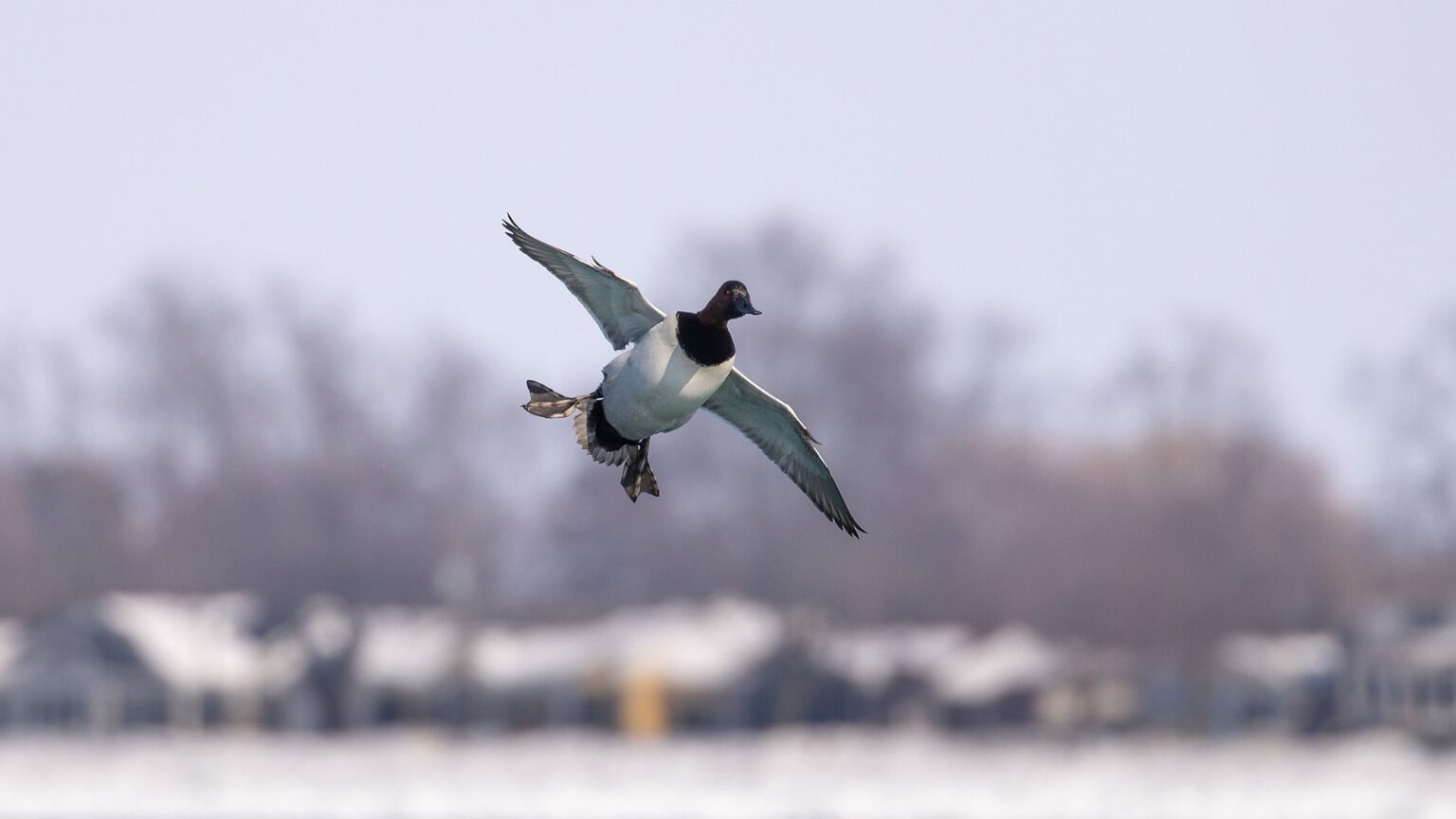
Once seen, the drake canvasback is unmistakable, both on the water and on the wing. His visual claim to fame is a high sloping forehead and bill—no other North American duck sports such an angular profile. The drake’s large head is a rusty-red, giving way to a jet-black chest and white or silvery-white back and sides. In flight, his profile is often obvious, as are his swept-back wings and extremely rapid pace, with one individual being clocked at over 70 miles per hour! Like most divers, the canvasback’s legs are placed well back on his body toward his tail, and he sits low in the water. Both drakes and hens are large ducks, often weighing 2.5-3 pounds.
The hen canvasback can best be described as drab, her head and chest a dull brown and her back and sides a lighter mottled gray, an overall color scheme that allows her to blend well with the marshland environment where she nests. Like her male companion, the hen canvasback shows the distinctive, radically sloped forehead and heavy black bill.
Canvasbacks aren’t especially boisterous ducks, with the drakes making a low, rolling growl, sometimes described as a croak, and the hens a softer mallard-like quack. Drakes are often heard making a repeated cooing sound during spring courtship.
Canvasback Duck Distribution
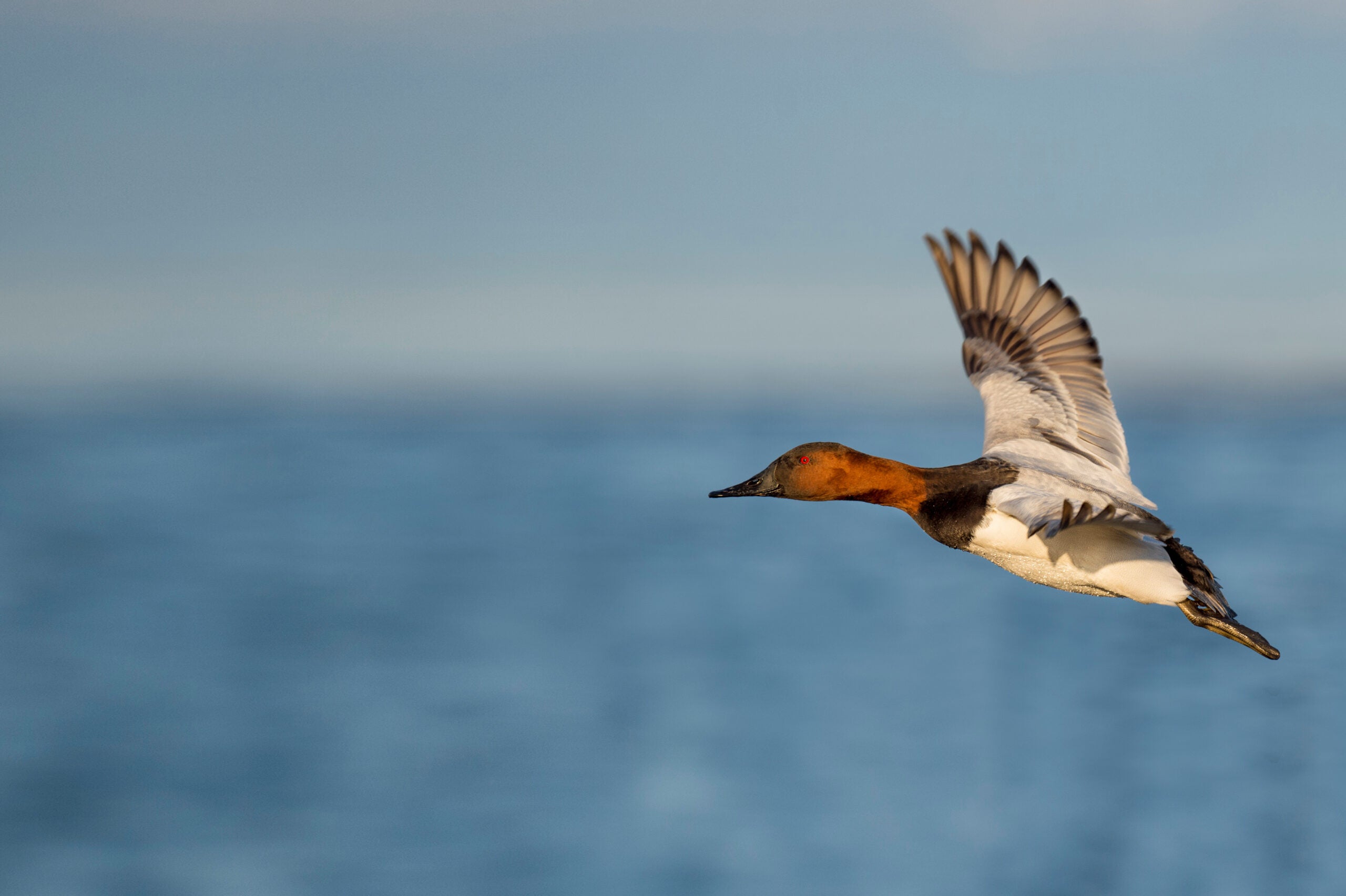
Unlike pintails, widgeon, and green-wing teal, canvasback ducks are almost exclusively a bird of North America, found in all four flyways. However, the bulk of the species calls the Central, Mississippi, and Atlantic flyways home. In the East, the famed Chesapeake Bay is a traditional stop-over for good numbers of canvasbacks, while the Mississippi River’s Pool 9 near Lynxville, Wisconsin, can hold upwards of 400,000 canvasbacks during the height of the migration in early December. In the Pacific Flyway, the Columbia River sees its share of canvasbacks, as does the San Francisco Bay. North Carolina’s Lake Mattamuskeet, part of the Mattamuskeet National Wildlife Refuge, is a prime wintering spot for canvasbacks.
Canvasback Duck Habitat
While canvasbacks are omnivorous, their diet primarily consists of vegetative material, namely wild celery. In fact, their love of wild celery, or eelgrass, lends itself to the bird’s scientific name of Aythya valisineria, as the Latin word for wild celery is Vallisneria Americana.
Though capable of diving to deeper depths, canvasbacks typically will search for their diet, which can include mussels, fingernail clams, and aquatic invertebrates along with plants, in water ranging from 5 to 15 feet deep. The Mississippi’s Pool 9, for instance, averages roughly 9 feet, while Lake Mattamuskeet is even shallower with an average depth of but 2 feet, debunking the myth that the canvasback only inhabits deep water.
Hunting methods
A bird of the open water, canvasbacks are usually and most successfully hunted offshore, but scouting can reveal land-based opportunities, too. These are typically where birds overfly jutting points of lands, sandbars, or the mouths of bays. On Pool 9, waterfowlers will frequently hunt from larger boat blinds anchored alongside any one of the countless brushy islands that dot the river. Here, too, some hunters will employ traditional one- or two-man layout boats—extremely low-profile stationary skiffs with sloping sides that place hunters prone at water level.
Canvasbacks, like most divers, are a gregarious sort, gathering in large flocks or “rafts” numbering in the hundreds, if not thousands of individuals. Thus, hunters targeting canvasbacks will usually set bigger decoy spreads, many using a method known in the vernacular as “long-lining,” where 12-20 individual decoys are tethered to a single main line, and that main line anchored at both ends. Unlike many puddle ducks, canvasbacks are fairly species-specific when it comes to decoys, as gunners primarily use drake fakes due to the male’s highly visible white coloration.
On the table
There are few game dishes equal in excellence to that of a whole canvasback stuffed with wild rice dressing and slow-roasted with frequent basting. However, I like to serve mine with grilled asparagus and homemade cranberry sauce for the best collective dish.
Read the full article here