





In North America and throughout most of the world where waterfowl are found, there exist two fundamental categories of ducks, the dabbling ducks and the diving ducks. There are other families of waterfowl, such as the sea ducks and tree ducks, but it’s the dabbling and diving ducks, or as they’re known in brief, the puddlers and the divers, with which most hunters are familiar and pursue during the hunting season.
Diving Ducks vs Dabbling Ducks
Waterfowl are and have been, at least among those who hunt them, been categorized into either the dabbling duck clan or the diving ducks based for the most part on how they feed. Dabbling ducks obtain their food, often plants and seeds, in shallow water via a method known as “tipping up.” Dabblers like mallards upend themselves, tail feathers to the sky, while they search at or just below the surface of the water for items such as coontail, millet, smartweed seeds, and a variety of small aquatic insects. Generally speaking, the water preferred by dabbling ducks ranges from almost nothing to roughly a foot or so.
Diving ducks, on the other hand, do as their name suggests, diving from 10 to 30 feet deep as they forage for clams, mussels, crayfish, crabs, and deeply submerged vegetation. To facilitate these foraging expeditions, a diving duck’s legs are positioned farther to the rear of their body than would be a dabbler’s, whose mid-body legs make walking on dry, soggy ground much easier and less clumsy. Diving ducks’ wings, too, are often more narrow and their bodies more streamlined to make diving and moving through the water as they search for food much easier.
Another distinction between the dabblers and divers, albeit to this writer an unfair assumption, is that puddle ducks make for much better table fare than do divers simply due to diets. A corn-fed mallard duck, many waterfowlers claim, will taste better than any scaup or bufflehead. However, I’ve enjoyed many a fine scaup stir-fry, roasting mallards that had been previously gorging themselves on winter-killed gizzard shad. It’s all in the specific hunting occasion, the bird, the diet, and, of course, the chef.
Let’s take a closer look at some of the more familiar divers, those that waterfowlers from Florida to Washington and everywhere in between might encounter, either intentionally or as a “bonus bird” added to the bag as it skirts the edge of a traditional puddle duck spread.
Diving Ducks: Lesser and Greater Scaup
Also known as “bluebills” due to their heavy black-tipped powder blue bills/beaks, scaup can be found in all four flyways. There are two subspecies of scaup: the greater, and the lesser. They do look similar, though the greater scaup will show white atop the wing from the body to the tip of the primary feathers, while the white on the lesser will stop about halfway. Greaters, too, are slightly larger than lessers, have more rounded rather than peaked head, and, under ideal lighting, will exhibit a green iridescence on the head as opposed to the lesser’s purplish tones. Hens of both subspecies are brown overall, with a similarly heavy though slightly subdued bill and a white facial patch ahead of their yellow-orange eye.
Bluebills (scaup) are most abundant in the Atlantic and Pacific flyways, where they gather on large bodies of water in expansive flocks, aka “rafts” often numbering in the thousands. Though scaup can be successfully hunted from shore, waterfowl hunters typically target them in open water, often from low-profile layout boats, surrounded by dozens upon dozens of decoys.
Redheads
Redheads, like the canvasbacks you’ll read about shortly, are devilishly handsome birds. Hen redheads are a well-camouflaged brown with softer, mottled shades, a slightly darker back, and a grayish, black-tipped bill. Drakes are unmistakable, and sport their namesake brownish-red head, glossy black chest and tail, and a salt-and-pepper midsection. Their round, puffy head gives way to a brilliant blue bill, also tipped in black. Like most divers, redheads ride low in the water and focus their diets primarily on aquatic vegetation with a smattering of shellfish and smaller crustaceans, when available. These tasty waterfowl are found in all four flyways, with the majority taken in the Pacific, Mississippi, and Atlantic corridors. They’re at home on both freshwater and saltwater, and while redheads are often seen on shallow ponds and impoundments, they’re more common on bigger lakes and rivers.
Like bluebills, redheads are traditionally targeted over open water, with hunters setting large (100-plus) decoy spreads and shooting either from layout boats or anchored boat blinds.
Canvasbacks
Often referred to as the “king of waterfowl,” the lordly canvasback is somewhat similar in appearance to the redhead. Like the hen redhead, the female canvasback is drab. However, with her soft brown head, darker chest, and light grey midsection, she’s a bit more showy. The drake? He’s brutishly spectacular and sports a cinnamon red head, “evil” red eye, black fore and aft, and whitish-silver midsection that earns him the popular “silverback” moniker. Both drakes and hens exhibit a radically sloping forehead and heavy, black, wedge-shaped bill. Canvasbacks prefer deeper water haunts, where they dive for submerged vegetation, seeds, and smaller mollusks like zebra mussels and fingernail clams. Canvasbacks are found nationwide in the U.S., but the biggest numbers are taken in the Mississippi and Atlantic flyways. Pool 9, for example, on the Mississippi River near Lynxville, Wisconsin, will hold upwards of half a million canvasbacks come late November and into early December.
Again, like scaup and redheads, canvasbacks are usually hunted over open water behind a decoy spread numbering well into the triple digits. Canvasbacks were a favorite diving duck among market hunters during the late 1800s and early 1900s, with individual birds sometimes commanding the outrageous price of $2 per bird. Due to the bird’s popularity, the population dwindled to dangerously low numbers. However, thanks to conservation efforts, carefully monitored harvest figures, and even a series of harvest closures, canvasback numbers have rebounded.
Bufflehead
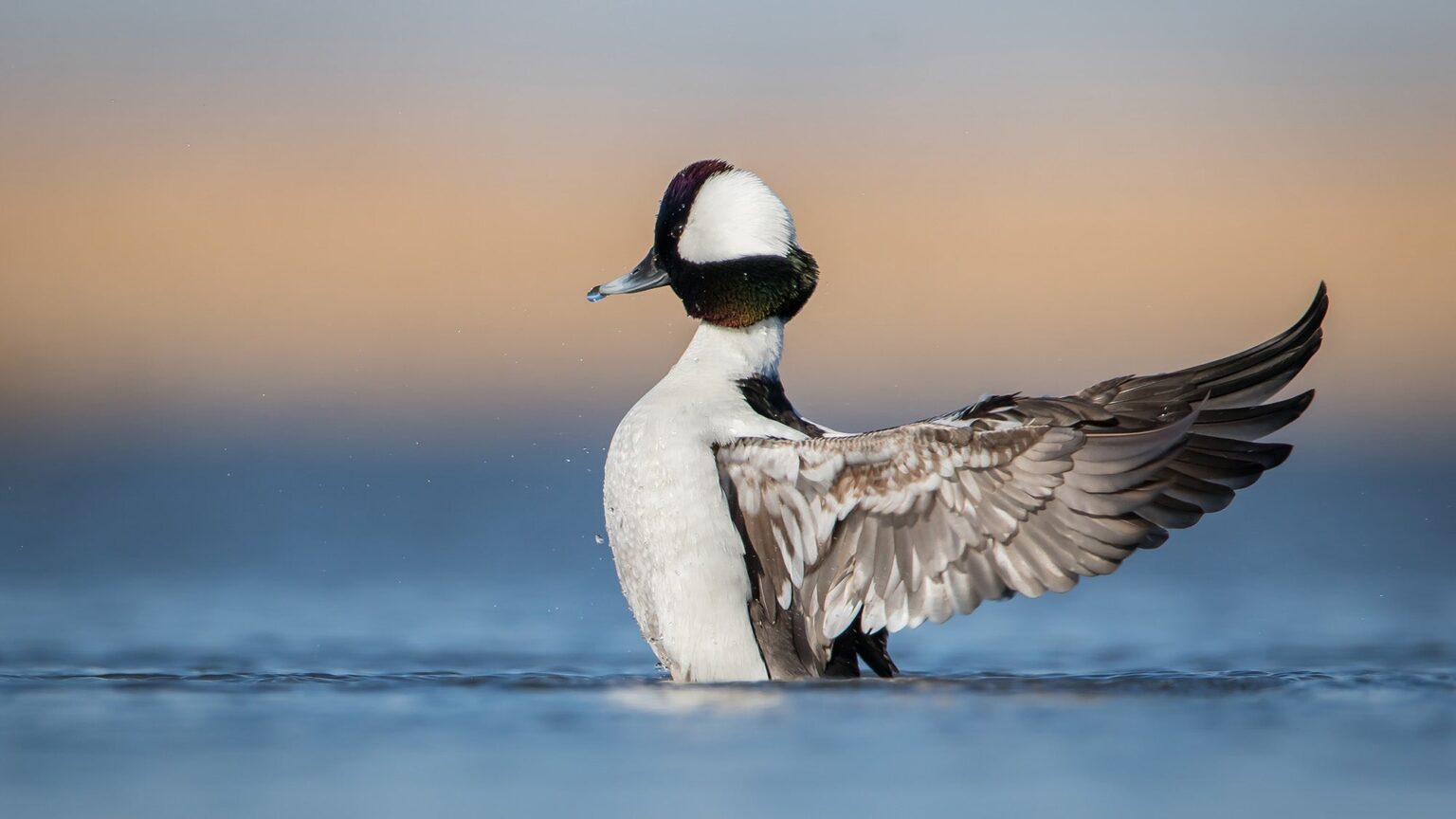
“The teal of the diver world” is how one of my good friends, a dedicated diver fanatic, described the diminutive bufflehead. Often weighing less than a pound, the drake bufflehead is as good-looking as he is tiny. The drake has a white chest and sides accented with a glossy black back. The white crest on the drake’s black head is an excellent field identifier, as are his white wing-stripes (visible in flight) and strange-looking pink feet deployed as he lands among the decoys. His bill is small, yet strong—perfect for grubbing about underwater for aquatic bugs, worms, snails, crayfish, and small mollusks. Hen buffies are mostly brown in color, with a lighter chest and a dark back and head—the latter marked with a small white cheek patch. Buffleheads can often be found on larger bodies of water, but pairs and smaller groups will frequent freshwater ponds and canals.
Buffleheads, like canvasbacks, seem to be a bit more species-specific when it comes to rubbing elbows with other waterfowl. Those wishing to target buffleheads, or for that matter, canvasbacks or goldeneyes, should set a handful of drake bufflehead decoys off to one side of the spread. The stark black-and-white appearance of the drakes provides excellent visibility at a distance and over open water.
There are other diving ducks waterfowlers might encounter throughout the season, including ring-necks; common and Barrows goldeneyes; common, red-breasted, and hooded mergansers; and long-tailed ducks. Those hunting in marine environments may come across any number of sea-faring divers, such as common eiders or the scoters, which include surf, white-winged, and black scoters.
Read the full article here