




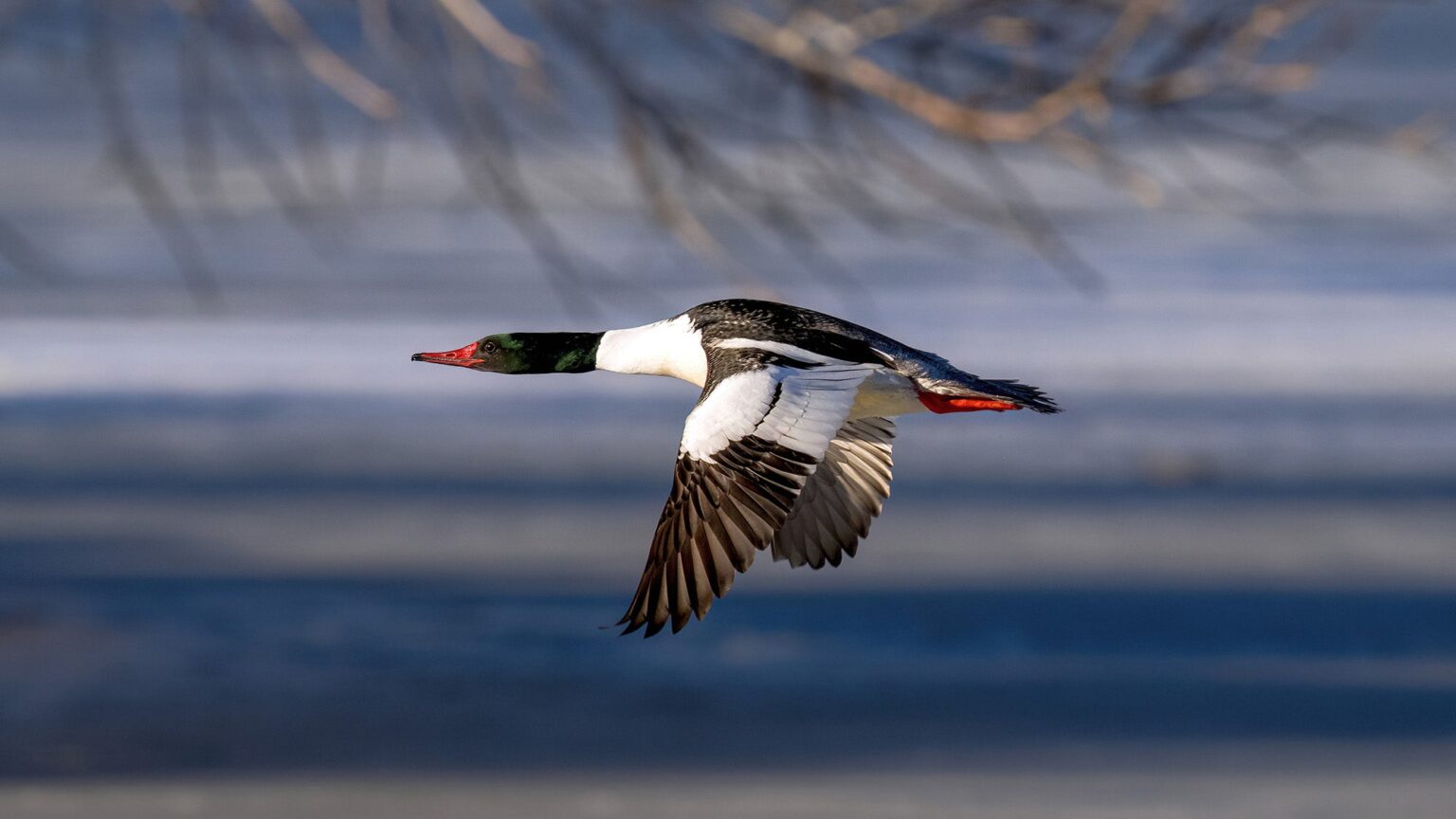

Long, serrated bills and crested heads grace much of North America. There are three diving, fish-eating ducks that fall into the merganser category—hooded, red-breasted, and common—all of which sport crests and streamlined bodies made for swimming. Beyond their striking appearance, merganser ducks are sight-feeders that prefer clear water where it’s easier to spot their prey. Bodies adapted for swimming make them awkward walkers on land, but they are also capable of high speeds in the air, with the red-breasted merganser capable of flying up to 81 miles per hour.
The word “merganser,” incidentally, dates to the 1500s and derives from the Latin “mergus” for “dipping or immersing” plus “goose.” That may explain why mergansers are called “gooseanders” in England and other parts, but mergansers are ducks, not geese.
Mergansers are widespread and their populations are stable. Your chances of seeing one while hunting, fishing or birdwatching across much of the U.S. are quite good if you’re in the right place. Knowing more about their habits, their life history, and their appearance can help you spot and identify them in the woods and waters where they live.
Hooded Merganser Duck
Appearance, range and habitat
The smallest of the merganser ducks, and the one with the most handsome plumage, the hooded mergansers have the fullest crest of the three. They are only about 20 inches long at most, and weigh between 1 and 2 pounds. The drakes stand out with their bold black and white “hoods,” which they raise during courtship. The birds have a low, raspy quack that can sound like a croak, earning them the nickname “frog duck” in parts of the South. The hooded merganser duck inhabits smaller freshwater or brackish ponds or marshes, often near trees, making it a little more elusive than the common and red-breasted mergansers, which live on bigger lakes on coastal areas. “Hoodies” are found throughout the eastern half of the United States and Canada, and in the far western states. They are the only merganser to nest exclusively in North America.
Feeding Habits
Like all merganser ducks, hooded mergansers are piscivorous ducks, meaning they feed on fish. Their diet also includes crayfish, tadpoles, and other crustaceans they catch by diving. Their gizzards are especially strong to grind shells. Their eyes are specially adapted so they can see well both above and below the surface of the water by changing the curvature of their lenses and corneas. They also have a third eyelid that functions almost like a goggle to help them see.
Mating and Nesting
Hooded mergansers form pair bonds in late winter. Males raise their crests and will arch their heads backward as part of their courtship display. Once a pair bonds they look for a cavity in a tree that is usually within 15 feet of the ground, but can be as 80 feet. The hooded merganser duck will often take advantage of nest boxes set up to benefit wood ducks. They make nests out of down and bits of wood. The hens lay clutches averaging around 10 eggs. Within 24 hours of hatching, the ducklings are ready to jump out of the nest onto the ground or water to follow their mother. They can dive and feed on aquatic insects on their own right away. The males do not participate in raising the young.
Merganser Duck Migration
A late fall and early spring migrant, hooded merganser ducks are short-range travelers, with only a few wintering south of the U.S.-Mexico border. However, many hooded mergansers that nest in the South don’t migrate at all.
Common Merganser Duck
Appearance, Range and Habitat
A big bird, the common merganser duck is the size of a large mallard (21-26 inches long) and the drakes have a green head as well. Their white breasts and narrow red bills make it easy to tell the difference between the two. Brown-headed hens wear the crests in the common merganser family. Mostly silent, common mergansers limit their calls to clucks and grunts to communicate to ducklings, to show alarm, and during courtship.
Common merganser ducks nest across Canada and in parts of the U.S., with their range in western states extending as far south as Colorado and northern California. Hardy birds, they don’t migrate far, and only a few cross the border to Mexico. Many winter much farther north, especially along both coasts.
Cavity nesters like the hooded merganser duck, common mergansers are often found on larger, forested lakes near mature trees, and they will winter on lakes, reservoirs, and ponds. They prefer freshwater but will also winter in bays and coastal estuaries. Common mergansers are also found across Europe and Asia.
Feeding Habits
“Sawbills,” as common merganser ducks are known, are adapted to diving and catching fish, and they will sometimes work together, circling fish and pushing them into shallow water. They will also feed opportunistically on snails and crayfish at times.
Breeding and Nesting Habits
Common mergansers form pair bonds in the spring. Lacking the crest of the hooded merganser, the drake common merganser duck confines its mating display to swimming fast circles around the hen, stretching its head upright and whistling. Females build nests in tree cavities with twigs and down, and will lay a clutch of 8-13 eggs. They will also lay eggs in another female’s nest. Chicks will jump out of the nest within a day of hatching and while they can feed themselves, they will often ride on their mother’s back.
Merganser Duck Migration
A late fall and early spring migrant, common merganser ducks are short-range migrants, with only a few wintering south of the U.S.-Mexico border. They will winter on brackish or even saltwater as well as on inland lakes, rivers and reservoirs. They winter in much of the U.S., with the exception of the Southeast.
Red-Breasted Merganser Duck
Appearance, Range and Habitat
Spiky crests on the male and female identify the red-breasted merganser. The male has a green head with a white ring around its neck and a reddish breast. The coloration is similar to that of a mallard drake, but there’s no confusing the two because the crest and the long, thin bill. Hens and immature males are gray with brownish heads. At 20-25 inches in length they are roughly in between the smaller hooded merganser duck and the larger common merganser in size. Nesting throughout the northern regions of the world, the red-breasted merganser does not nest in trees like the hooded and common merganser ducks, but on the ground close to a shoreline. Although they nest inland, they winter almost exclusively on coastlines. While some stay far north but move toward the open water of the coasts, others migrate as far south as the Baja peninsula on the West Coast and the Florida Keys on the eastern seaboard.
Feeding Habits
Red-breasted mergansers feed largely on baitfish that may be up to 6 inches long. Like common mergansers, they sometimes hunt together to herd fish. They will also eat crustaceans and shellfish. They often swim head down, so they can spot fish, then dive after them.
Breeding and nesting habits
Males court females with a display that involves holding their heads high on outstretched necks, then dipping their chests. They make a kind of “meow” noise, too. The female sometimes responds by poking the male with her bill, then does a head-bob to indicate she accepts the male as her mate. Unlike the common and hooded merganser ducks that nest in tree cavities, red-breasted merganser hens scoop depressions near shore, line them with grass, then pull down from their own breast to create a soft bed. They lay anywhere from a handful of eggs to a couple of dozen. As with all the mergansers, the males go off to molt on their own while the female raises the young, who are capable of feeding themselves once barely out of the egg.
Merganser Duck Migration
Red-breasted mergansers migrate across every state but Hawaii, but their ultimate destination is almost always a coastal area. Some stay far to the north, while others migrate as far south as the Baja peninsula on the West Coast and the Florida Keys on the East Coast.
Merganser Duck Conservation and Hunting
The populations of all three North American mergansers species remain stable, and there is even speculation that nesting boxes built to help increase wood duck populations have boosted hooded and common merganser numbers as well.
Antique merganser decoys prove that earlier generations did sometimes target mergansers, and all three species are legal to hunt. In fact, merganser limits are separate from regular duck limits so you can take one as an interesting bonus bird and still shoot a full duck limit. However, the merganser duck’s strong flavor due to their fishy diet makes them of little interest to most waterfowlers, who prefer to hunt tastier ducks. Some hunters want to shoot one or two as taxidermy specimens, as the birds do make a handsome and unusual mount. I will confess to having a pair of hooded mergansers mounted on my wall, both mistaken early in the morning (on separate mornings, 10 years apart) for wood ducks, which can be easy to do. Mergansers will come to a decoy spread, especially hooded mergansers, so it pays to learn to identify them. I did not want to cook either of my mergansers, to I chose to have them mounted so as not waste them entirely.
If you do shoot a merganser duck and want to cook it, remember that most of the strong, fishy flavor resides in the skin, so plucking the bird is a bad idea. Some game cooks will add a small amount of merganser to other duck meat being ground into sausage. Others will marinate the breasts and cook them rare, or use Asian recipes that include fish sauce. My thought, having already shot a hen and drake hoodie and mounted them, is to try harder to identify ducks on the wing and enjoy watching mergansers while waiting for better-tasting ducks to discover my decoys.
Read the full article here