





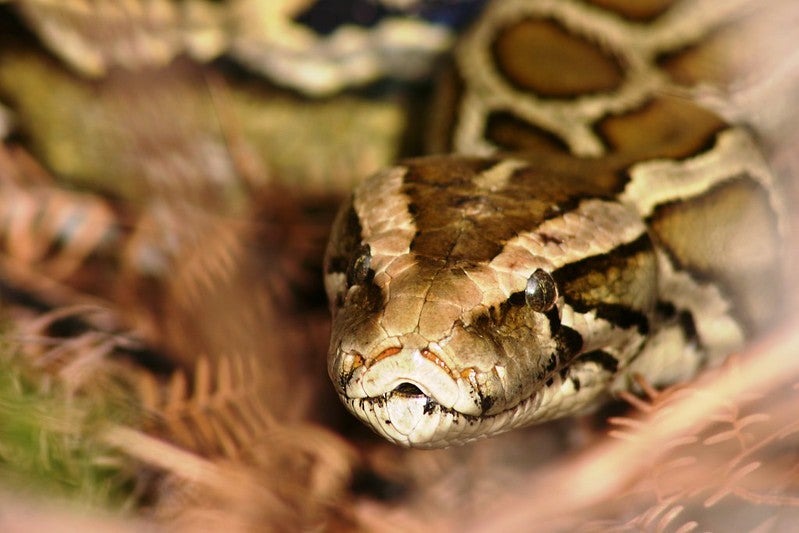

Releasing what it calls a comprehensive synthesis of Burmese python science, the U.S. Geological Survey (USGS) announced early last month that the giant invasive snakes have now spread beyond their core range in the south Florida Everglades and into places like West Palm Beach and Fort Myers, Florida. The study calls Florida’s python invasion “one of the most intractable invasive-species management problems across the globe.” And it says that, as the snakes continue to spread north, leaving a trail of ecological devastation in their wake, eradication of the species is impossible with existing tools.
“For the first time, all the science on python ecology and potential control tools have been consolidated into one document, allowing us to identify knowledge gaps and important research areas to help inform future python management strategies,” said USGS Ecologist and lead author of the study, Jacquelyn Guzy. “This synthesis is a major milestone for Burmese python research; six years in the making, it represents the consensus of the scientific community on the python invasion.”
That consensus appears to be somewhat grim, at least for anyone who was hoping to see pythons removed from Florida’s fragile and remarkably biodiverse ecosystem. “Extremely low individual python detection rates hamper our ability to both estimate python abundance and expand control tools across the extensive natural landscape,” said USGS Research Ecologist Kristen Hart, another author of the study.
Pythons are notoriously hard to locate in the immense stretches of south Florida wetlands where they thrive. They don’t readily enter traps, and their natural camouflage is incredibly well suited to the Florida terrain, where they’ve been breeding rapidly since at least 2000.
A Snake Expert Weighs In
Dr. Chris Jenkins is a Geogia-based herpetologist who serves as the CEO of a reptile and amphibian conservation organization called the Orianne Society. He’s working to conserve several snake and turtle species, including a snake that’s native to the Florida panhandle called the eastern indigo snake. Jenkins keeps a keen eye on the python problem unfolding in the Everglades, and he says that the invasive snakes have introduced a parasite that’s now turning up in threatened eastern indigo snakes.
“From my perspective, it would be next to impossible—very, very difficult—to get these pythons out of their current range,” Jenkins tells Field & Stream. “Part of that has to do with the landscape. The epicenter of their distribution right now in Florida is the wildest place east of the Mississippi. You’re talking about one of the largest wilderness areas in all of the United States—huge tracts of public land. And those tracts of land are not as accessible as what we see with more terrestrial environments.”
Jenkins says that one of the primary challenges when it comes to reducing Burmese python populations has to do with the invasive snakes’ relatively high rate of reproductive success. Like another well-known invasive—wild hogs—they multiply so rapidly, that no amount of human efforts put a substantial and lasting dent in their population numbers.
“Imagine trying to eradicate wild hogs from the landscape,” says Jenkins, an avid hog hunter himself who pursues wild pigs in the mountains of north Georgia and along lowland stretches of the Peach State. “Just based on their biology alone, the amount of effort it would take to get rid of them is very, very difficult. And pythons are nowhere near as accessible as hogs in most cases. They’re out in these seas of wetlands that go on forever, and they’re underground. They’re just incredibly difficult to detect.”
That’s bad news for south Florida’s native species, particularly small to medium-sized mammals like possums and raccoons, and even whitetail deer. “The populations of the mid-sized mammal have really declined,” Jenkins says. “Florida is a very unique place within North America in terms of biodiversity, and there are other things like the key deer—this really small version of a whitetail deer. Pythons will eat key deer, and one of the great fears is that pythons could impact their population.”
According to the Florida Fish and Wildlife Conservation Commission (FWC), the largest key deer bucks reach a height at the shoulder of just over 3 feet. Mature bucks weigh no more than 80 pounds while does trend even smaller, rarely exceeding an average weight of 65 pounds. Currently, there are only 700-800 key deer left in the wild, the FWC estimates, and they all live in south Florida.
A Potential Solution
If there’s any light at the end of Florida’s “python invasion” tunnel, it may originate from a novel technique called “genetic biocontrol”—the USGS study suggests. This refers to a landscape-level release of organisms that have been genetically modified in a way that disrupts the reproductive processes of invasive species. According to a paper published by the National Institute of Health (NIH), one past application of genetic biocontrol involved using radiation to sterilize a number of screw worms and then releasing them into a larger population of the insects to suppress their overall reproductive success.
Read Next: Researchers Tracked Down and Killed a Giant Burmese Python After it Ate a Collared Possum
One way it could be applied in the Everglades is through the release of genetically-modified pythons that would enter the population and, by breeding with the non-altered pythons, promote a “male-biased sex ratio” in new hatchlings. This could produce a population collapse, the authors suggest. If successfully implemented, they say the cutting-edge technique could “one day provide an avenue toward large-scale population suppression” of Florida’s ecologically destructive Burmese pythons.
Read the full article here