




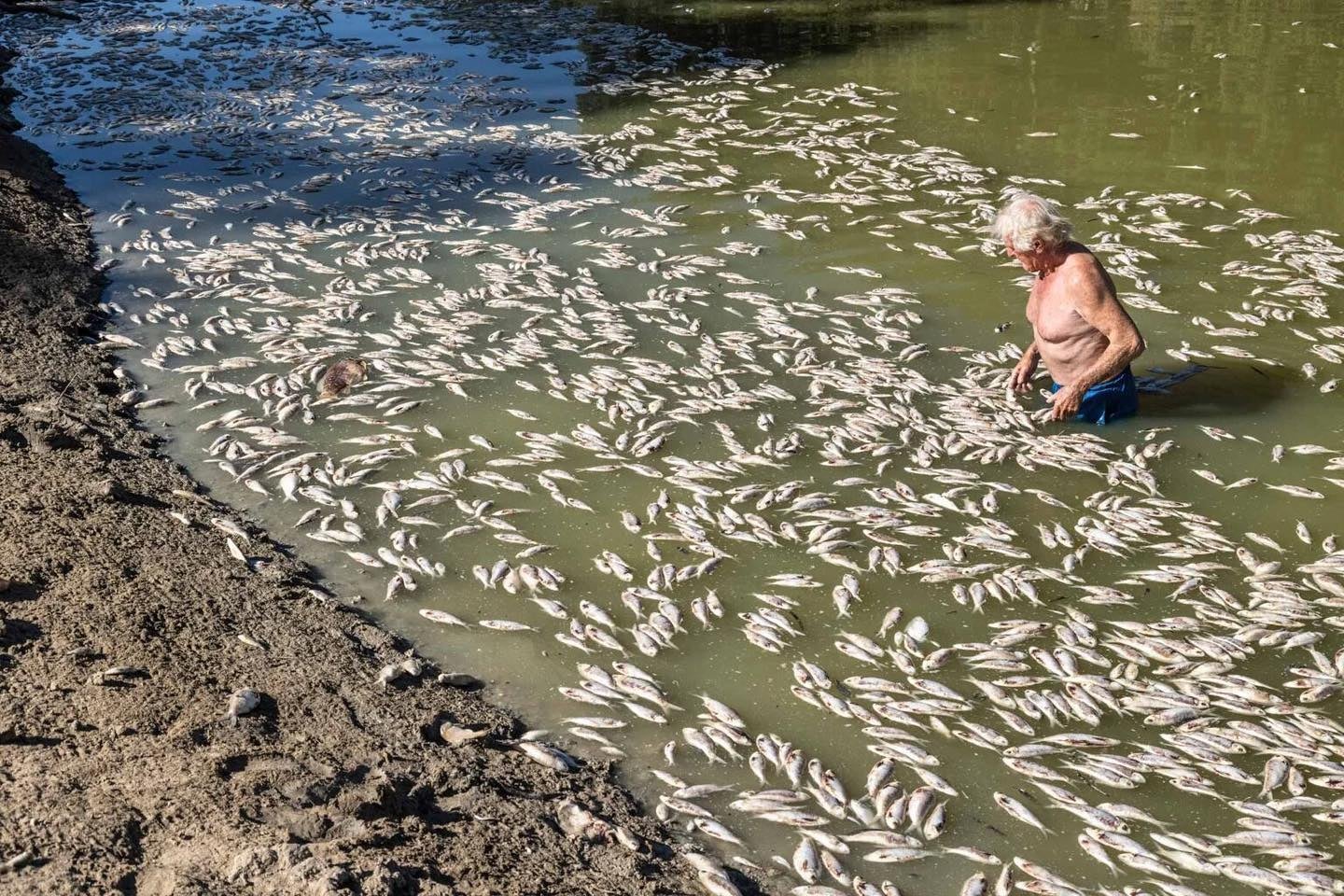

Australia’s third-longest river, the Darling-Baaka, is experiencing yet another catastrophic fish kill. Millions of fish went belly up near the small inland town of Menindee last week, and government officials worry the die-offs could continue. They point to warm water and low oxygen levels in the river as the cause.
“It is estimated that millions of fish, predominantly Bony Herring, have been affected, as well as smaller numbers of other large-bodied species such as Murray Cod, Golden Perch, Silver Perch, and Carp,” the New South Wales government explained in a Facebook post on March 17. “The event is ongoing as a heatwave across western NSW continues to put further stress on a system that has experienced extreme conditions from wide-scale flooding.”
Residents of Menindee were met with the unpleasant sight (and overwhelming stench) of millions of dead fish in the Darling-Baaka over the weekend. Local politicians and others have called on the government to dispose of the rotting carcasses already blanketing the river. Member of Parliament Cate Faehrmann called the fish kill “an existential threat” to the health of the river and water security in the region.
“This is categorically a catastrophe,” Faehrmann told the Guardian on Saturday. “Regardless of whether this is a consequence of receding floods or water mismanagement, the NSW and federal governments should be acting now to clean up the millions of rotting fish which are spanning kilometers of the river.”
The New South Wales government responded to these concerns by activating an Emergency Operations Center at Menindee over the weekend. In addition to coordinating a massive cleanup operation, officials are releasing higher quality water into the Darling-Baaka in an effort to boost oxygen levels in the river.
“There is no need for community concern as the initial assessment has determined multiple viable solutions to maintain water supply to the Menindee township and surrounds,” NSW Deputy Commissioner Peter Thurtell said in a press release on Sunday. “Importantly, there is ongoing testing of the water quality, which will ensure immediate action if a switchover supply is required.”
Human-health concerns aside, many Australians worry that the future health of the Darling-Baaka is in real jeopardy. The river experienced another fish kill in late February, the Associated Press reports, with tens of thousands of fish dying in the same stretch of river. Some also remember the massive die-off that occurred there in late 2018 and early 2019, when severe drought conditions gripped the region and the river barely flowed at all. A million or more fish died in the Darling-Bakka during that incident, although the numbers from this week’s fish kill have already far surpassed that number.
How Warm Water Kills Fish
The New South Wales government has attributed the ongoing fish kill to a natural phenomenon known as “hypoxic blackwater,” which leads to dangerously low levels of dissolved oxygen in the river and is exacerbated by hot weather.
The hypoxic conditions in the Darling-Baaka were created by a one-two punch of flooding and heatwaves, according to NSW fisheries. The Darling-Baaka flooded in January, washing plants, soil, and other vegetation into the river. All this organic matter sucked up dissolved oxygen from the water, and it led to the proliferation of micro-organisms that fed the bony herring, carp, and other fish (which also breathe dissolved oxygen). Fish populations in the river boomed as a result.
Read Next: “Red Tide” Is Causing a Massive Fish Kill in San Francisco Bay
Then, in March, the heatwaves came. Temperatures climbed above 104 degrees. As water levels receded, the large number of organisms in the Darling-Baaka were left fighting for a shrinking supply of dissolved oxygen. And as water temperatures rose, there was even less oxygen to go around. Warm water holds less oxygen than cold water, and fish typically require higher levels of oxygen at warmer temperatures, which compounded the problem even further.
More to Blame Than a “Lack of Oxygen,” Some Say
While the NSW government insists that booms and busts in herring populations are part of the natural cycles of the Darling-Baaka, the immense scale of the ongoing fish kill has many locals and river advocates crying foul. They say there’s much more to blame than a simple “lack of oxygen” caused by floods and warm weather.
“This is not a natural event,” said one river advocacy group. “This has been caused by years of water mismanagement and over extraction for large-scale development.”
The Darling-Baaka is one of Australia’s most imperiled rivers. The entire system suffers from pollution and it’s water has long been over-allocated to meet the overwhelming demands for drinking water and irrigation in the region.
Read the full article here