

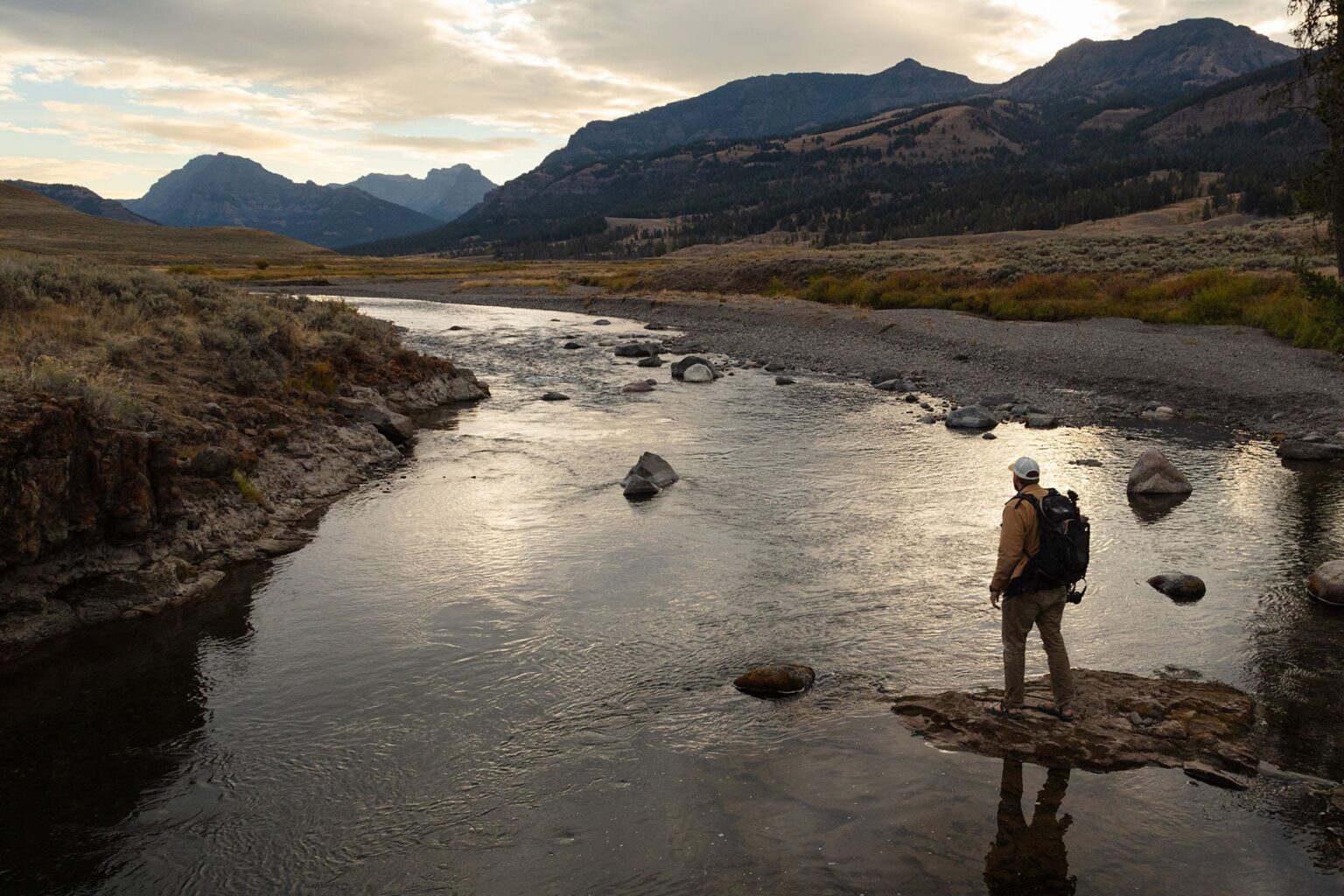

Earlier this month, a team of fisheries biologists with the National Park Service (NPS) and Montana Fish, Wildlife & Parks (FWP) applied fish-killing poison to a 9.6-mile stretch of Soda Butte Creek, which flows through the northwestern corner of Yellowstone National Park. The scientists dispensed the toxic substance, known as rotenone, after routine monitoring detected non-native brook trout. Now they’re using advanced genetic analysis to determine wether or not the invasive fish were put there by people.
Soda Butte Creek is a stronghold for the iconic Yellowstone cutthroat trout, but the creek has been threatened by invasive brook trout for years. The brookies were first detected there in 2014. Because they can quickly outcompete the native cutthroats when left unchecked, NPS and FWP took quick action to eradicate them from the fishery.
Over the course of one week in 2015, state and federal agencies killed 450 brook trout using a broad application of rotenone throughout 38 miles of the Lamar River tributary. They salvaged as many of the native cutthroat as they could, removing them from the creek prior to applying the poison, then putting them back in after the toxins dissipated.
After a few more spot treatments with rotenone, Soda Butte was declared brook trout free. And it stayed that way until last fall when an NPS electrofishing crew shocked up more than a dozen brookies along a one-mile stretch of Soda Butte.
“It’s kind of like removing mice from an infested house,” FWP fisheries biologist Shannon Blackburn tells Field & Stream. “With rotenone, you do a big treatment and then you have to keep doing some monitoring. You have to keep some traps out there.”
With their most recent round of rotenone spot treatments, conducted one week ago, FWP and NPS removed eight additional brookies from Soda Butte. How the fish got back into the creek after they were presumed eradicated by the heavier rotenone treatments of 2015 is a matter of speculation—for now.
“We’re trying to think of all the different ways that brook trout could have gotten in,” says Blackburn. “Was it an illegal introduction? Was there a deep hole in the creek that was maybe missed during previous rotenone treatments and now we’re just seeing them after the previous high water year?”
There are brook trout in isolated lakes in the nearby Beartooth Mountains, as well as the Clark Fork drainage west of Continental Divide, but Blackburn doubts that fish from either of those established populations could have migrated into Soda Butte on their own.
According to Blackburn, FWP is employing two separate methods in hopes of tracing the origin of Soda Butte’s most recent brook trout woes. “One thing we’ll do is genetic analysis using fin clips from brook trout we’ve removed,” she says. “Another method we can use is otolith microchemistry.”
Otoliths are tiny bones inside a fish’s inner ear that sense gravity and detect movement. “There are ways, especially on the smaller fish, where you can test their otolith bones to find out where they were born,” she says. “If we can match the fingerprint of the microchemistry of the otolith bone with the fingerprint we get from water samples collected from a given watershed—that’s how we can tell where they might be coming from. But we might not know for awhile.”
Read Next: Feds Look to Add Rare Salamander Mussel to Endangered Species List
Regardless of wether the recently-discovered brookies of Soda Butte Creek were holdovers from 2015 or they were placed there by some misguided “bucket biologist”, Blackburn says that keeping them out is absolutely critical for the future health of the Lamar River watershed. “The Yellowstone cutthroat trout is a really important species,” she says. “They’re iconic to the area, and they don’t cohabitate well with these non-native brook trout.”
Read the full article here