






It’s like the high-pitched HA-ha of the white-fronted goose, the raucous cackle of the rooster ring-neck pheasant, or the chattering bark of an upset fox squirrel. Once you’ve heard the pre-dawn whistle of wings and a flight fast enough to rival the speed of sound, you’ll never mistake the goldeneye duck for any other species of waterfowl on the planet.
No, the goldeneyes don’t get the same respect as the coveted drake mallard, the wary bull sprig, or the lordly canvasback, but that’s not to say these fast-flying members of the diver clan don’t provide just as great a hunting challenge to any waterfowl hunter.
Appearance and Vocalization
First things first, as it’s important to know there are two subspecies of goldeneye that hunters can encounter throughout North America—the common goldeneye, and the rarer Barrow’s goldeneye. Both are similar in appearance, but with some noteworthy differences.
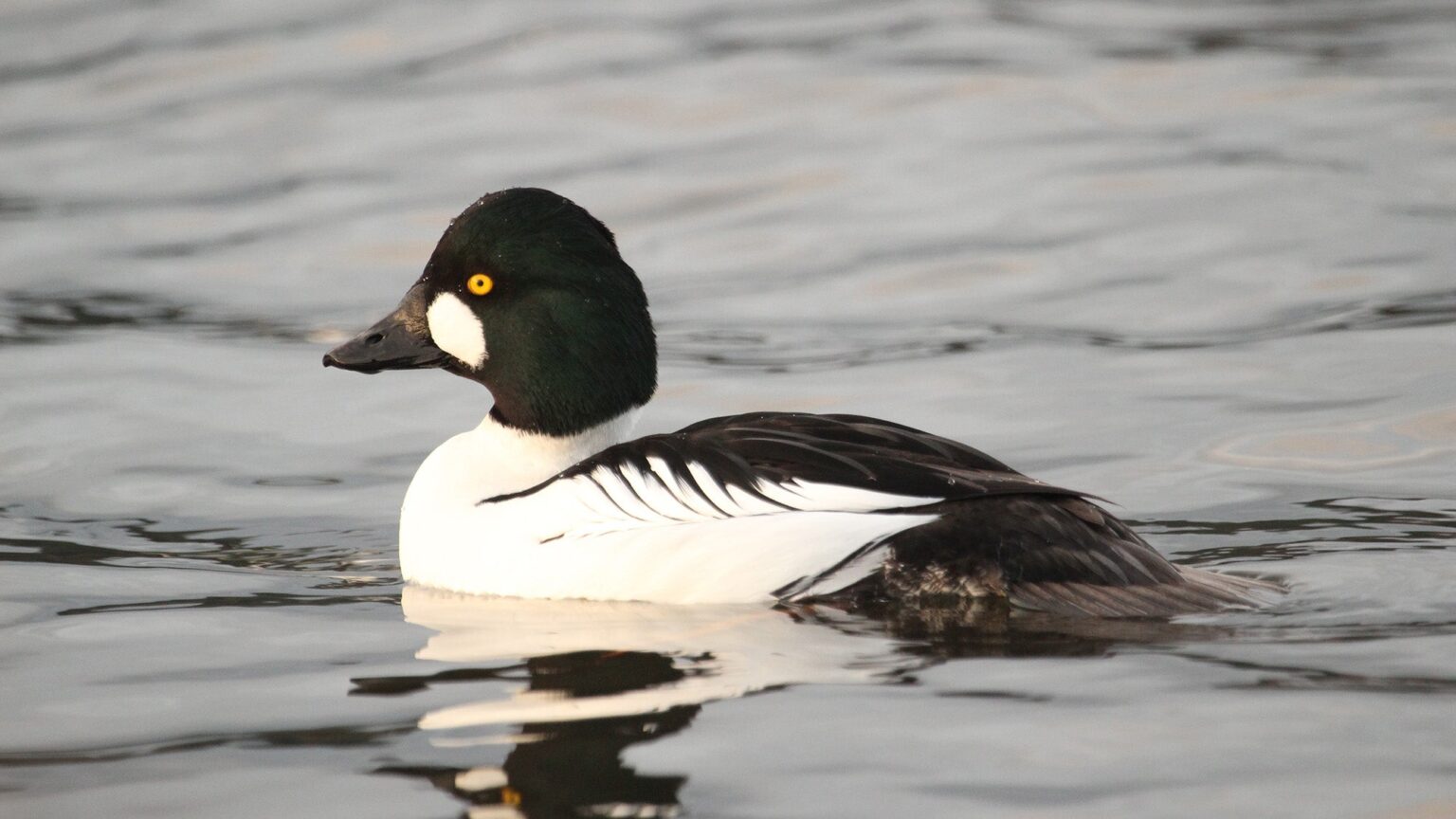
The drake common goldeneye is a medium-sized duck. He’s primarily black and white overall, with an iridescent greenish-black head, distinctive yellow eyes, and a short stubby black bill. Like most divers, he rides low in the water, with his tail touching the surface. The true identifier for the common goldeneye is the drake’s round white facial patch located in front of and slightly below his eye. In contrast, the hen common goldeneye is a mottled gray-white front to back. She sports a subtle white neck ring, brown head, and the same strong bill, hers tipped in a lighter pink.
The drake Barrow’s goldeneye is almost a mirror image of the common, but instead of the circular white facial patch, the Barrow’s shows an oval or crescent-shaped marking ahead of the eye. The Barrow’s head, though similar to the common’s, will often exhibit a purple-green hue, and he’s a bit more defined or separated in his black-and-white overall coloration. Like her common counterpart, the hen Barrow’s goldeneye is a mottled brownish-grey, with an all-brown head, off-white eye, and stubby light orange-yellow bill tipped in black.
Both the common and Barrow’s goldeneyes are relatively quiet birds, with the hens making a soft cooing, while the drakes call with what might best be described as a gravelly croaking peep or growl. Likewise, both subspecies can be identified by the distinctive whistling of their wings in flight, the volume often accentuated during cold weather and a sound which has earned the Goldeneye the nickname, “whistler.”
Goldeneye Duck Distribution
Common goldeneyes breed and nest throughout the boreal forests of Canada and north into Alaska. However, the winter migration will see these handsome “tuxedo” ducks moving southward into the Lower 48 from the Chesapeake Bay west to the Columbia River.
According to research done and documentation supplied by the Joint Sea Duck Venture, two populations of Barrow’s goldeneye exist in North America. The western population begins life primarily in the British Columbia interior, with off-shoots reaching north into south-central Alaska. Wintering populations of this western segment can be found in Washington and Oregon south to San Francisco Bay and east into the western foothills of the Rocky Mountains. Conversely, the eastern population of Barrow’s goldeneyes traditionally winter in the St. Lawrence River estuary east to Maine.
Habitat and habits
Goldeneyes are open-water diving ducks, partial to big lakes and rivers throughout North America. However, late winter will often see good numbers, especially of commons, flocking to smaller interior rivers kept open, courtesy of current.
Though goldeneyes will indeed eat vegetation, their preferred diet consists of aquatic invertebrates, crustaceans, shellfish, and insect larvae, all of which they can find by diving in roughly 20 feet of water. In comparison, the long-tailed duck, another member of the sea duck family, has been known to dive 200 feet deep in search of food.
Unlike mallard hens that build traditional bowl-shaped nests among the reeds and other cover, goldeneyes, like wood ducks and hooded mergansers, are cavity nesters. The hens of both subspecies lay an average clutch of 8-10 eggs. Incubation is then 30 days, after which the hen guards the little ones fiercely against predators such as mink, weasels, hawks, crows, and even northern pike and muskellunge.
Goldeneye Duck Hunting Methods
With but few exceptions, goldeneyes are harvested incidentally or as “a bonus duck” over a puddle duck spread or a diver hunt. It’s important to note for those who wish to specifically target goldeneyes that the birds are quite species-specific when it comes to decoys. It’s best to set out a least a handful of goldeneye decoys—ideally drakes, as their black-and-white contrast provides excellent long-distance visibility.
How many goldeneye decoys? If I’m setting a diver spread, I’ll always throw three or four drake goldeneyes by themselves and off to one side, just in case a common or Barrow’s should wander by. As for a choice of non-toxic shotshells, goldeneyes, though not exceptionally large ducks, are rugged, well-feathered, and tenacious of life. Therefore, steel No. 2 shot or HEVI-Bismuth No. 4 shot are both great choices.
Goldeneye Duck On the Table
Opinions are mixed when it comes to the goldeneye’s ranking as table fare, based almost entirely on the species’ diet of non-vegetative materials. Me? I’ve enjoyed an Asian style goldeneye stir fry which was absolutely wonderful, as well as mallards that were presumably dining on shellfish that my cats wouldn’t touch. Here, edibility lies in the eye—or rather, the taste buds—of those doing the eating.
Read the full article here