




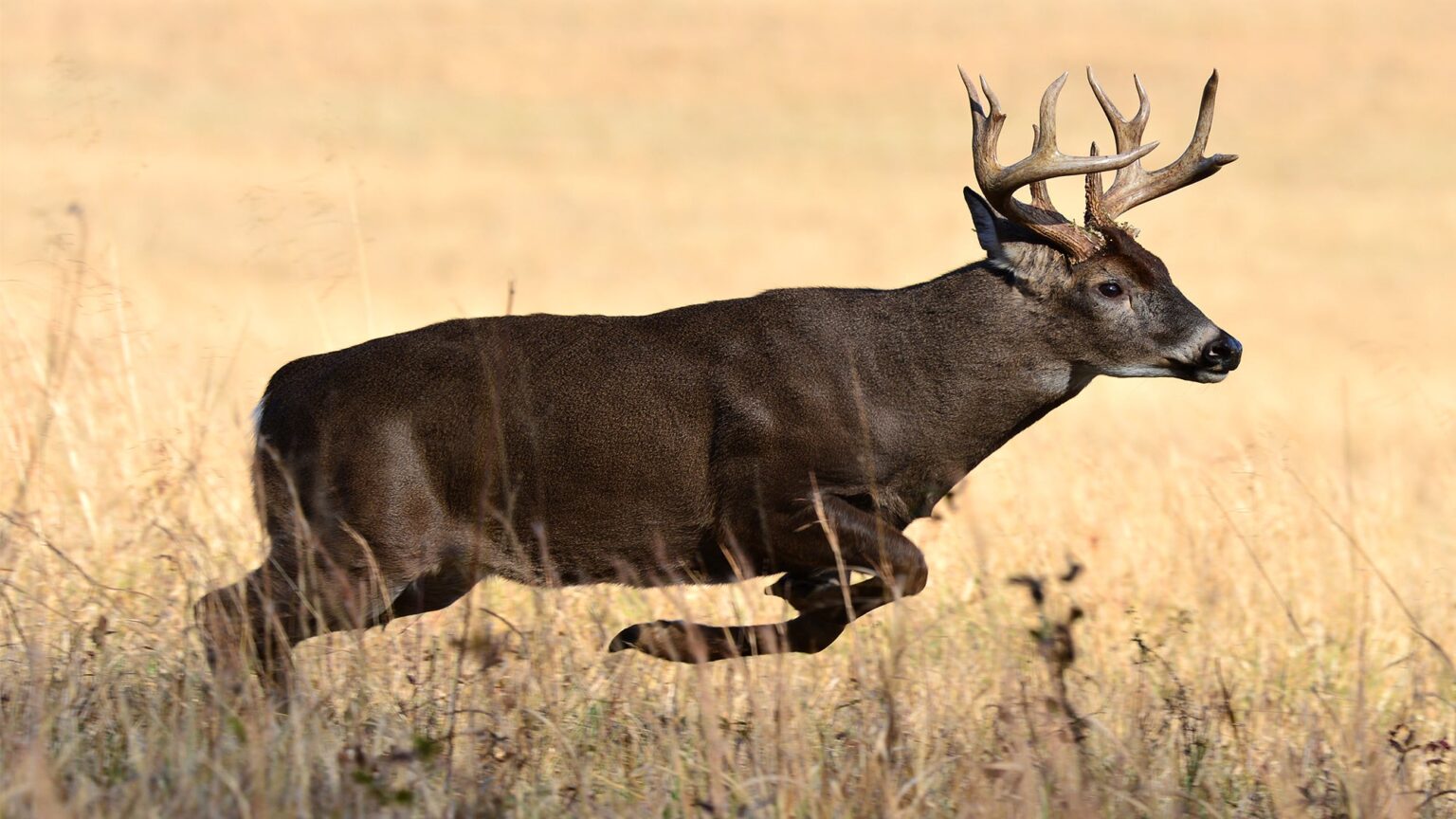

Anyone who’s seen a deer bounding along a hay field or zipping across a road should have no trouble believing that these critters are pretty fleet of foot. But just how fast can a deer run? How long can deer maintain their sprinting ability? And how does, say, a whitetail deer’s speed compare to a mule deer’s, and to other North American deer species. How about compared to their top predators? Let’s find out. Here’s a deep dive into how fast deer can run.
How Fast Can a Deer Run? The Short Answer
Whitetail deer can reach a top speed between 35 and 40 miles per hour, according to most estimates. That’s pretty darn fast. Imagine a whitetail buck running alongside your car while you’re going 40 miles per hour. That’s speedy enough to outrun the fastest human, most horses, and just about all their natural predators. Given that whitetails are by far our most common and widespread deer, this answer the question of “how fast can a deer run” for most of us. That said, they are hardly the only deer.
There are 46 deer species world-wide, and most can reach top speeds of between 30 and 50 miles per hour. While whitetails are now slouches, they actually wouldn’t make the podium in even a North American deer dash. So, let’s take a look at the continent’s major deer sprecies, and see how it breaks down.
How Fast Can North American Deer Species Run?
When compared to other deer species, whitetails are respectable, but not world-class. Elk, for example, (which have longer legs and more muscle mass) are capable of running up to 45 mph. Mule deer can approach 40 mph. Caribou, the fastest North American deer species, have been clocked pushing 50 mph, which is no small feat given the ruggedness of the muskeg and rocky ground they call home. Bringing up the rear, moose are able to reach 35 mph in their similarly unforgiving terrain.
Although the caribou is our speediest deer, it is not our fastest big-game animal. That honor, of course, goes to the pronghorn, which can only reach 57 mph, but can sustain that speed for quite a distance. These prairie speedsters have evolution to thank for their fleetness; early pronghorns evolved alongside a cheetah-like predator that was equally swift, and natural selection insured that only the fastest speed-goats survived to procreate.
Related: How High Can a Deer Jump
How Fast Are Deer Compared to Thier Predators?
What about deer predators? How fast do they run, by comparison? In fact, most deer predators can reach top speeds that are about as fast or faster than whitetail deer, and even as fast as elk and caribou. But that fact hardly makes deer easy prey. Here’s a quick breakdown of predator speeds compared to whitetails.
- Whitetail Deer: 35-40-mph
- Bears: 35 mph
- Wolves: 35 mph
- Mountain Lions: 40-50 mph
While bears are considered a deer predator and can approach 35 mph for a short sprint, they don’t mess with chasing down adult deer a whole lot; instead they prefer gobbling up fawns in the spring time, when the baby deer’s main defense is to lie still and try to avoid detection.
Wolves are certainly a deer predator, and the speed match is pretty even, with wolves also capable of running 35 mph for a good stretch. Still, a healthy adult whitetail can often evade a wolf under normal conditions. Studies in the upper Midwest (a stronghold or timber wolf populations) have shown that in winters with little or no snow, wolves have a tough time catching deer and often go hungry. Conversely, winters with heavy snow congregate deer in “yards” (usually conifer lowlands that offering some shelter from the elements) and make deer more vulnerable to wolves.
Mountain lions are another deer predator that can turn on the burners in a big way; the best estimates place a cougar’s top speed at 40-50 mph. While that’s plenty quick enough to catch a deer, lions can maintain that pace for only a short distance. Mountain lions make up for their limited stamina by hunting from ambush; waiting for deer to move closer, or inching close to make a short, quick burst of speed to put them in killing range.
How Fast Can a Deer Run Compared to Humans?
The fastest human sprinter of all time–Jamaican speedster Usain Bolt–covered the 100 meter dash at the World track & Field Championships in 2009 in 9.58 seconds. While Bolt left his competition in the dust, his top speed in the race was about 27 miles per hour, and he didn’t maintain that pace the entire distance; he built up to that mark at about 67 meters, then slowed some in the final stages of the race. His average speed was 23 mph. So, assuming Bolt could find a deer willing to go head-to-head for 100 meters, he’d be staring at a whitetail butt the entire race, and definitely at the end. The average human, with a top speed of under 15 mph, probably wouldn’t get a good look at the deer’s butt, because it would be too far out ahead.
Why Are Deer As Fast as They Are?
Deer are fast so as to escape predators, naturally. But it’s important to note that raw speed is only one factor that helps a deer from being eaten. While deer can credit most of their running ability to their heavily muscled hindquarters, their slender front legs are uniquely designed for evasive running. Anyone who’s butchered a deer knows that a deer’s front legs do not sport the ball-and-socket attachment of the rear legs. Instead, the front quarters are attached to the deer’s skeleton only by muscle and cartilage. This looser connection allows the front legs to “float” and absorb the type of shock that biologists feel would fracture or break a tighter connection. Consequently, deer can cut, or change direction, quickly and fluidly, throwing a juke at a predator that might have otherwise sunk its teeth into a deer’s hindquarters.
Read the full article here