




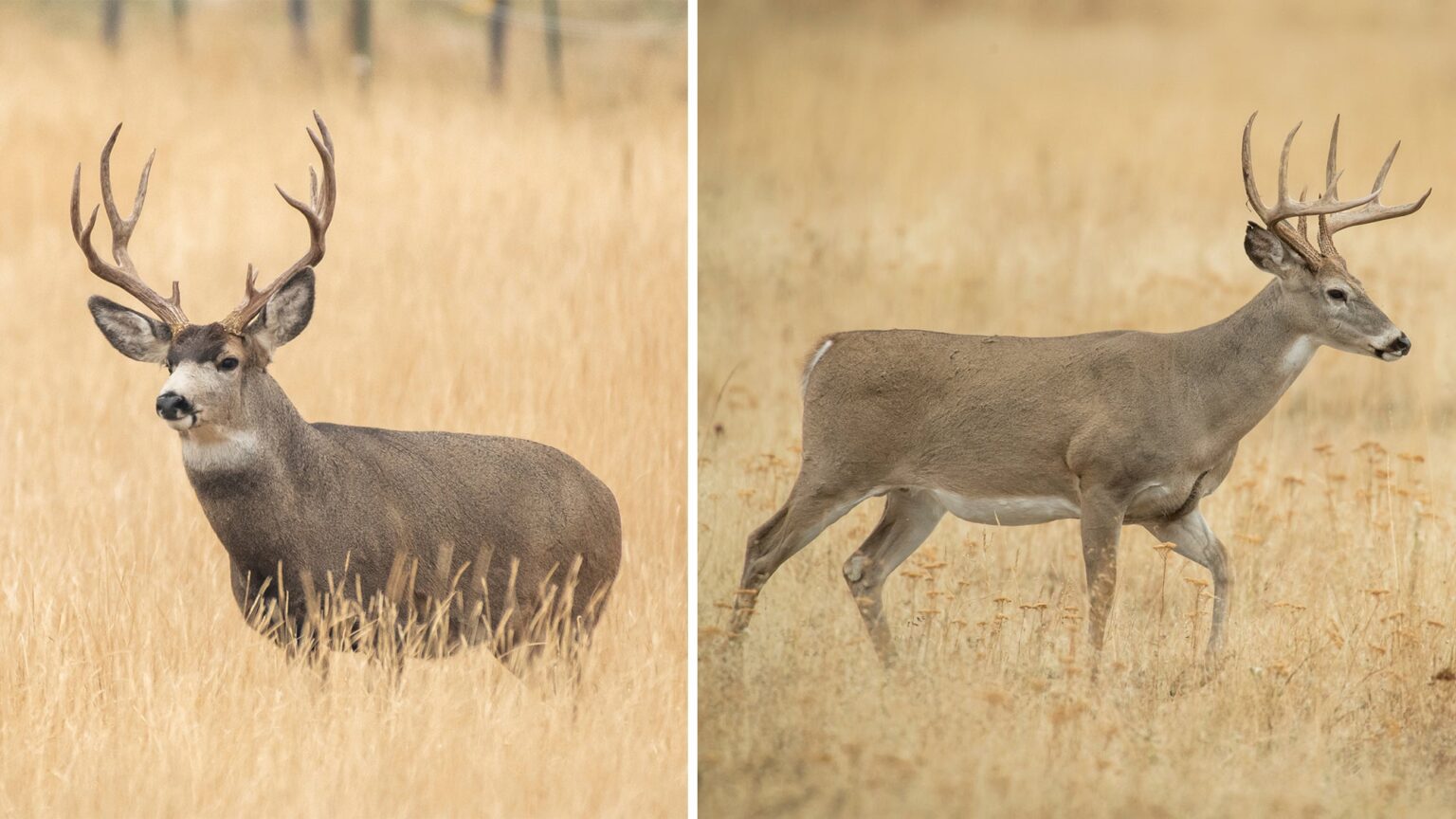

At first glance, the two main deer species of North America–the whitetail and the mule deer–can look very much the same. But there are important differences, and being able to spot them will not only help you be a better wildlife watcher, but a more effective (and legal) hunter. The species share habitat in many places, and since your tag might only be good for one or the other, distinguishing between can be critical. When it comes to mule deer vs whitetail, here are five tell-tale signs for determining whether the deer you’re looking at is a whitetail or a muley.
1. Mule Deer vs Whitetail: Ears and Face
At a Glance
Mule Deer
- Large, rounded ears
- Gray face and neck patch, both of which can appear almost white on some individuals
- Dark, almost black, brow line above the eyes
Whitetail
- Sleek, pointy ears, usually held higher
- Tawny face with white around eyes, nose, and mouth, and a white neck patch
One of the tell-tale signs you’re looking at a mule deer is its ears, which are much larger than a whitetail’s—to the point where they appear mule-like, which accounts for both their common name and scientific name, Odocoileus hemionus, which is Latin for “half-mule.” The mule deer’s large ears are usually set at about a 30-degree angle to the face. In contrast, whitetail ears are sleek, a bit pointy-looking and typically held more erect.
Another tip-off is the coloration of the face. Mule deer faces are gray, sometimes very light-gray (at least in the fall), while whitetail faces are tawny or brownish, with white typically found around the eyes, nose, and mouth. During the summer, the hair of both species will be more reddish-brown.
2. Mule Deer vs Whitetail: Antlers
At a Glance
Mule Deer
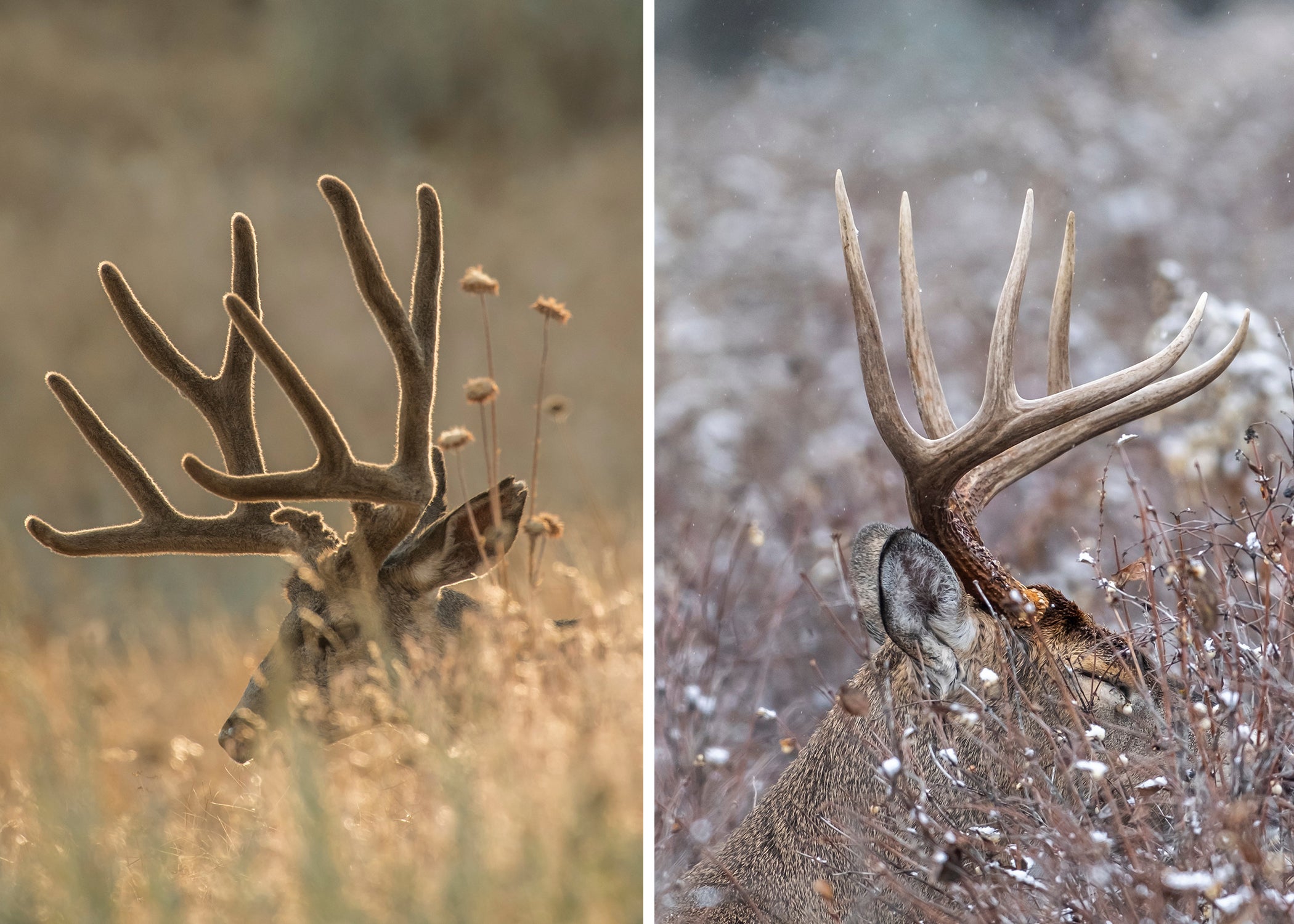
- Bifurcated antlers fork and then fork again
- Antlers typically grow taller and wider than a whitetails
- Brow tines are usually small or absent
Whitetail
- Antler tines typically grow straight up from the main beam without forking
- Brow tines are more common and typically grow taller than on a mule deer
Mule deer antlers are very distinctive and grow significantly taller and wider than most whitetails. They typically have small, and often no, brow tines, and the other tines are usually “bifurcated”, which means they sport deep forks. Whitetail antlers, on the other hand, typically feature tines that grow straight upward from a pair of main beams. Obviously, there are exceptions to these basic configurations, and nontypical racks are grown by bucks of both species. A whitetail’s tines can fork, just as they can grow straight downward from the main beam (which is called a droptine) instead of upward. But typical racks of both species follow the basic rules above, and it takes only a little experience to differentiate a mature muley buck from even the largest whitetails by its antlers alone.
Bucks of both species shed their antlers every year, typically in late winter. Growing a new set begins in spring and ends in late summer or early fall. These velvet-covered antlers are among the fastest-growing tissues known in Nature.
3. Mule Deer vs Whitetail: Tails
At a Glance
Mule Deer
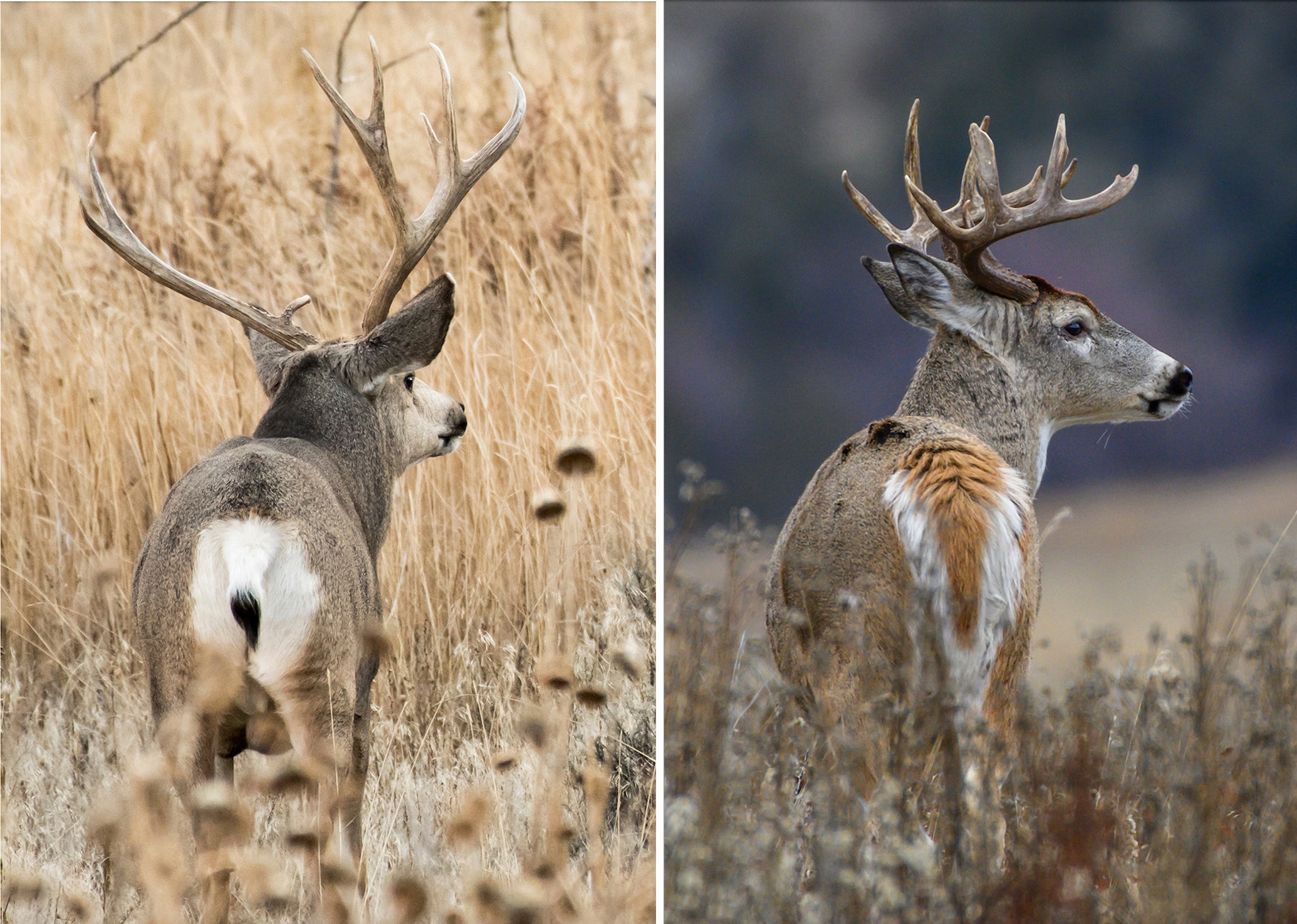
- Large white rump patch is an easy way to tell a muley from a whitetail at a distance
- Tail is rope-like and black-tipped
Whitetail
- Brown on top, fringed in white
- All white on the underside
- When spooked a whitetail with raise and wave this white “flag” as alarm
Another easily-distinguishable difference between the species, the tail is a sure-fire giveaway to the deer you’re observing. Mule deer have a rope-like tail with a dark brown or black tip, and the entire rump of a muley will be pale-colored to pure white. In contrast, the backside of a whitetail’s tail is brown, and the underside—which is typically only seen when the deer is alarmed—is white. But when a whitetail is startled and running, it lives up to its name, elevating its tail (often called a “flag”) and flaring the white hair underneath. It’s thought this “flagging” behavior is used to warn any companions of danger.
4. Mule Deer vs Whitetail: Body Size
Deer are no different than humans, with some individuals growing abnormally large or small for their species. But as a rule, the average mule deer is heavier (and appears blockier and taller) than most of its whitetail cousins. There is also a huge discrepancy in deer weights based on location. That said, on average, whereas a large mature whitetail buck may weigh over 220 pounds, a large, mature muley might push 250. When it comes to the biggest whitetails and muleys ever taken, there have been reports of both species reaching estimated live weights of over 500 pounds, at least anecdotally. But again, on average, mule deer are apt to be a bit bigger.
5. Mule Deer vs Whitetail: Escape Behavior
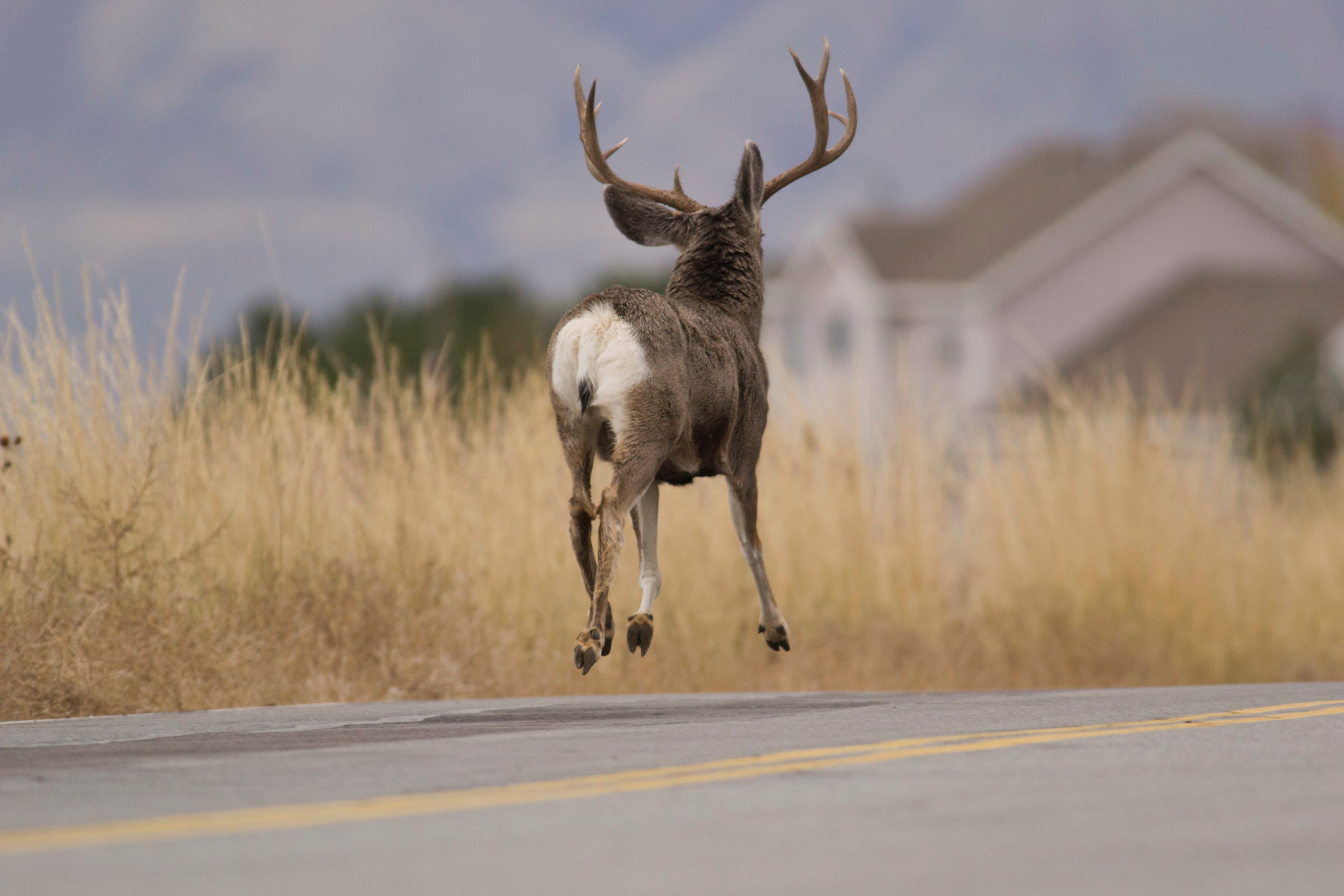
The final tell-tale difference between whitetails and mule deer is revealed when the deer detect, and flee from, danger. While a whitetail will “flag” its namesake tail and often engage in a ground-eating sprint, mule deer will seemingly hop straight in the air on all four feet, like a kid hopping on a pogo stick. This behavior is called “stotting” and is also practiced by African gazelles. While it’s not known exactly why muleys stot, some believe it’s an effective way for the deer to navigate the rough ground mule deer often inhabit. However, there’s evidence too that stotting might be a signal to an approaching predator that the fleeing critter is not only aware of danger, but fit enough to escape (and therefore a waste of energy to pursue). In one study, cheetahs abandoned more hunts when a gazelle stotted, and were less likely to catch their prey if it did stot.
Read Next: Video: Muley and Whitetail Buck Lock Antlers in Battle to the Death
Read the full article here