



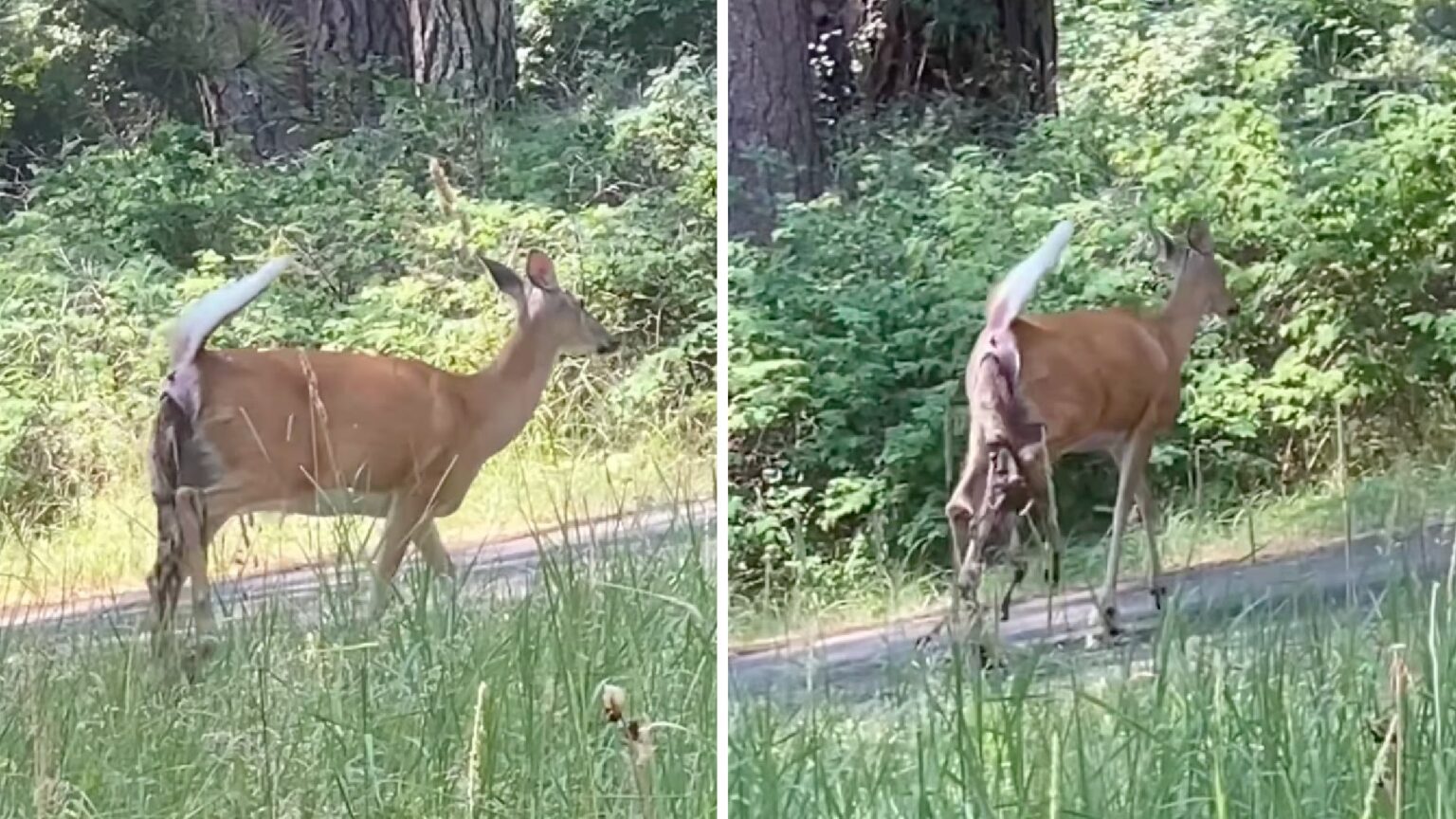

The doe was likely disturbed mid-birth and had yet to fully deliver the fawn. Nature Is Metal / Instagram
The birthing process for every mammal species is stressful and full of potential complications. For deer birthing fawns in the wild, the chance of something going wrong is ever-present. In footage Instagram account Nature is Metal posted on Sept. 5, a whitetail doe grazes and crosses a road with a fetus hanging from her birth canal, a sign that something went awry when she tried to give birth.
This footage is absolutely grim. But it also shows a pretty rare phenomenon. Nature is Metal diagnoses the situation as a case of dystocia, or complicated, slow birth. But recorded cases of dystocia in free-ranging deer are few and far between, National Deer Association director of conservation Matt Ross tells Outdoor Life.
“Is it a common thing? No. The reason we have millions and millions of whitetail deer and other deer species is because they are prolific breeders, they are very good at being productive and giving birth,” Ross says. “[Dystocia] is a very rare circumstance and it is not a population-level issue. This is not a concern from a wildlife management standpoint.”
One study on dystocia in free-ranging sika deer says the lack of recorded instances of the complication could be a result of natural selection toward optimal birth size in does and fawns. It might also be because researchers don’t witness dystocia when it does happen in wild populations. But Ross cites a different study from Clemson University that used vaginal implant transmitters in pregnant whitetail does, which he likens to “radio collars for the birthing process,” to determine that out of 100 free-ranging whitetail births, just seven resulted in stillbirth. (Three of those stillborn fawns were piebald.)
Wild fawn mortality results from predation much more frequently than it does from labor complications. Nearly 90 percent of all studies on fawn mortality in the last 30-plus years point at predation as the number one cause, the NDA reports. But the NDA also explains that in certain parts of the country where deer don’t have any natural predators, birth defects, malnourishment, and environmental hazards cause a shockingly similar mortality rate to that of areas with predators. The NDA team looked to Sussex County, Delaware for proof.
“Our findings suggest that predators may simply be removing the ‘doomed surplus’—the individuals that would have died regardless of predator intervention,” NDA writes. “For example, if a predator kills a fawn that is dying of pneumonia, the event is recorded as predation because we have no way of knowing the animal was sick before it was eaten. This scenario might explain why many studies have found predation to be the most important cause of mortality, as well as why some predator management efforts have been largely unsuccessful.”
This means that even if dystocia isn’t a major cause of fawn mortality among America’s whitetails, other natural complications during the birthing process can have an impact on a fawn’s chances of survival. As for the case captured in the video above, it could prove deadly for the doe. But they’re also incredibly tough and resilient creatures.
Read Next: Pregnant Whitetail Doe Gets Hit by a Truck and Gives Birth on Impact
“Yes, she could be at risk, although the likelihood of her being at risk is much lower than that of the fawn being stillborn,” Ross says. “Even if she does have a complication, deer are amazing at surviving some pretty intense trauma. Deer get hit by cars, shot by hunters, partially wounded by predators, and they survive, and there are thousands more examples of deer surviving than deer succumbing to ailments or trauma.”
Read the full article here