





All throughout human history, we’ve been both fascinated and fear-stricken over the question of what do wolves eat. The topic has spawned myths, fair tales, and nightmares alike. So, let’s start with a few basic facts:
What Do Wolves Eat: Key Points
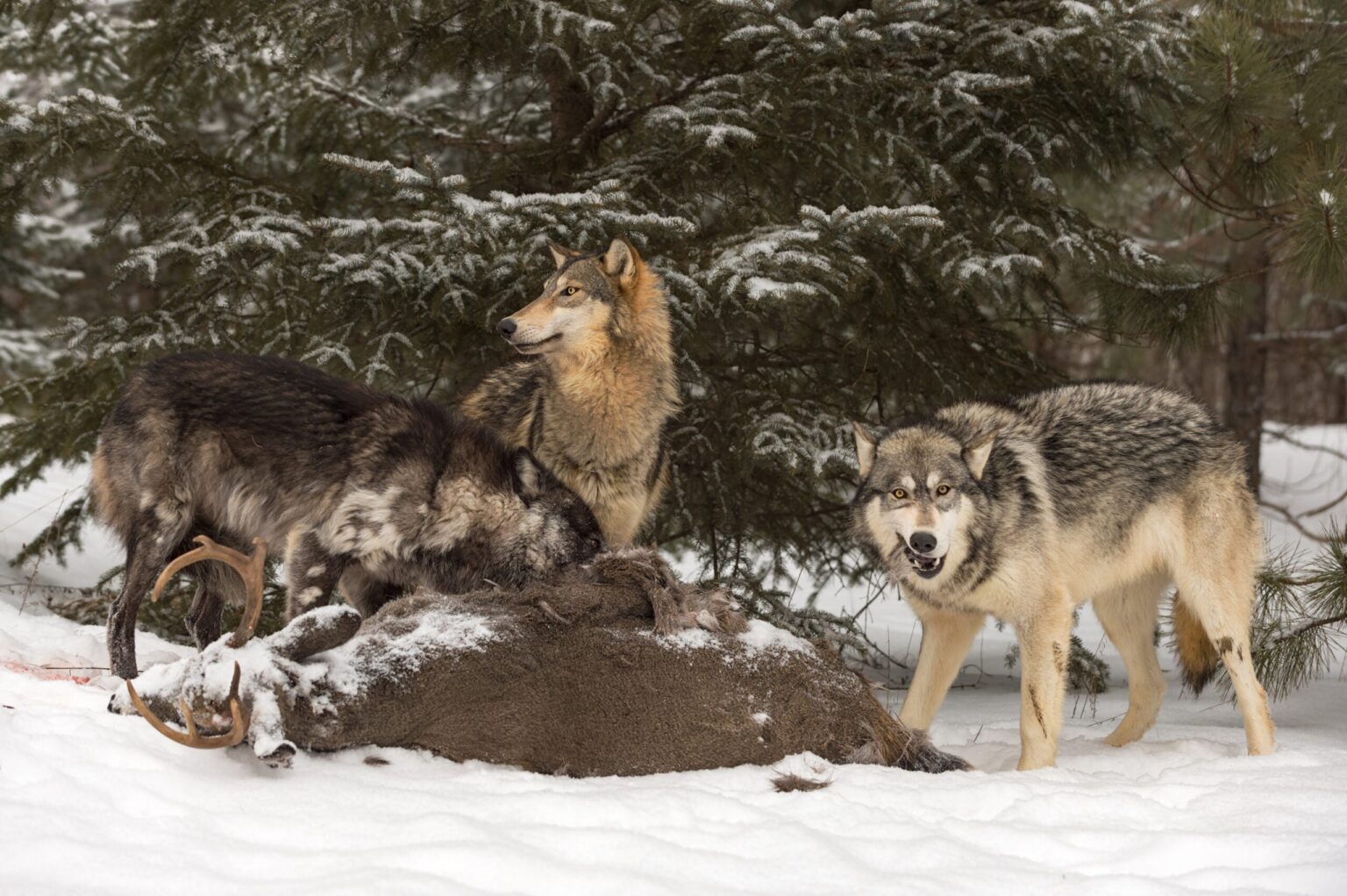
- Wolves are carnivorous apex predators that favor large ungulates, especially those in the deer family, which they typically hunt in packs.
- Wolves are the main predators of moose, muskoxen, elk, and caribou, but also eat deer, wild boars, bighorn sheep, Dall sheep, mountain goats, and bison.
- But, wolves are opportunistic generalists. They also scavenge, cannibalize dead wolves, and eat a range of small menu items when larger animals are in short supply.
- Wolves’ diet includes a variety of rodents, fish, birds, reptiles, insects, fruits, and nuts.
Among North American carnivorous apex predators, the wolf is the most prolific and proficient big-game hunter. As any big-game hunter knows, however, large prey species can be elusive, and to survive in the wild, even apex predators cannot always afford to be choosy.
Feast or famine is a lifestyle for the world’s largest canines. After a kill, they can eat up to 20 pounds of meat in a single meal. When prey is scarce, they can survive without food for days, even weeks. In between the two extremes, wolves eat nearly anything they can get their jaws on, including vegetarian fare. Here’s your complete guide to the question, What wolves eat?
What Do Wolves Eat: Table of Contents
- The Dominant Apex Predator
- Big-Game Hunters
- Small Game Is Plan B
- Wolves Even Go Fishing
- Scavenging, Cannibalizing, and Eating Veggies
- Livestock and Pets
Wolves: The Dominant Apex Predator
In the regions where they roam, wolves are North America’s dominant apex predator. Brown and black bears are bigger, of course, but omnivorous. They are much more likely to steal a wolf kill than they are to kill the animal themselves. Mountain lions, on the other hand, are what are known as hypercarnivores, preferring to eat what they’ve freshly killed themselves. But since they are solitary hunters, they rarely ambush anything larger than deer. While wolverines can kill moose, Dall sheep, and caribou, they do so very rarely and typically target much smaller prey. The continent’s other top predators, polar bears and alligators, have limited ranges, and, in the case of the polar bear, specialize in marine mammals. In short, across the continent, wolves are top dog.
Wolves Are Big-Game Hunters
If wolves had their druthers, every hunt would end with the pack surrounding a freshly expired large ungulate. Plenty of meat for every stomach. Arctic wolves account for nearly half the mortality rate for muskoxen and caribou. In places where wolf and moose ranges overlap, these predators are responsible for about 32 percent of moose deaths—compared to 30 percent from parasitic infections, 21 percent from bacterial infections, and 3 percent from vehicle accidents. (Other predators hardly register.) In Yellowstone, wolves are responsible for 75 percent of elk predation deaths.
If large ungulates are not available, wolves go for smaller ones. They hunt and consume mule deer, white-tailed deer, wild boars, mountain goats, Dall sheep, and bighorn sheep. Basically, any animal with hooves is on the first page of the menu, unless that animal can run nearly 60 miles an hour, like the pronghorn. Pronghorn are the one North American ungulate that wolves cannot typically catch and therefore rarely eat. Like most predators, wolves tend to target old and young prey, or ones they can isolate from a group. But they are fully capable of hunting and killing healthy adults if there are no easy pickings.
Small Game Is Plan B for Hungry Wolves
When wolves are hunting for big game, they will ignore most everything else. But when ungulates are regionally, seasonally, or otherwise unavailable, wolves largely turn their attention to small game, especially rodents, of which they eat whatever type they can find. Here a snapshot of the common rodents wolves eat, and roughly how many of each they’d need to consume to fill their bellies for a day.
Wolves Even Go Fishing
While wolves have their clear preferences, they are not picky when facing slim pickings. As opportunistic generalists, they will feed their hunger pangs with anything that is made of meat. In a study by the Alaska Department of Fish and Game and Oregon State University, DNA analysis of 860 wolf scats identified 55 food sources in the wolves’ diet. Wolves prey on a variety of mammals, amphibians, reptiles, birds, and insects, including the following:
- Porcupines
- Skunks
- Coyotes
- Raccoons
- Polar Bear Cubs
- Black Bears
- Opossumns
- Weasels
- Armadillos
- Lizards
- Snakes
- Grouse
- Eagles
- Wild Turkeys
- Waterfowl
- Frogs
- Cicadas
The Voyageurs Wolf Project, a University of Minnesota research project working in collaboration with the National Park Service, has even recorded wolves catching suckers in Minnesota over the past seven years. In oceanfront habitat, wolves eat sea lions, seals, and sea otters.
What Do Wolves Eat: Scavenging, Cannibalizing, and Eating Veggies
When hungry, wolves will kill and eat whatever they can catch. But, according to a study by the National Park Service, they are also North America’s “top scavenger.” Because they are bigger, stronger, and more aggressive than foxes and coyotes, they dominate the carrion scene, often chasing other scavengers away from found carcasses. Wolves also cannibalize other wolves they might happen to kill in a territorial dispute or that they find dead. And, in other scat studies, wolves have been found to consume nuts, grasses, herbs, mushrooms, berries, and even tree bark. If they live near humans, wolves will also eat garbage.
What Do Wolves Eat: Livestock and Pets
Ask any rancher what they think of wolf re-introductions or management and you’ll likely to hear about another thing wolves eat: livestock. Wolves do in fact eat cows, pigs, and sheep when the opportunity arises. They also eat poultry and, occasionally, dogs and cats. In the end, the answer to the question What do wolves eat? is lots of things. But when it comes to big-game animals and livestock, in particular, the question of What do wolves eat? and How much? is absolutely central to the larger and always contentious questions of where wolves should be allowed to roam and how many should be on the landscape.
Read the full article here