






Hours have passed since you first climbed into your tree stand. The woods are perfectly still. Suddenly, the head and shoulders of a large, wild canine appear before the timber that begins just 40 yards away. You lift your binoculars. You see upright ears, piercing amber eyes, a familiar tapering snout. The animal slinks away without making a sound. You see gray, red, tan, white. Thick, mottled fur. A bushy tail, black at the tip. Then it’s gone, leaving you with a sense of awe—and a question: Wolf vs coyote, which was it?
The fact that you saw it may be the strongest clue. Coyotes now live in rural, suburban, and urban areas in every state except Hawaii. Wolves, on the other hand, which were reintroduced in 1995 to a country that nearly wiped them off the map once upon a time, currently only live in the most remote areas of 13 states and tend to avoid humans. But the animal you saw seemed too big to be a coyote, and you’ve heard stories of lone wolves seeking new territories. So, wolf versus coyote? How do you tell the difference?
Table of Contents
- The Quick Answer
- Size
- Color
- Eyes
- Ears
- Face/Snout/Nose
- Howl/Calls
- Geography
- Migration and Genes
- Tracks
- Packs
- Diet
- Sighting
The Quick Answer
The biggest difference between a wolf and a coyote is size. Even compared to eastern coyotes, which are bigger than their western counterparts, gray wolves, on average, weigh twice as much and typically are taller, longer, and bulkier. But since the two species’ weight and length ranges overlap, especially when including juvenile wolves, size is not always a defining characteristic, as hunters in New York learned last year.
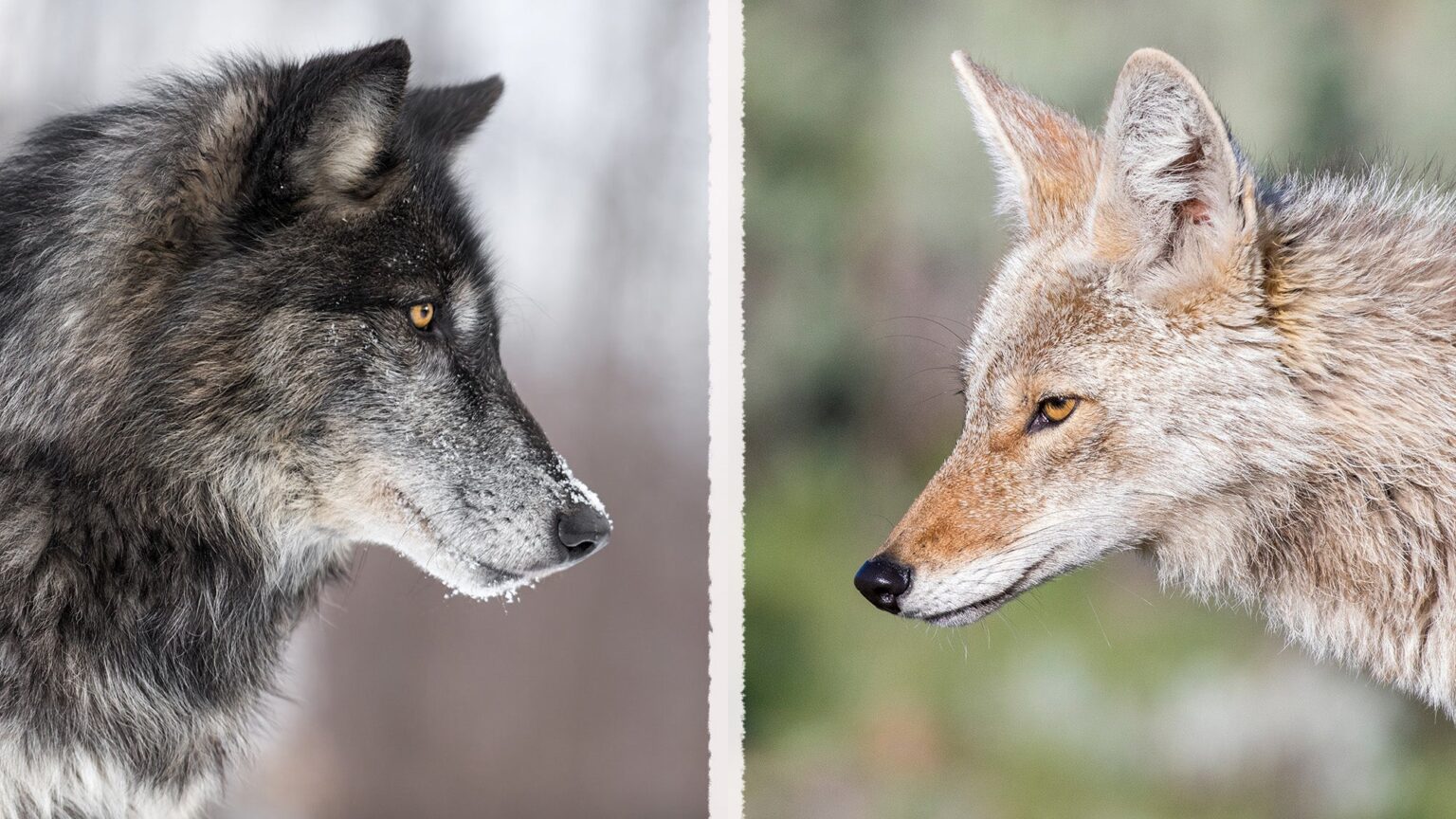
So, look closer. Coyotes have smaller and narrower muzzles and relatively longer ears, both of which are often reddish in color, giving them a distinctive fox-like profile. Wolves’ ears are slightly more rounded, their snouts boxier, their heads broader, and the fur around their necks and faces more tufted, as if they are wearing parkas. Both typically have black-tipped tails, but coyotes’ hang downward, nearly reaching the ground. And, wolves don’t yip when they howl.
Wolf vs Coyote Size
Hunters often mistake adult coyotes for larger domestic dogs, while juvenile and small adult wolves can appear to be large coyotes. Adult eastern coyotes typically range from 34 to 50 pounds, though they have been known to reach 75 pounds. On average, they stand two feet tall at the shoulders and have a body length of 42-52 inches, including their 12- to 15-inch tail.
By comparison, gray wolves, which on average stand 2 1/2 feet tall at the shoulders, can reach 6 feet in length, including the tail. Females usually weigh between 70 and 80 pounds, while males range from 95 to 115 pounds, with outliers reaching up to 175 pounds.
Color of the Coats
Can you tell the difference by color? Gray wolves and eastern coyotes can feature any of the following colors:
- Gray
- Black
- Brown
- White
- Tan
- Buff
- Tawny
- Red
- Blonde
While coyotes are more likely to be in the blonde to brunette range, and wolves more likely to appear gray, individuals from both species exhibit a mix of these colors. And, while both can be solid gray or black, wolves land on the gray scale more frequently. Wolves are also more likely to be solid white, too, although such a coloring is rare for both species. Of the mottled varieties, both species tend to be lighter underneath. Of the lighter varieties, both often have white strips over their top jaws, which tend to be wider on wolves, often extending into their broader cheek patches. To complicate the issue, individuals of both species go through different color phases throughout each year.
A coyote is more likely to have a reddish snout and red on the backs of their ears, and wolves are more likely to have a black or gray necklace of fur, but both can have either. So, given the wide variations, don’t count on color to tell the difference.
Wolf vs Coyote Eyes
What about eye color? Gray wolves and eastern coyotes can both have the following eye colors:
- Yellow
- Gold
- Orange
- Amber
- Hazel
- Light brown
Yellow and amber are most common for both. Wolves, very rarely, can have green eyes. Coyotes, extremely rarely, can have blue eyes. Coyote pups often have blue eyes that transition to yellow or other colors.
So, don’t count on eye color to tell the difference either, unless you are looking at a pup—or a green or blue-eyed anomaly.
Shape of Ears
There is a clearer difference in the ears. Both gray wolves and eastern coyotes have upright ears that are typically lighter on the inside and tinged with a darker color. But coyotes’ ears are more pointed and longer relative to their head size, giving them, with their narrower and often reddish snout, more of a fox-like appearance.
Face/Snout/Nose
Given that they tend to kill and eat larger prey, it makes sense that wolves have longer and wider snouts than coyotes. Their nose pads are also broader and tend to be more squared than a coyote’s more typically rounded nose tip. A wolf’s snout also opens into a broader face, with puffier cheek hair and a more noticeable ruff of fur around their necks and shoulders, giving them a full-bodied appearance suited for wintery weather.
Howl/Calls
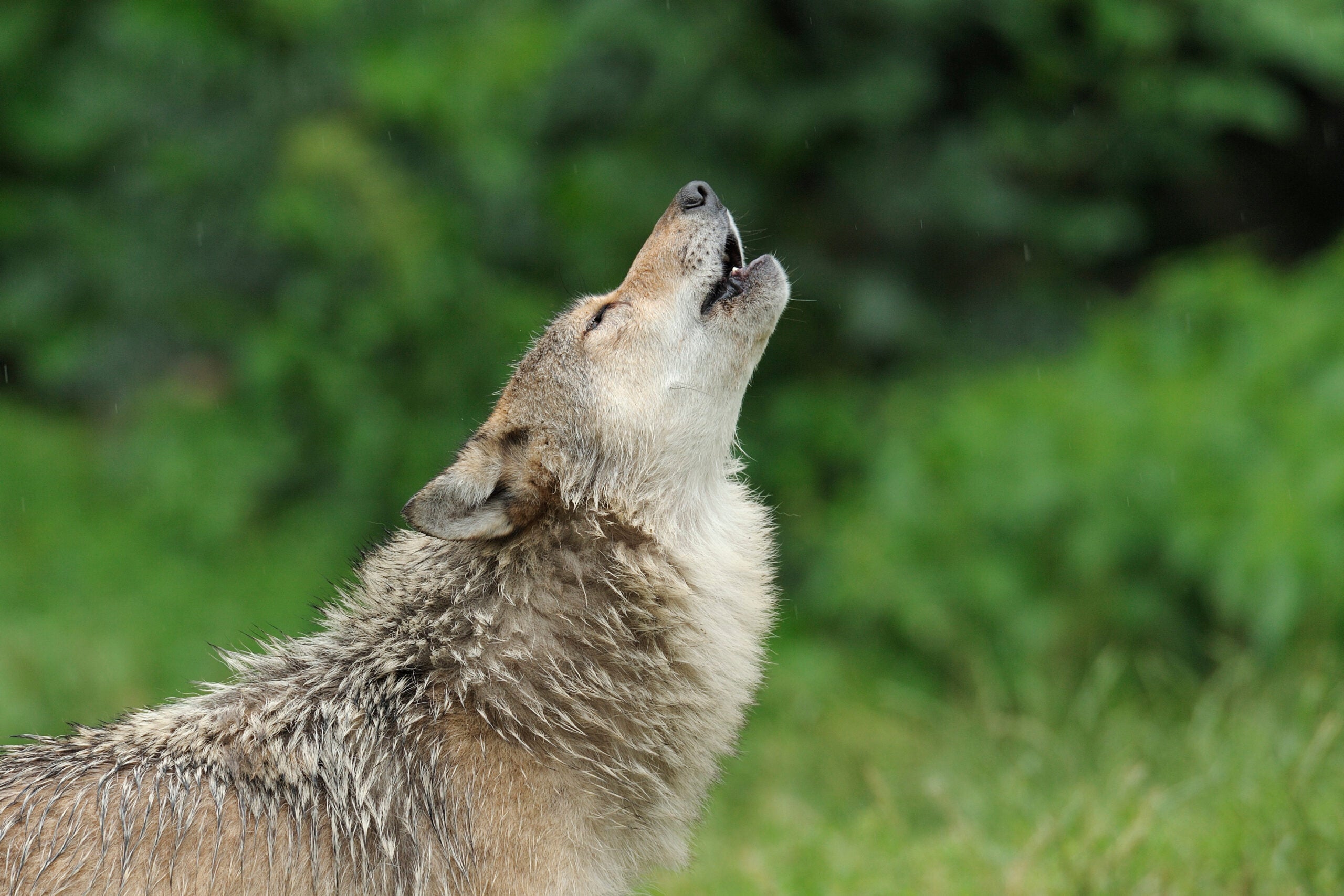
Both species howl, bark, growl, and yip to communicate with their packs and their neighbors, but wolves have a lower, deeper, smoother, and longer howl. Coyote howls are high-pitched and often preceded and interspersed with yips, cackles, and yodels.
Wolves bark as juveniles, but much less frequently as adults. Coyotes, whose scientific name, Canis latrans, means “barking dog,” use the sharper, shorter sounds a regular means of communication throughout their lives.
Geography
If you are still in doubt, consider geography. Wolves once ranged across all of North America north of Mexico City. Now, fewer than 200 Mexican gray wolves live in Arizona and New Mexico; North Carolina sustains a population of 20 critically endangered red wolves through captive breeding; and only 10 states have self-sustaining wild populations of gray wolves (Alaska, California, Oregon, Washington, Idaho, Montana, Wyoming, Minnesota, Wisconsin, and Michigan). Western coyotes also live in those 10 states. Only in Minnesota, Michigan, and Wisconsin are there also relatively small populations of eastern coyotes.
Migration and Genes
Coyotes, once confined to the western half of the country, moved eastward as wolves declined in the 19th and 20th centuries. The waxing coyote populations sporadically interbred with the waning wolf populations, giving rise to hybrid eastern coyotes. Now, eastern coyotes, which predominate in states along the East Coast, spanning from Maine to Georgia and as far west as Ohio and West Virginia, have genomes that are, on average, 62 percent western coyote, 27 percent wolf, and 11 percent domestic dog. So, they are naturally larger and more wolf-like than their western kin.
Wolf vs Coyote Tracks
As wolves tend to be larger, so do their tracks. While coyote paw prints typically range from 2 1/8 to 3 1/16 inches long and 1 5/8 to 2 1/2 inches wide, wolf paw prints typically range from 3 1/2 to 5 1/2 inches long and 3 3/4 to 5 inches wide.
Wolf vs Coyote Packs
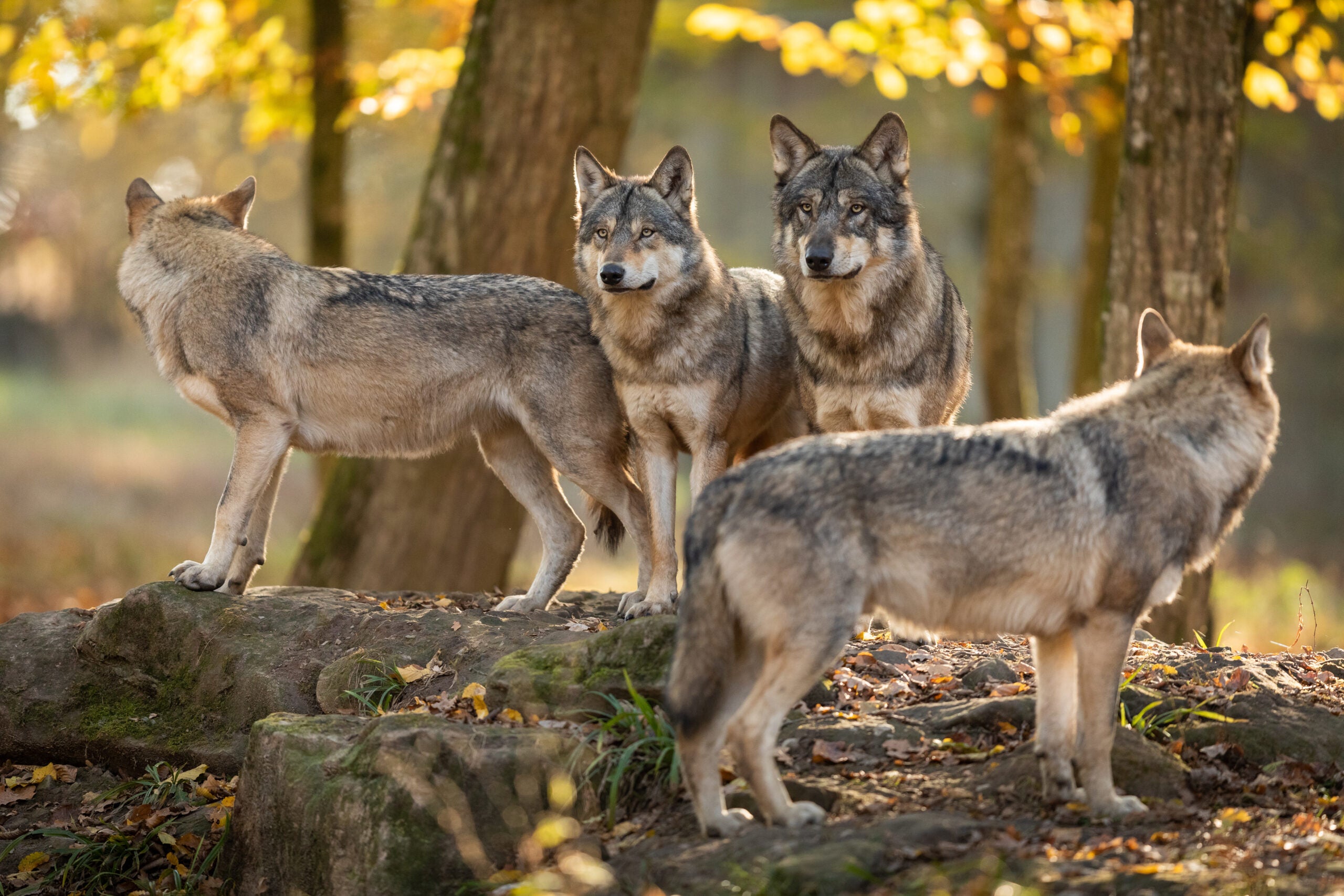
Wolf packs range in size from two to 30 or more individuals. While many are related, membership is not exclusive to those sharing family genes. Coyotes live in smaller family packs of up to six adults, plus pups, and spend more of their time alone.
Wolf vs Coyote Diet
Whereas wolves are carnivorous apex predators that typically eat large prey and will occasionally eat small prey, coyotes, conversely, are both predators and scavengers that typically eat small prey and occasionally kill larger prey.
Wolves primarily feed on large ungulates, including deer, mountain goats, bighorn sheep, elk, moose, caribou, bison, and wild boar. They tend to target old, sick, or weak individuals, often hunting in a pack to bring the larger animals down. They also eat:
- Rabbits
- Hares
- Mice
- Songbirds
- Snakes
- Fish
- Beavers
- Squirrels
- Muskrats
- Marmots
- Grouse
- Insects
- Nuts
- Fruits
- Berries
Coyotes eat:
- Raccoons
- Rabbits
- Hares
- Domestic pets
- Feral cats
- Voles
- Shrews
- Moles
- Rats
- Mice
- Roadkill
- Trash
- Garden produce (both fruits and vegetables)
- Insects
- Frogs
- Toads
- Fish
- Reptiles
- Birds (including thrashers, sparrows, and wild turkeys)
- Cows
- Sheep
- Corn
- Wheat
- White-tailed deer
- Elk
- Bighorn sheep
- Bison
- Carcasses of dead coyotes
Sighting
So, which animal did you see? Based on numbers alone, it probably a coyote. However, if you were hunting in wolf country and saw a canine that checked all the boxes of an apex predator with a larger, fuller appearance, anything is possible.
Read the full article here