




We may earn revenue from the products available on this page and participate in affiliate programs. Learn more ›
The most dangerous knife isn’t a freshly sharpened knife—it’s a dull knife. Once that blade is dull, it forces a person to misuse a knife, resulting in problems. Traps don’t get carved right. Meat doesn’t come off the bone of your deer right. And, in either case, there’s a good chance that you’ll end up cutting yourself. By the end of this article, I want to help us fix all these problems by sharpening a knife properly.
The Basics of How to Sharpen a Knife with a Stone
The easiest way to conceptualize sharpening a knife with a stone is to break it down into three steps:
- Get the blade prepped for sharpening.
- Start the process of sharpening with a stone.
- Get the knife razor-sharp.
Before we go into detail on each knife-sharpening step, it’s important to understand the difference between sharpening and honing a knife. Sharpening involves removing material from the blade to create a new edge, while honing focuses on refining and aligning the existing edge. While sharpening is necessary to restore a dull knife, honing should be done regularly to maintain the knife’s sharpness. Both processes are crucial for achieving optimal cutting performance. Grinding is another word commonly heard when preparing a knife; it is like sharpening but is most often used when building knives from stock.
Read Next: The Best Knife Sharpeners
Sharpening a Knife in Three Steps
To learn how to sharpen a knife with a stone, you don’t need a lot of fancy tools. You will need:
- Whetstone
- Leather strop
- Water
- Honing oil (optional)
Step 1: Straighten the Knife Edge
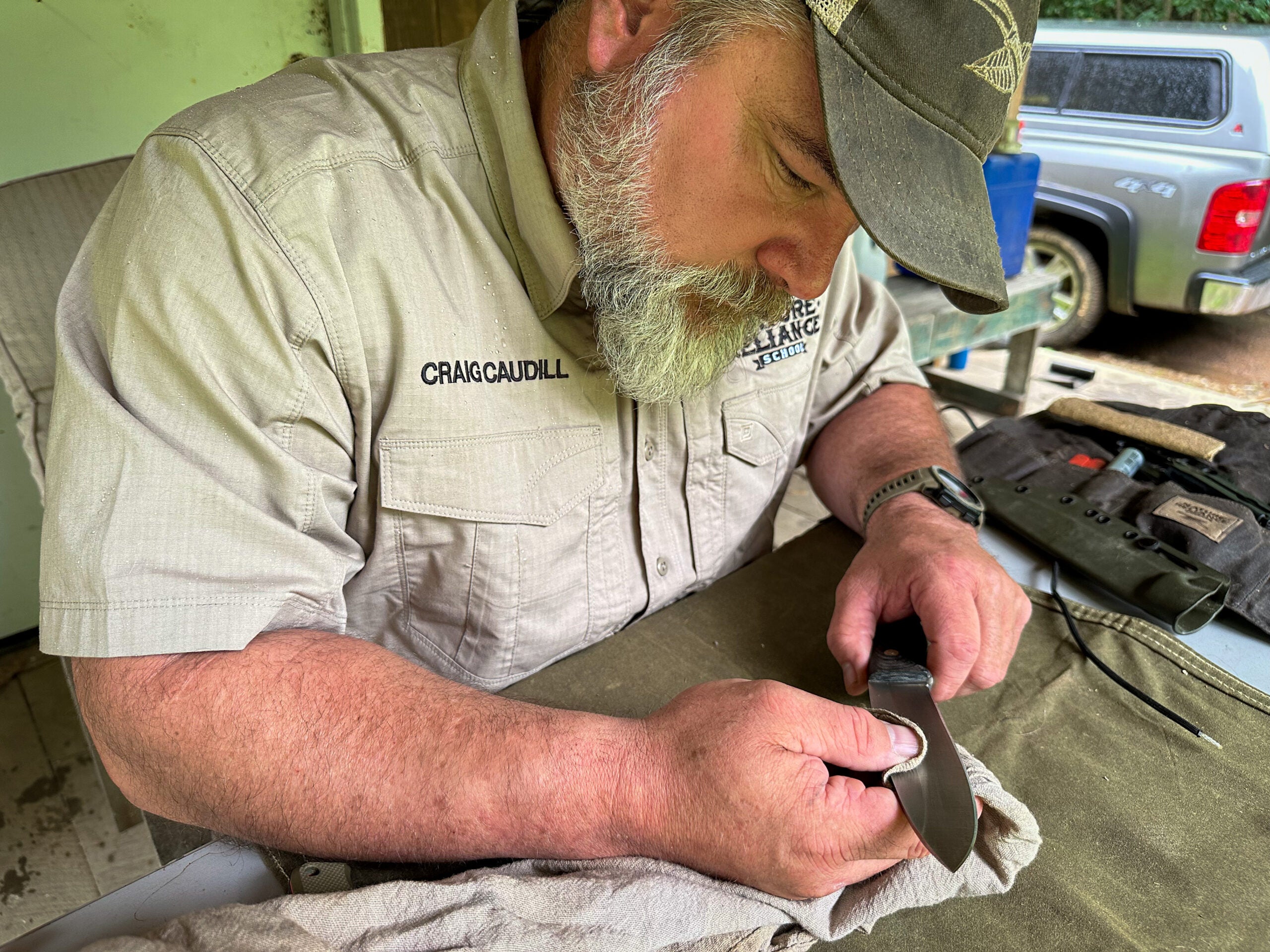
Before you sharpen you knife, examine the blade. You are looking for visible nicks and an edge that is straight and uniform along its length. You must remove nicks before you do anything else. If there are significant nicks, you may have to use a file. For most nicks, you can run the edge perpendicular to a stone. You can also use the edge of a ceramic mug. Doing so will remove the nicks and give you a straight, albeit dull, edge. Once you have achieved a straight edge, you can move on step two in learning how to sharpen a knife with a stone, and start getting the edge sharp and uniform in appearance and usefulness.
Step 2: Sharpen the Knife on a Stone with Water or Oil
The second step is crucial. When done improperly, getting the knife sharp will take significant effort and time. The goal in this step is for the edge of the blade to have a distinct “V” shape. (After heavy use or improper sharpening, it will have a more rounded “U” shape.) One test that I like to use for determining what I am starting with is running the blade’s edge across my thumbnail. It should drag and slightly cut into my thumbnail if it is sharp. If it is dull, it will run smoothly across my thumbnail.
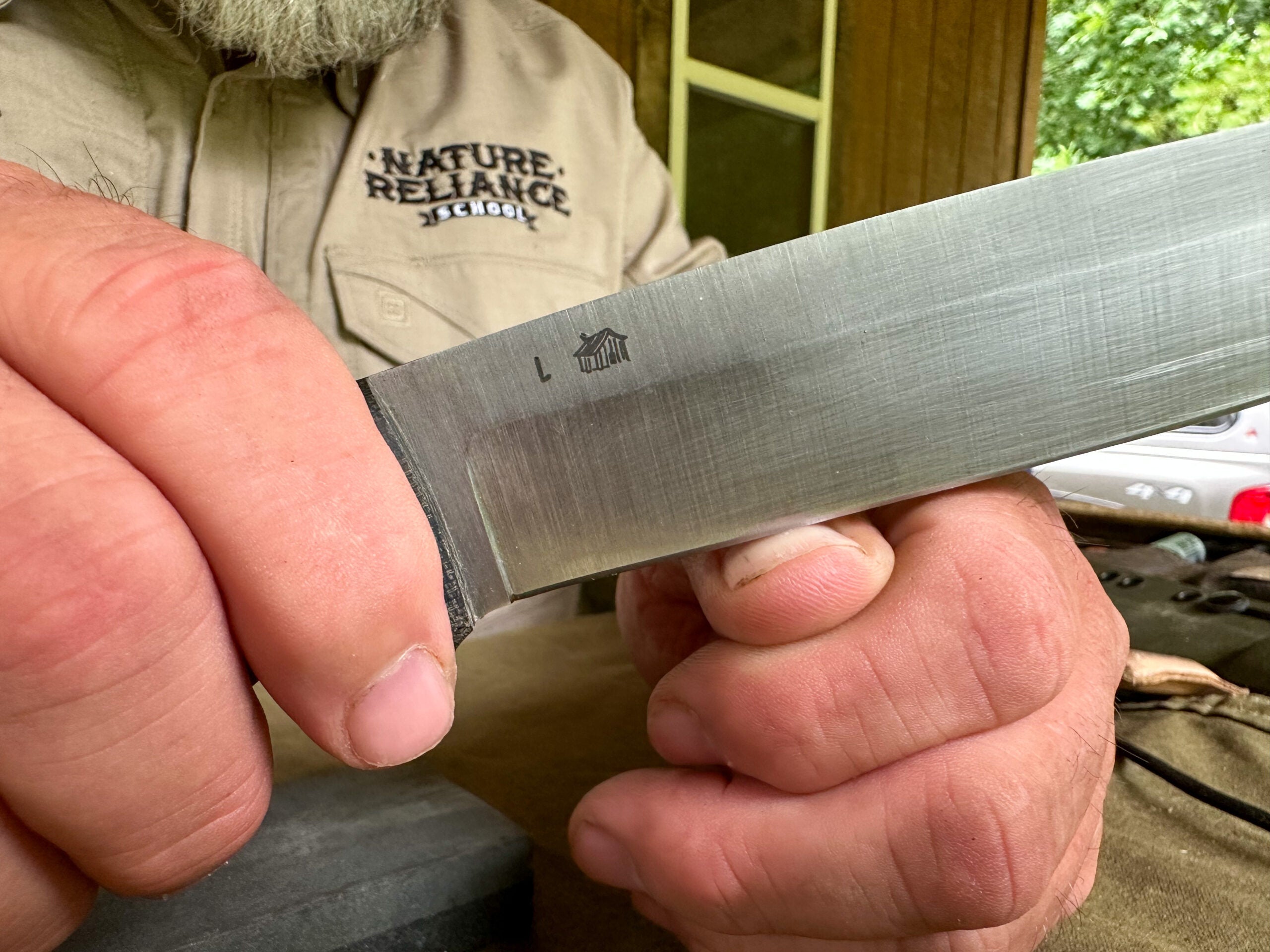
Most sharpening stones come with a coarse and fine side to them. For knives that are very dull, you will start sharpening with the stone’s coarse side. Whetstones are best used wet. Seems obvious, but not for some. I will soak them before use if they do not feel damp. In the field, I have often spit on the stone and use that moisture instead. Some sharpening supplies come with honing oil, which I have found to be more problematic than helpful for most beginners. It makes it too easy for the knife to glide across the stone and not “dig” into it enough to remove metal. Once you get comfortable, oil works well as it helps remove metal shavings and debris from continued use.
I typically use five strokes on one side of the blade, flip it, and do five strokes on the other. Again, the whole purpose here is to start turning the U edge and into a V. I think of slicing off a thin layer of the stone as I stroke the blade against it. The most important part is recognizing that each knife has its style of grind and angle. Focus your attention on keeping that same angle throughout the stroke and slice. Keep even pressure on the blade as you move it.
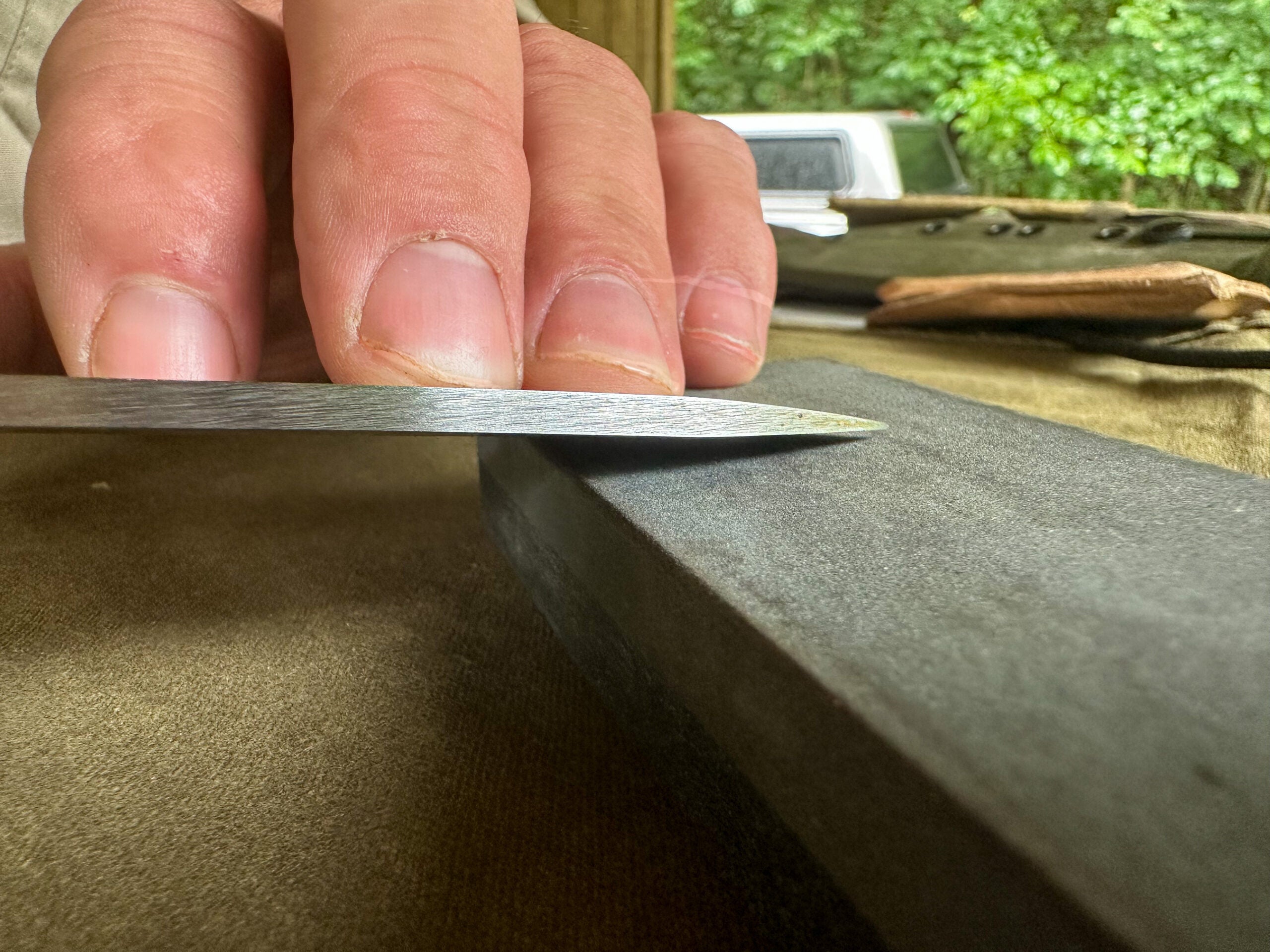
As you continue to sharpen, pay close attention to the slicing strokes and how they feel and sound. With continued practice, you will observe what a blade feels and sounds like when it gets sharp. Regularly check the edge’s sharpness with your thumbnail, or a similar method that you may be more comfortable with. Once you feel the knife getting sharp, switch your stone to a fine-grit side instead of a coarse one. You will be taking less metal off the blade, but it helps to manage the metal reduction from going too far. It is best to continue with this method, alternating sides for the same number of strokes until you get your knife to the desired sharpness.
Step 3: Strop the Knife with Leather
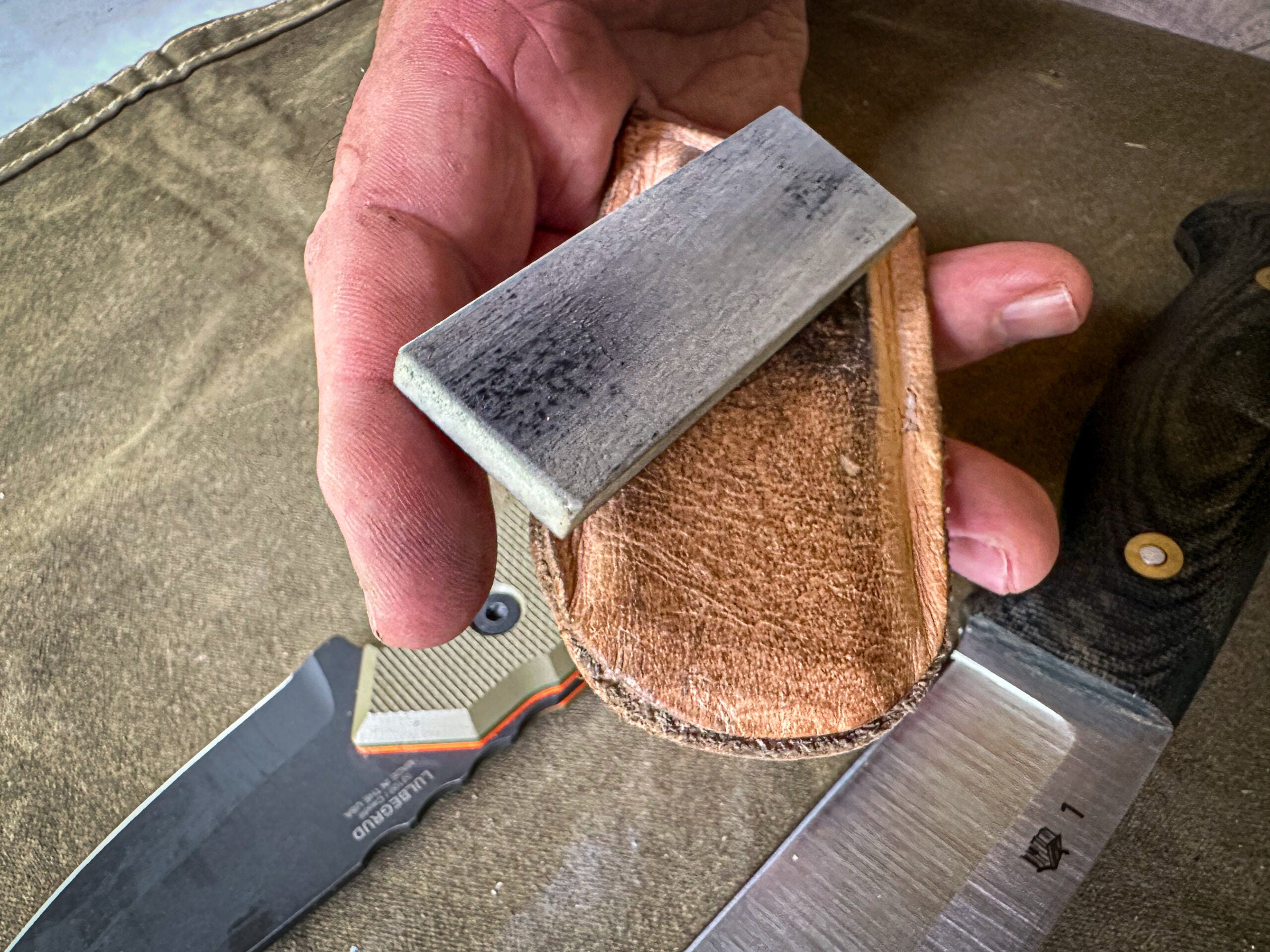
When you start with a damaged or dull knife, steps 1 and 2 in how to sharpen a knife with a stone are necessary. However, if you take care of your knife and hone it regularly, all you’ll need to do is step 3. It is the act of stropping your blades with leather. You can do this for field use with a belt or leather boots. Otherwise, have a strop that you can use on your workbench or in a toolbox in your vehicle.
When you get the knife ready after step two, you will often have a small “curl” of the blade left over on the edge. This curl, known as the burr, is not easily visible to the naked eye and can also be missed with a feel. The leather strop removes that burr. I tend to strop my knives in the field after an hour or so of working on hardwoods. I strop my knives when they start cutting poorly when I’m processing game.
When you strop the knife, keeping an angle on the blade that matches the grind is crucial. To strop, draw your knife backward from heel to tip. I start with three strokes on each side and go from there, testing sharpness along the way. As mentioned earlier, I carry a small stone in a leather sheath. I use that leather sheath in the field for stropping. When field stropping, I hold the knife in place and push the leather sheath across the blade. Again, doing the same strokes on each side while paying close attention to the angle of the blade.
FAQs
Q: Can you sharpen a knife with just a stone?
A sharpening stone is a primary tool used to sharpen knives effectively. However, additional tools like a strop can further refine and maintain the edge.
Q: How many strokes does it take to sharpen a knife on a stone?
The number of strokes varies depending on the three things: 1) The knife’s starting condition. 2) The type of steel. 3) The desired sharpness. It’s recommended to start with 4 to 5 strokes per side and adjust as needed.
Q: Do you use cold or hot water for sharpening stones?
It is typically recommended to use cold or room-temperature water when soaking sharpening stones. Hot water can cause the stone to become brittle or crack.
Q: Is it better to use oil or water on a sharpening stone?
It depends on the type of sharpening stone you have. Water is suitable for water stones, while oil is used on oil stones. Check the manufacturer’s instructions for the recommended lubricant.
Final Thoughts on How to Sharpen a Knife with a Stone
Mastering the art of knife sharpening is a valuable skill that allows you to maintain the performance of any knife—be it a top pocket knife or a fishing knife—elevate your use with them, and stay safe. By following the step-by-step instructions outlined in this guide on how to sharpen a knife with a stone, and understanding the difference between sharpening and honing, you can repeatedly restore your blades to their optimal sharpness.
Read the full article here